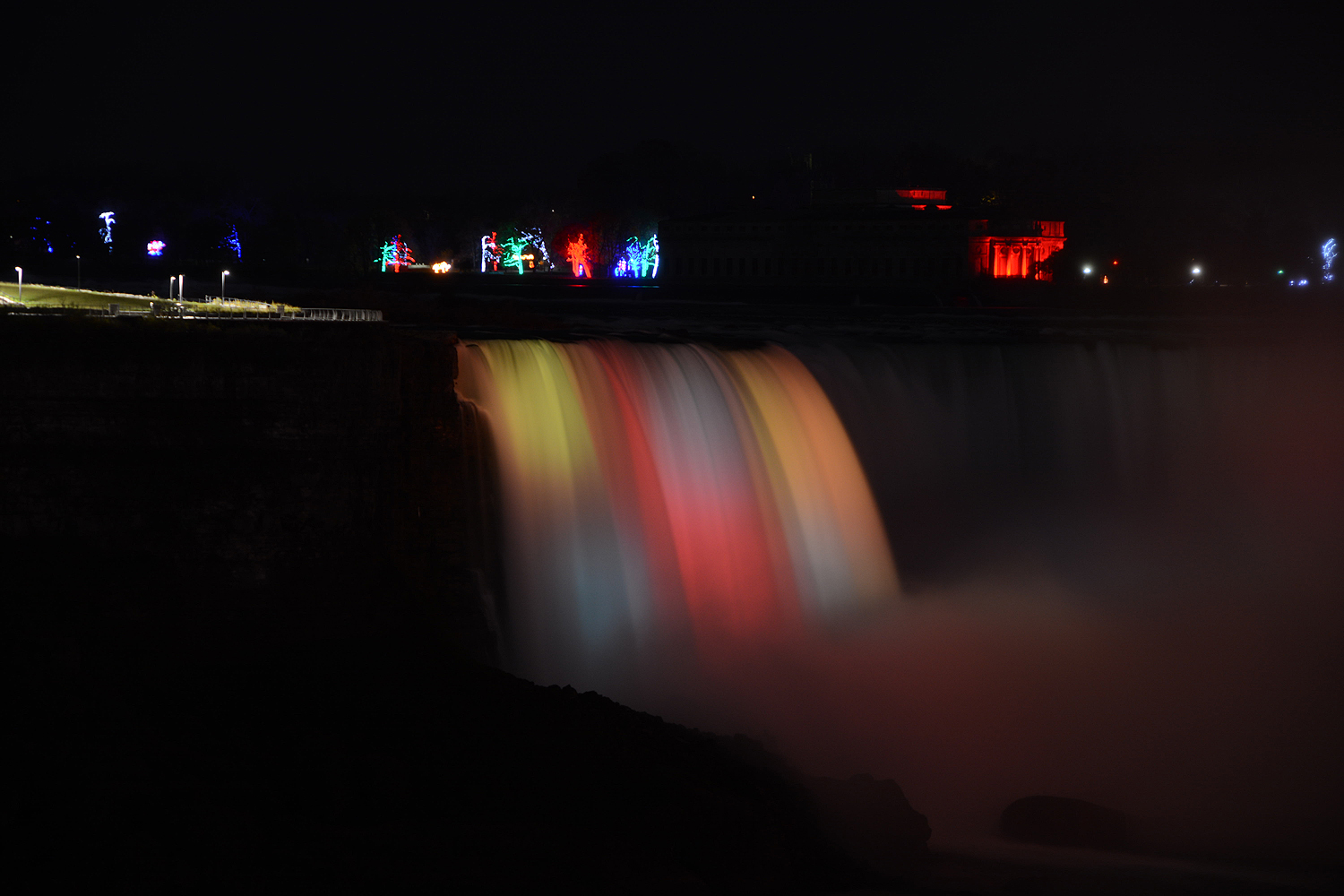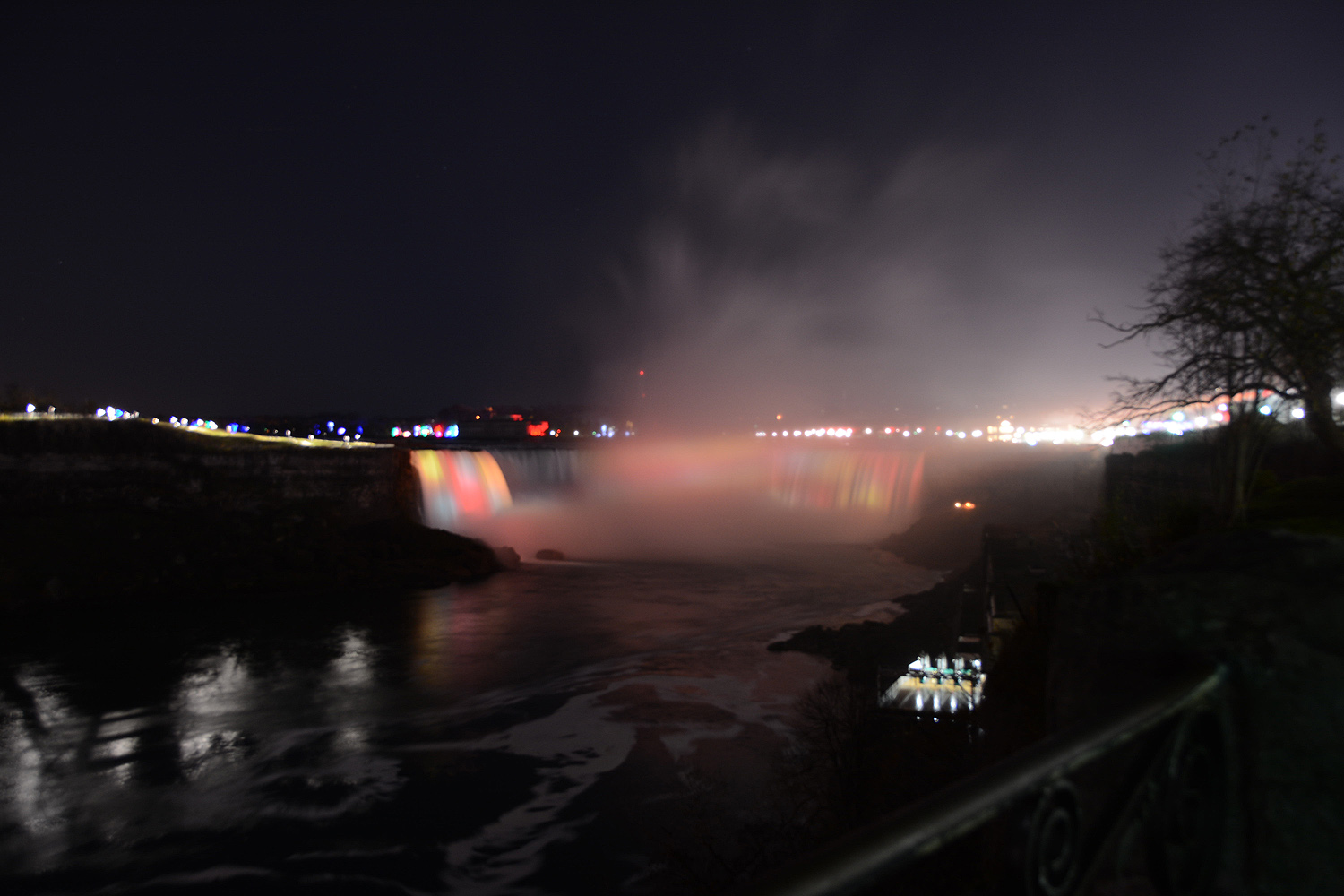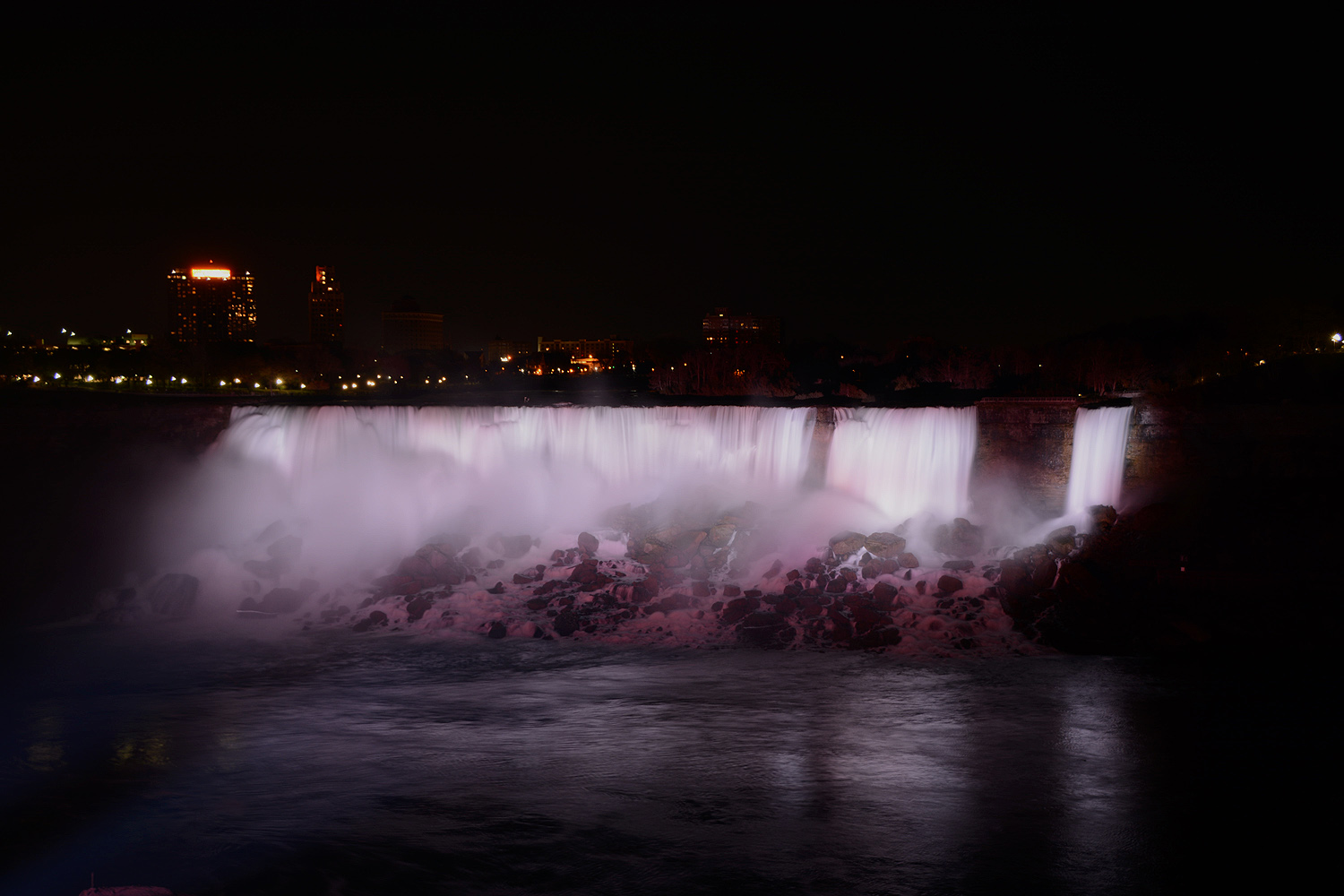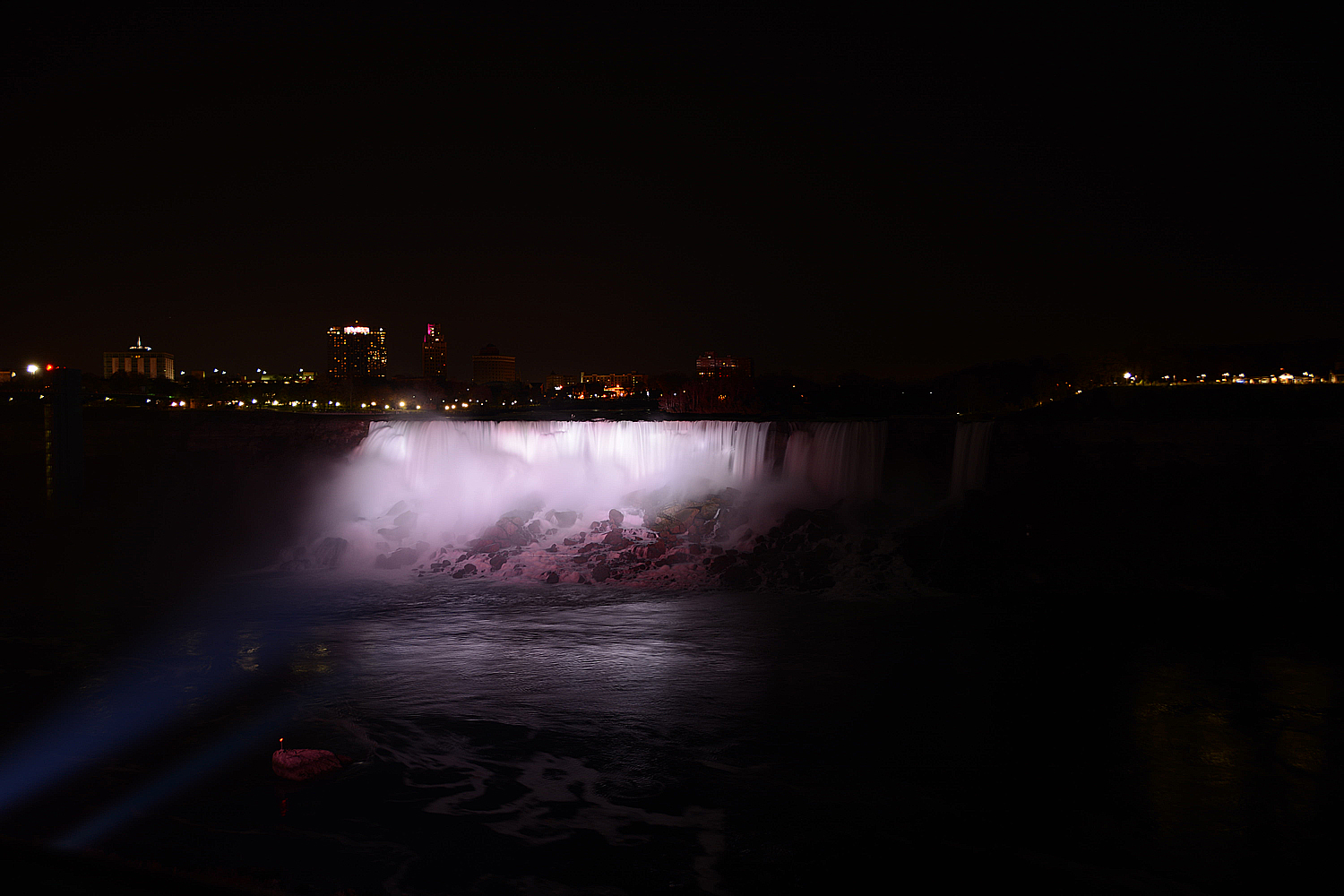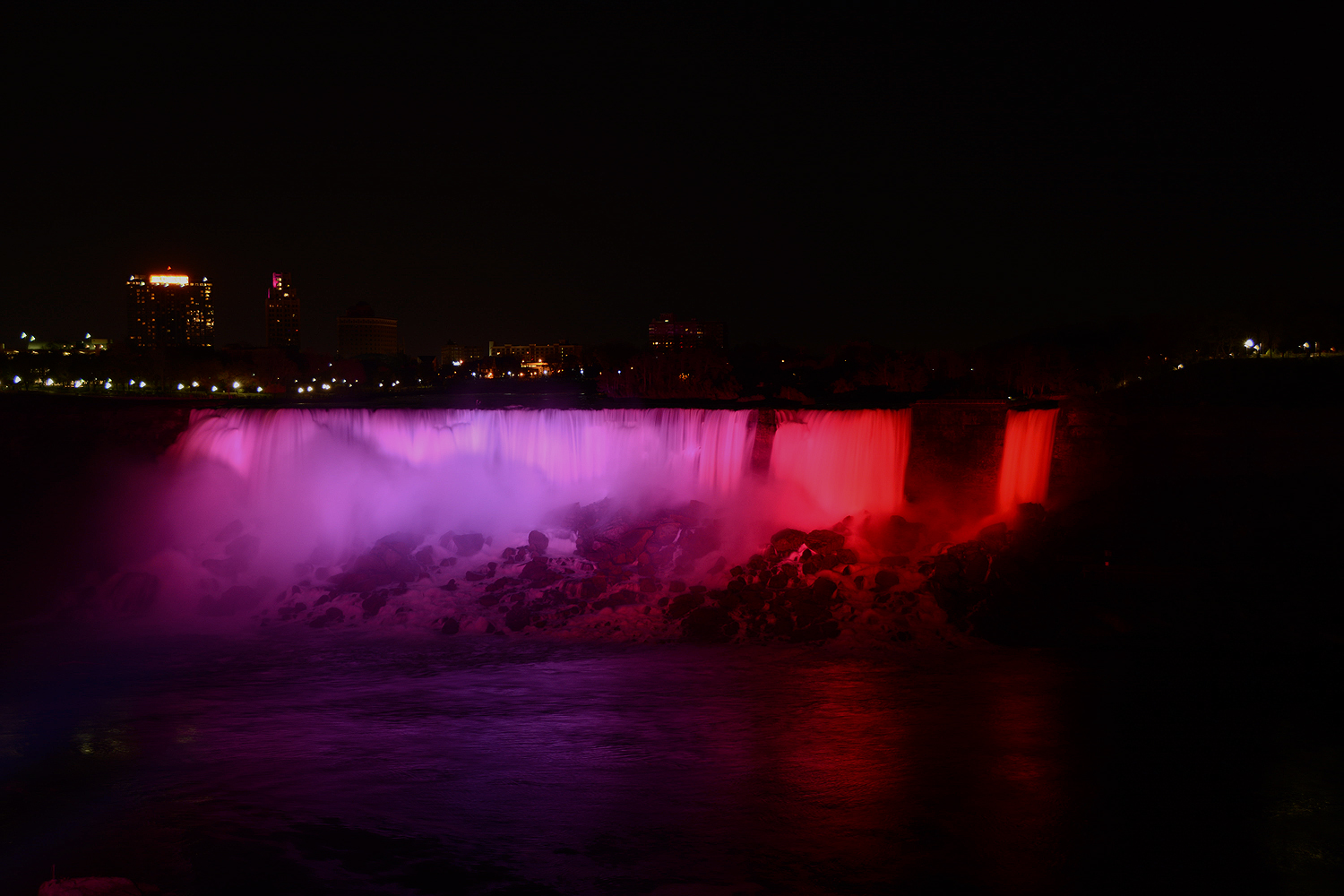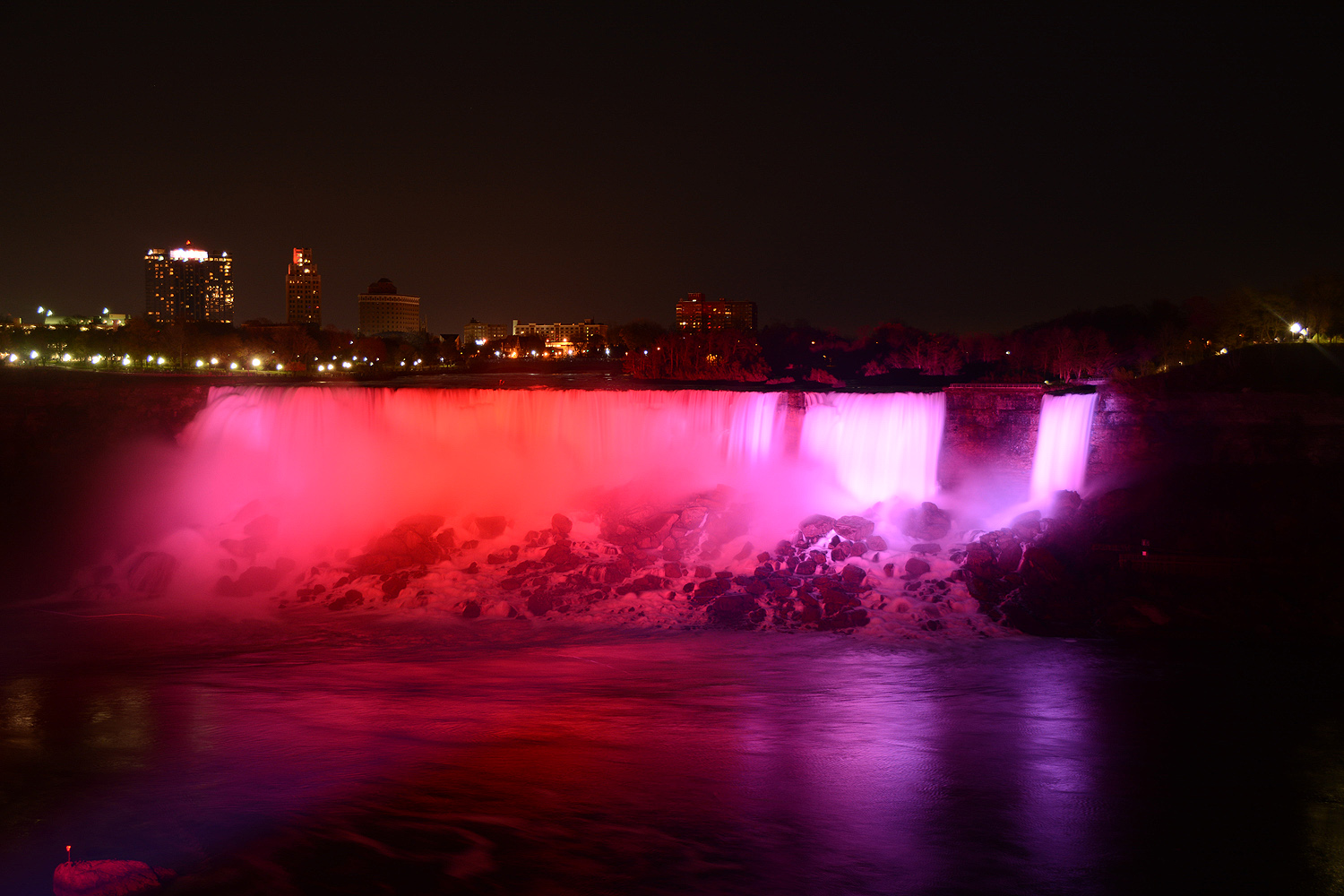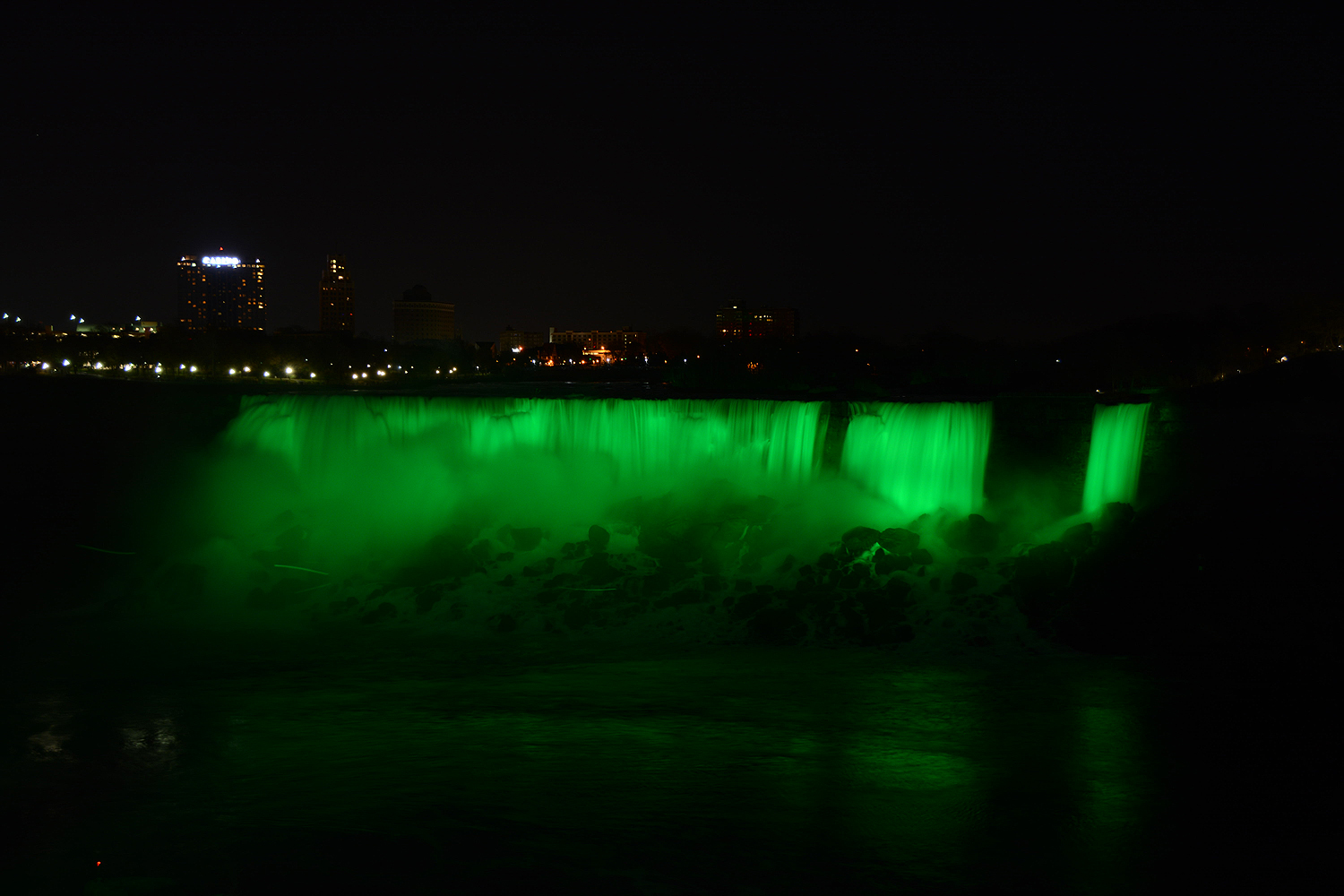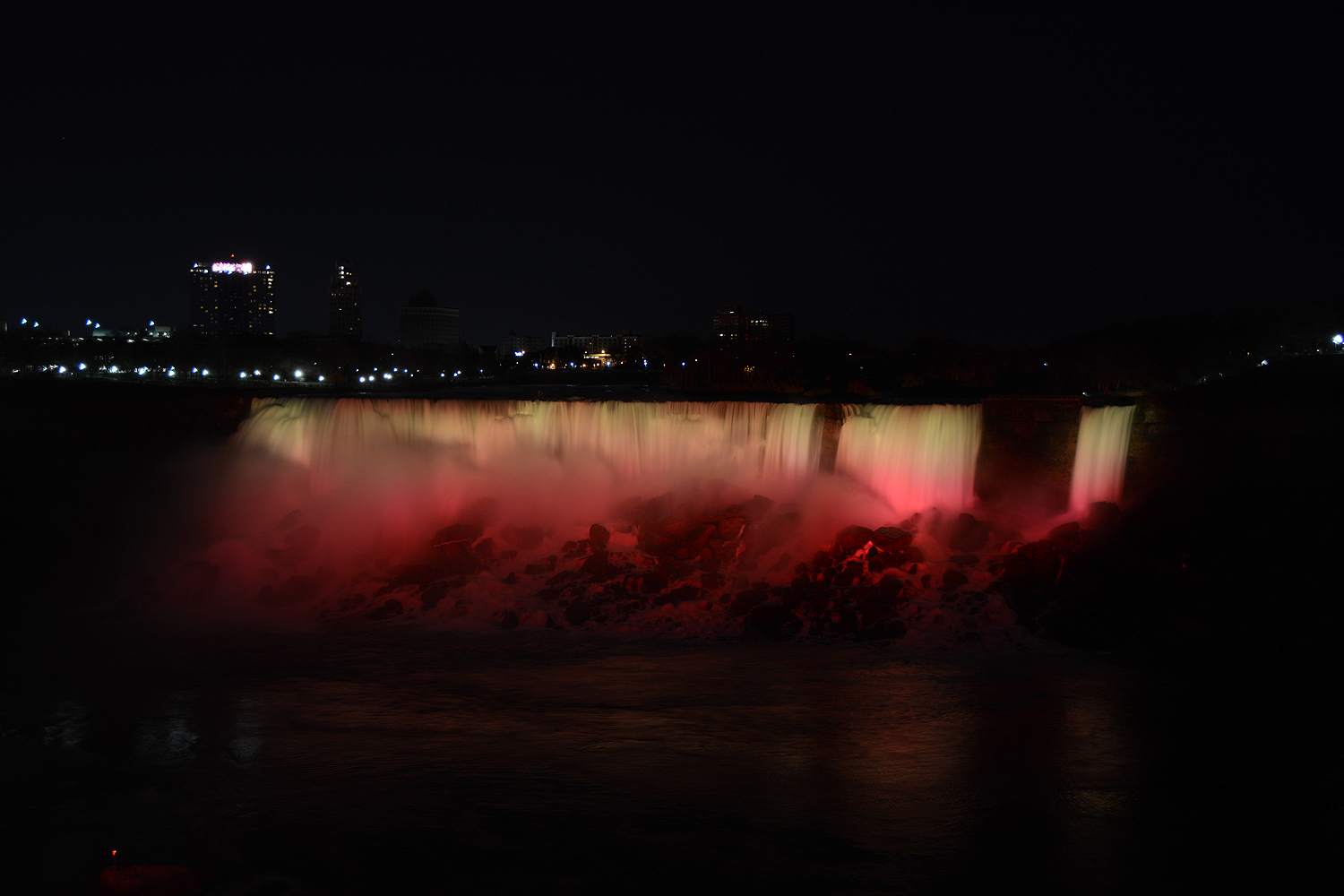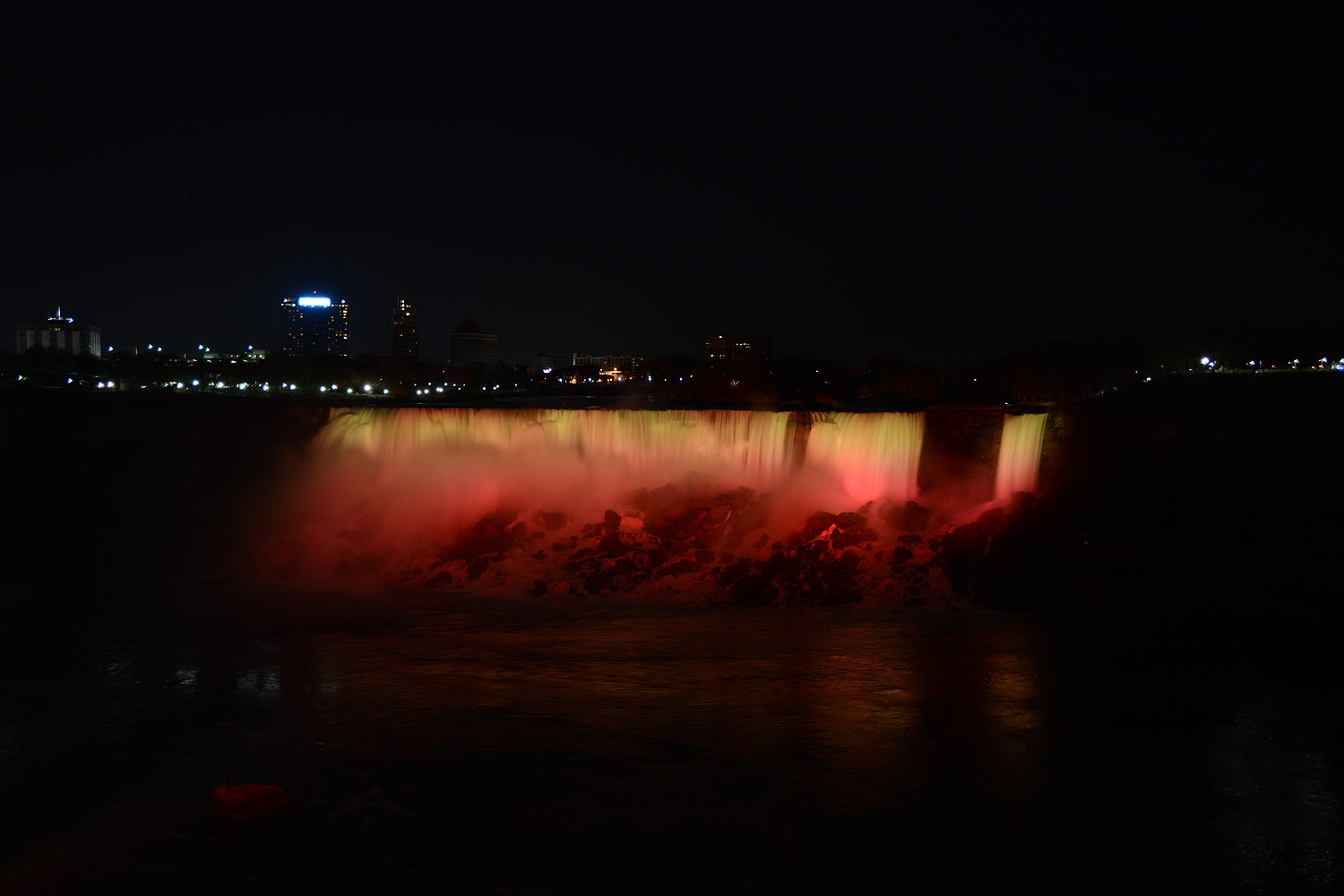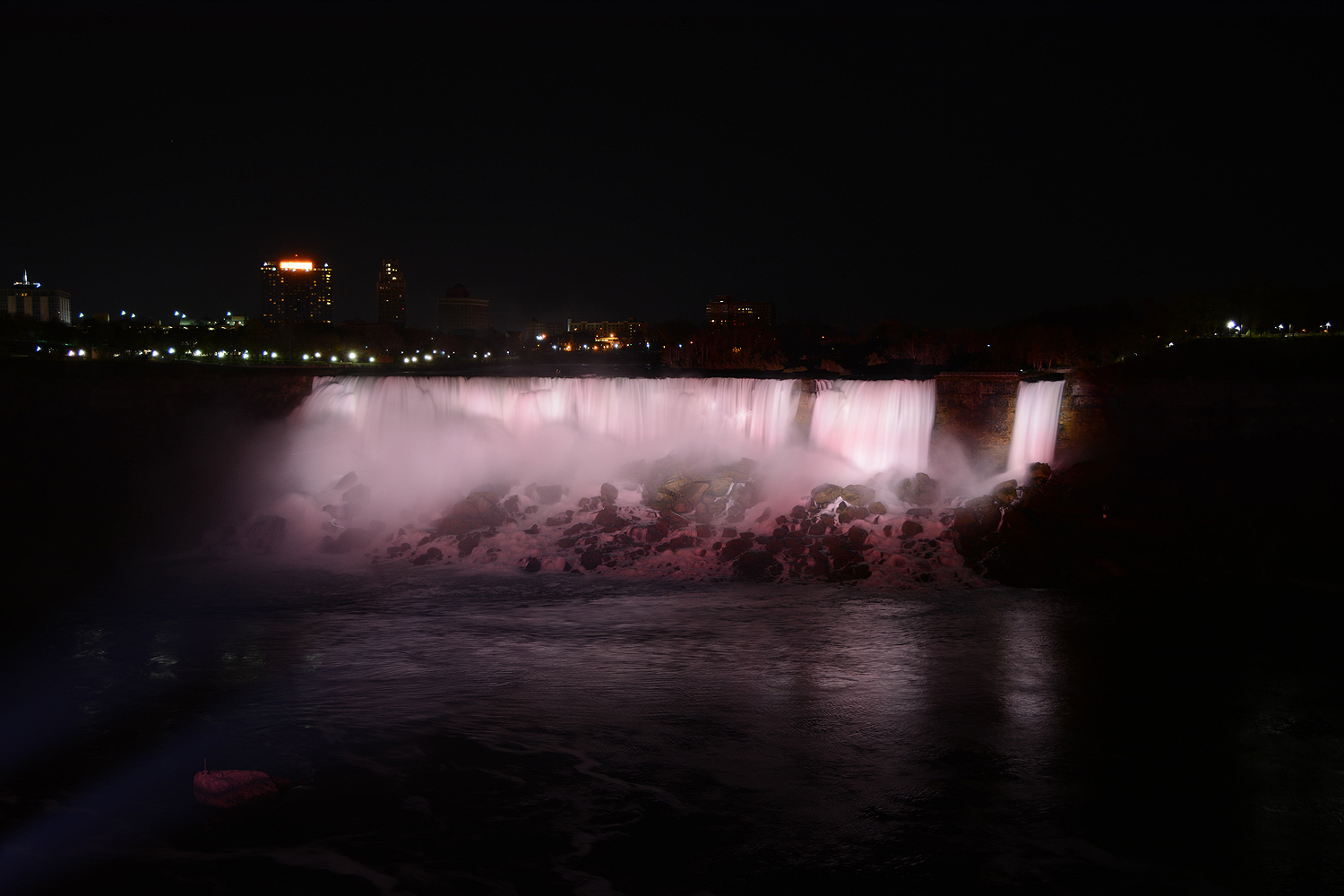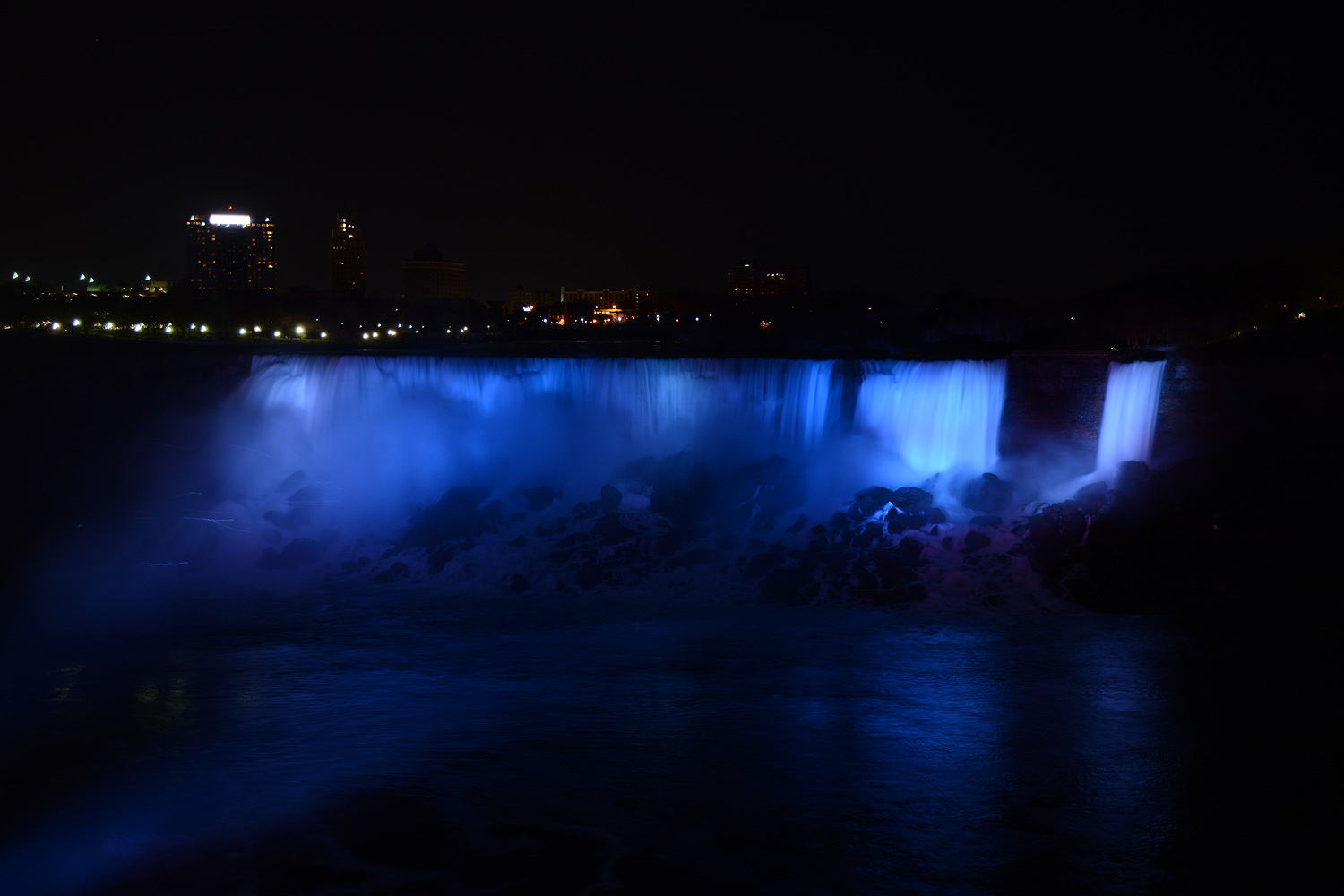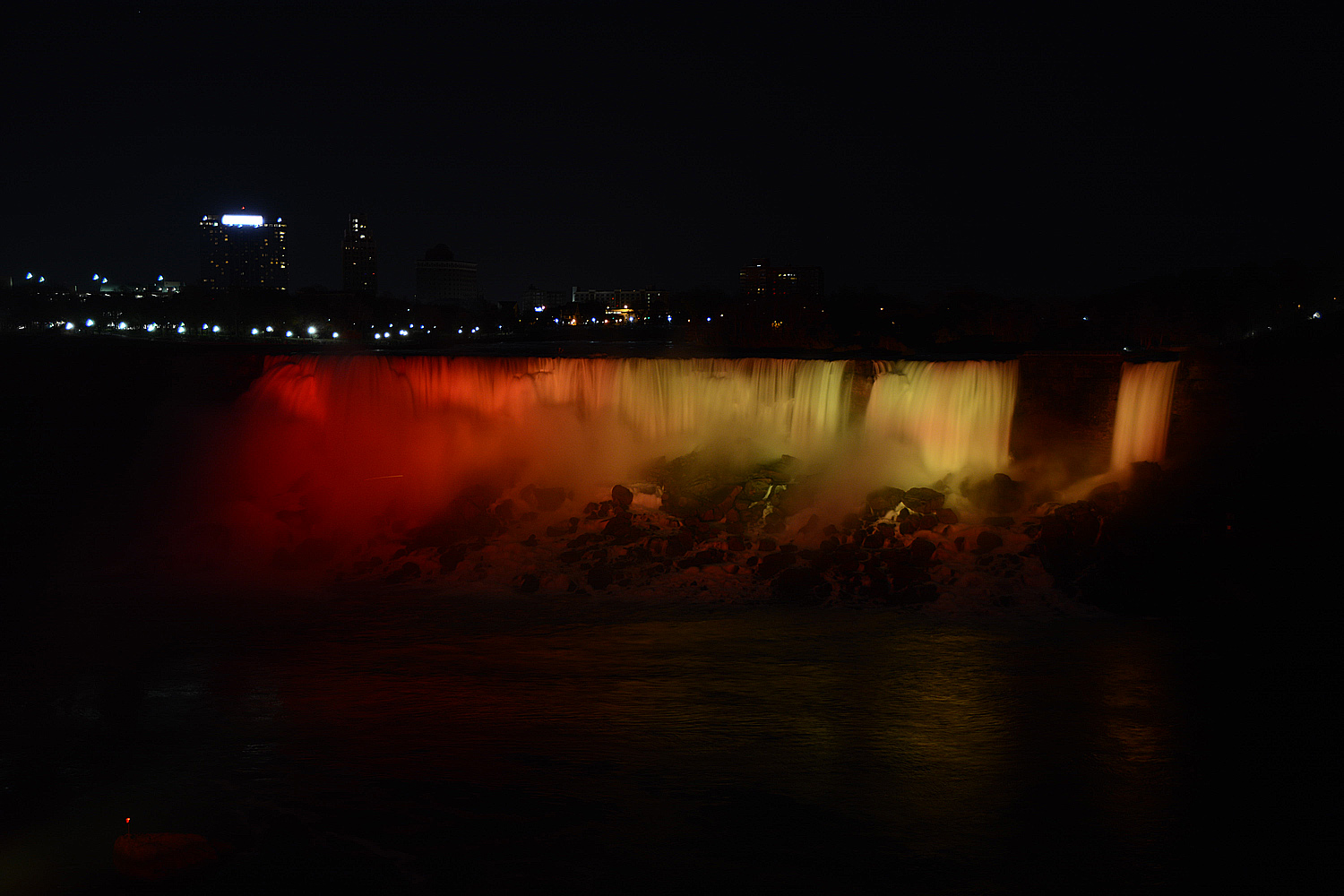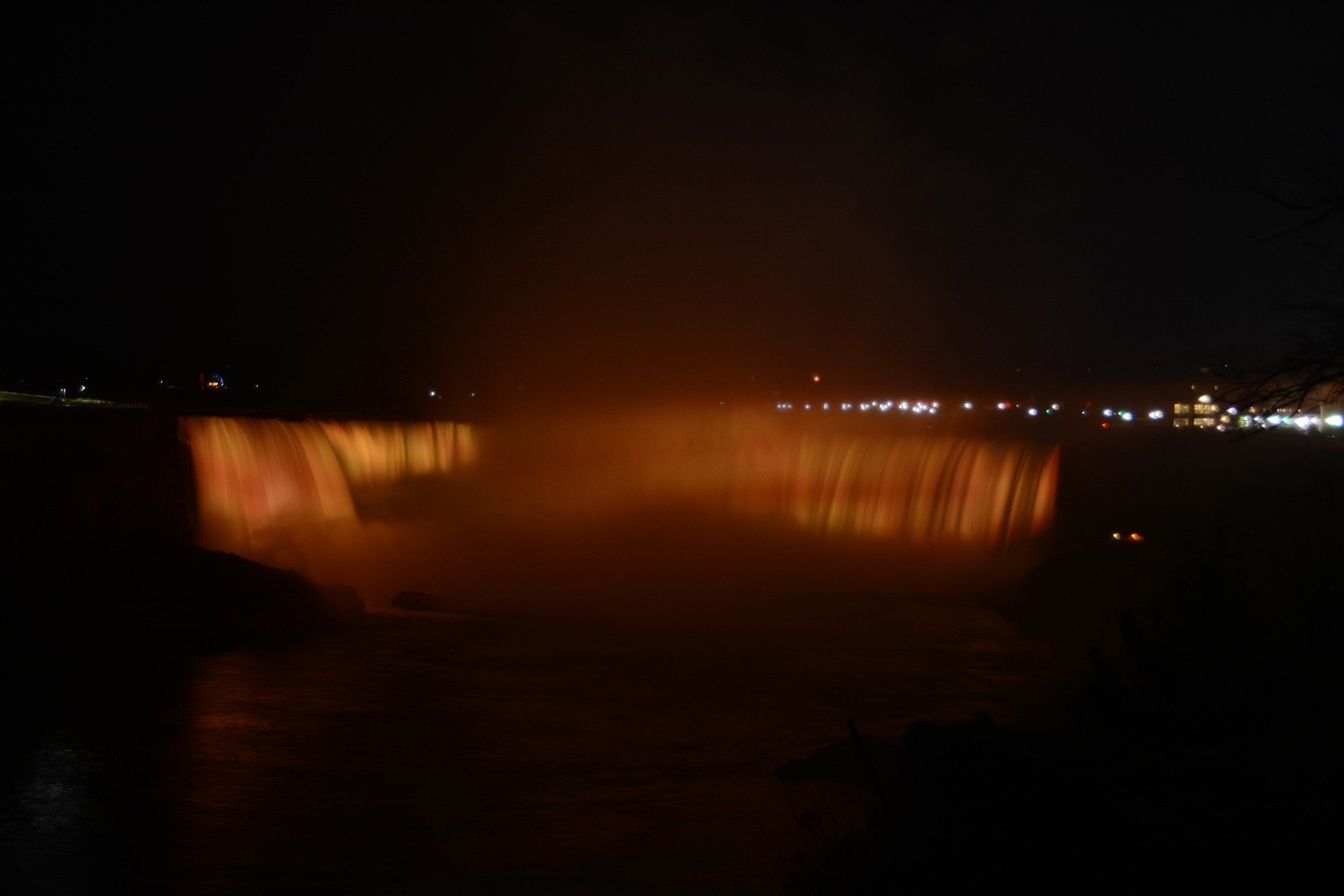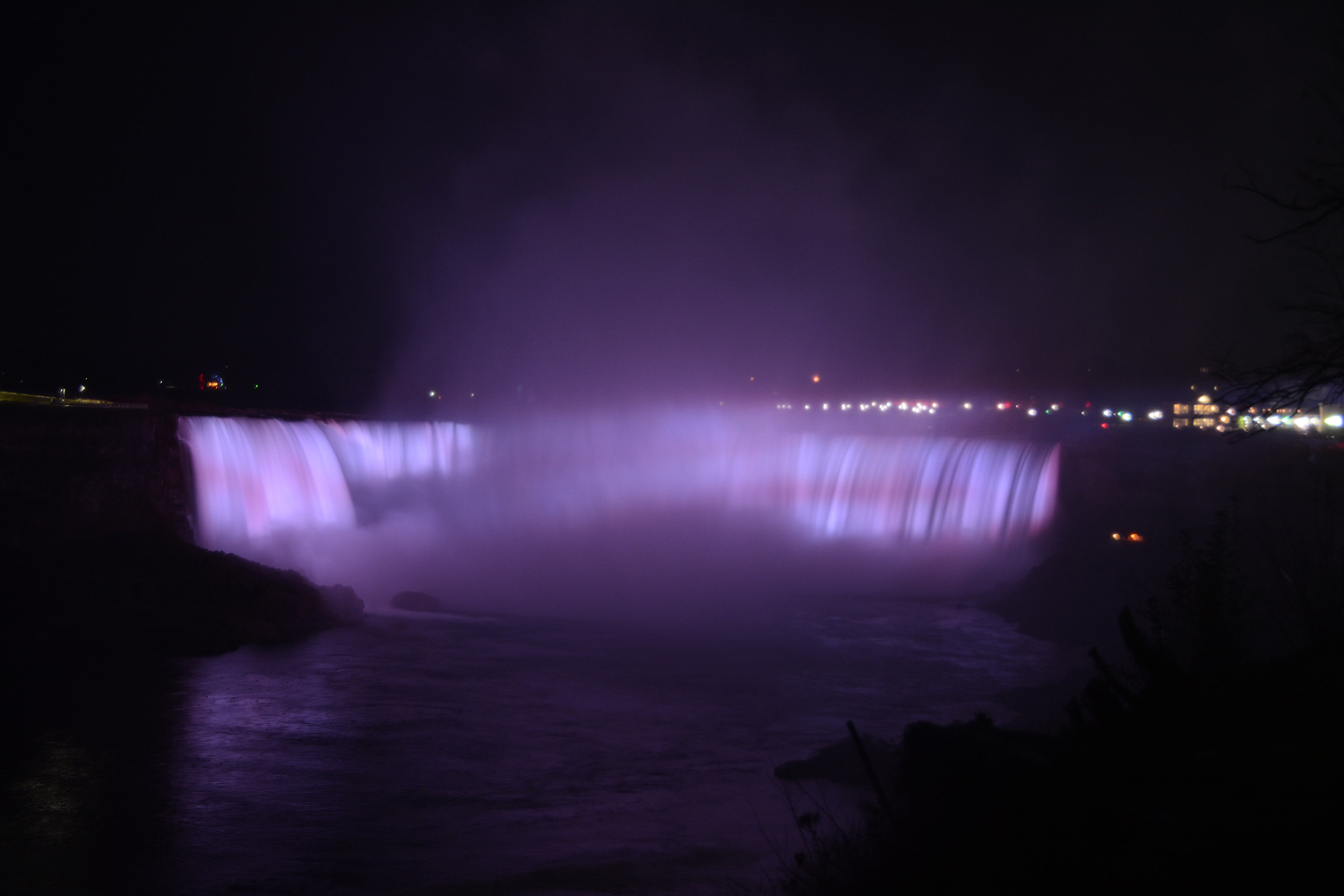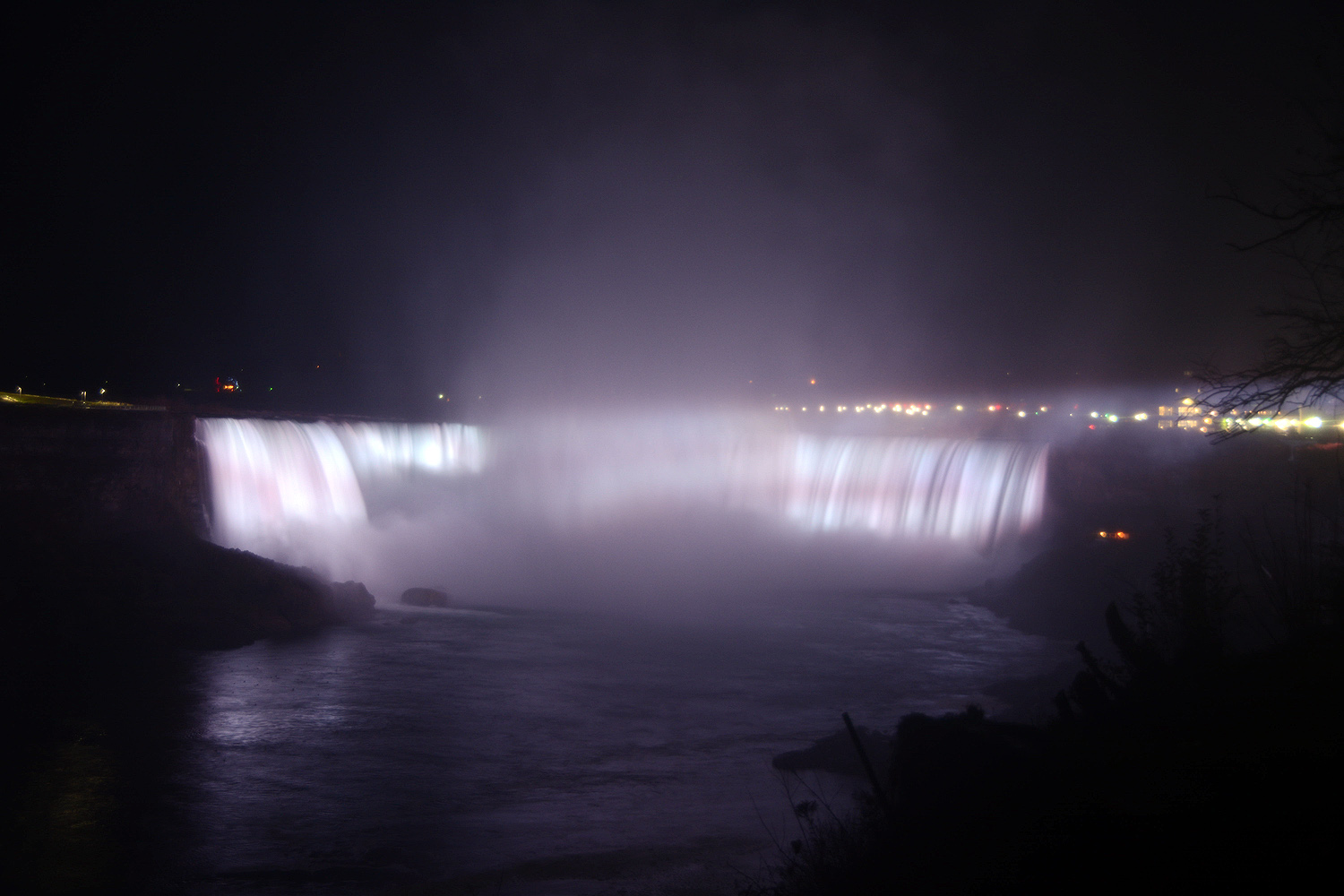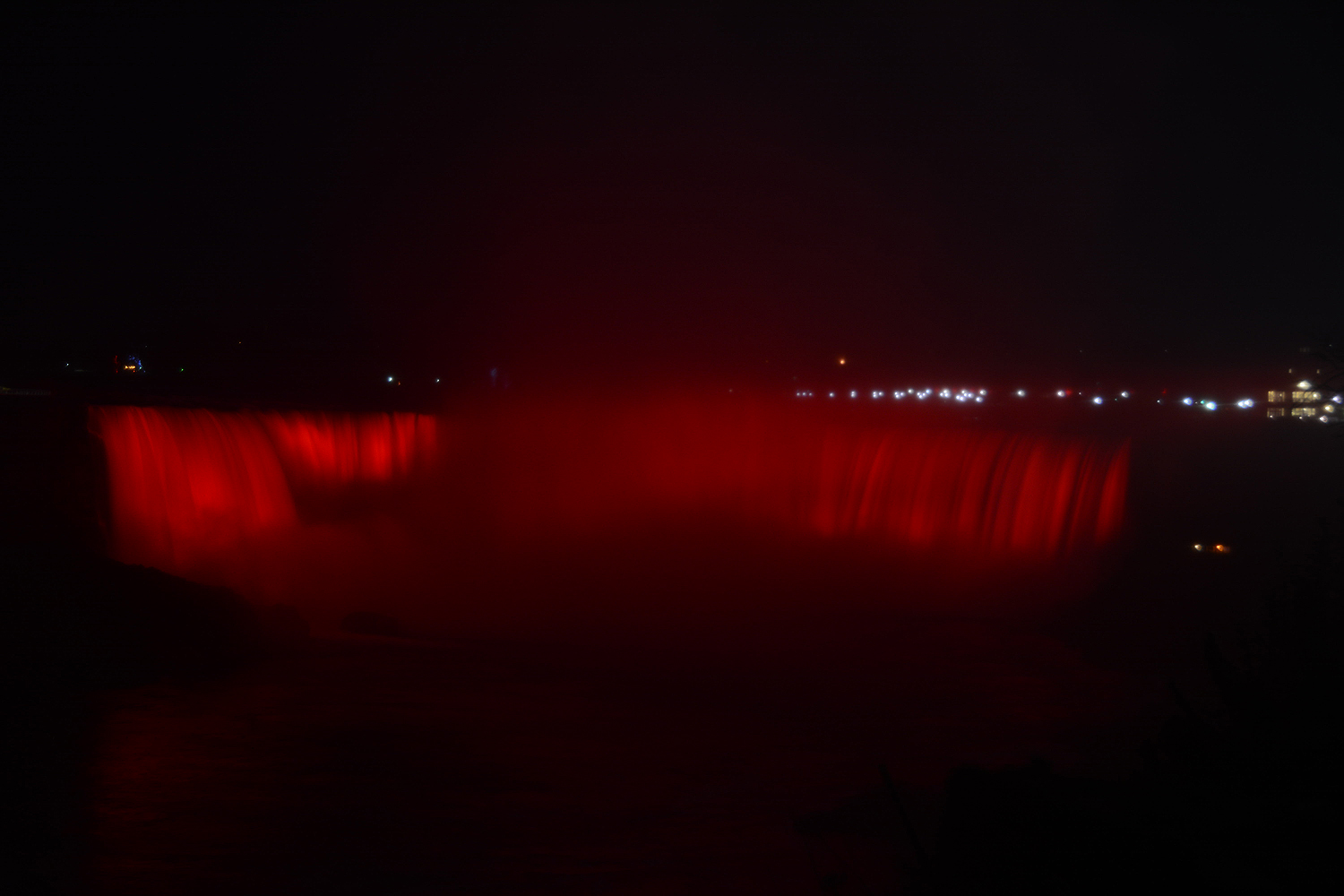
The Niagara Falls Illumination Board's
This page is dedicated to
Pete Gordon and Dick Mann
(see biographies below)
|
The Latest News
January 2017
Janice
Thomson named new Chair of Niagara Falls
Illumination Board. In
addition, the New York State Power
Authority (NYSPA) was welcomed as a new
member to the International Niagara
Falls Illumination Board. The authority
played a leadership role in garnering
U.S. stakeholder support for the
enhanced Illumination of both the
Canadian Horseshoe and American Falls. City
of Niagara Falls (Ontario)
December 1st 2016
Official Ceremony of New - LED Lighting for Niagara
Falls In February of 2016, after a process of requesting qualifications and proposals, the board selected a consortium of firms comprised of ECCO Electric Ltd., Mulvey & Banani Lighting Inc, Salex Inc., Sceneworks and Stanley Electric. Construction to begin work on the lighting project in September 2016. As part of a $4 million CAN revitalization project, the Niagara Falls Illumination Board intends to illuminate the Horseshoe and American Falls with LED lighting. The lighting will replace 21 Xenon spotlights that have illuminated the falls for the last 20 years. The new lighting system features more than 100 panels containing 12,600 LED lights that will provide 2-3 times the lighting intensity levels of the xenon spotlights they replace. The LED light panels will also allow for a full palette of more than 1,800 colour combinations that was not available before. Lights can be solid colours to rainbows of varying intensity. The lights can be computer programmed to add movement or automated sequences (side to side, middle outwards, top to bottom or any portion thereof). Using 82% less power consumption, the new LED light bulbs have a life span of approximately 25 years and are 42% more efficient than the old spotlights. The energy usage for the existing lights is about 126 kilowatts, which costs $33,000 a year to operate. The new system would only use 52 kilowatts, a 59 percent reduction in energy use, Niagara Falls Mayor Paul A. Dyster told the City Council several months ago. The new system is projected to cut $19,470 from the annual energy bill to an annual cost of $13,530 and a cut of 74 kilowatts. New LED lights have been installed to light the American Falls from a riverside bunker in the lower gorge while a new system will brighten the tower beside Victoria Place to focus on the Horseshoe Falls. LED lights have also been positioned atop Table Rock to light the lip of Horseshoe Falls. The new bunker is built a short distance downriver from the old concrete bunker and closer to the river's edge. It is from this bunker that the LED's will illuminate the American Falls entirely. Previously spotlights on the Illumination building were the primary lights to illuminate the American Falls while three spotlights inside an old bunker supplemented them by illuminating the left edge of this waterfall. The bunker lights became operational in early August of 2016, however the lights intensity was scaled back to attempt to match that of the older lights that lighted the American Falls from the Light Tower. The replacement of the remainder of the old lights on the Light Tower began in September. In order to fund this project the cost was split equally among the Canadians and Americans of this bi-national organization. Besides the City of Niagara Falls (Ontario) commitment of $350,000 toward Canada’s $2-million share, the Fallsview BIA has contributed $470,000, the Victoria Centre BIA has chipped in with $125,000 as has the Clifton Hill BIA. The Lundy’s Lane BIA has agreed to contribute $30,000 and Hornblower Niagara Cruises has anted up $100,000. Falls Management Company, which operates the city’s casinos, has added $150,000. Public sector commitments include $200,000 from the Illumination Board’s reserves. The Niagara Parks Commission has contributed $350,000 while Ontario Power Generation contributed $100,000. On the American side most of the costs are being picked up by New York State and New York Power Authority Greenway funds. The City of Niagara Falls' share is $35,850, an amount that has already been approved the City Council. The official lighting ceremony took place on December 1st 2016.
The New LED Lighting System
|
|
NEW |
|
OLD
|
|
|
1,800 Colour Combinations Total Cubes =1,400 Total LEDs = 12,600 Each LED = 2.8 watts 9 LEDs per Cube = 25 watts Total watts = 35,000 52 kW annually Cost - $4 million dollars (CAN)
Illumination Tower 792 Cubes 7,128 LEDs 6 Panels per Frame 11 Frames located on Illumination Tower in Queen Victoria Park. Illuminates the Horseshoe Falls.
Table Rock Pavilion 128 Cubes 1,152 LED’s8 Cubes per Panel 4 Panels per Frame 4 Frames located on top of the Table Rock Welcome Centre - Niagara Parks. Illuminates the center rim of the Horseshoe Falls behind the rising mist.
Bunker Lights 480 Cubes 4,320 LEDs 12 Cubes per Panel 4 Panels per Frame 10 Frames located in Niagara Gorge near edge of river. Illuminates the American Falls including Bridal Veil Falls
The new LED lighting system provides a total of 350 zones of control, 120 across the American Falls and 230 across the Canadian Falls. Each control zone is equipped with separate Red, Green, Blue and White LED luminaires. A total of 1,400 individual luminaires are used and together provide the ability to produce up to 16,777,000 different colours combinations. 3° Light Projection Beam Average lighting levels 3 to 14 times the previous system improved the overall uniformity by 75 times reduced energy consumption by 60 percent Began December 1st 2016 42% Less Power = 35,280 watts
610,400,000 Million Candlepower |
|
7 Colours (include white) 21 Lights: 18 on Tower - 3 in Bunker a total of 21 zones of control, 10 across the American Falls and 11 across the Canadian Falls 4,000 watt Xenon Bulbs = 84,000 watts 500 million Candlepower - each light projecting 23,809,523 candlepower 126 kW annually
Began June 20th 1958 - carbon
arc Cost - $158,000 |
|
|
Niagara Falls Illumination Enhancement Team
|
In
Memory Of
RICHARD "DICK" MANN
1933 - 2014
Dick was one of two light operators for the Niagara Falls
Illumination Board.
He worked for 33 years before passing away on May 7th 2014
following a brief illness. He was a dedicated and loyal employee.
Dick was a special person and he will be missed by all.
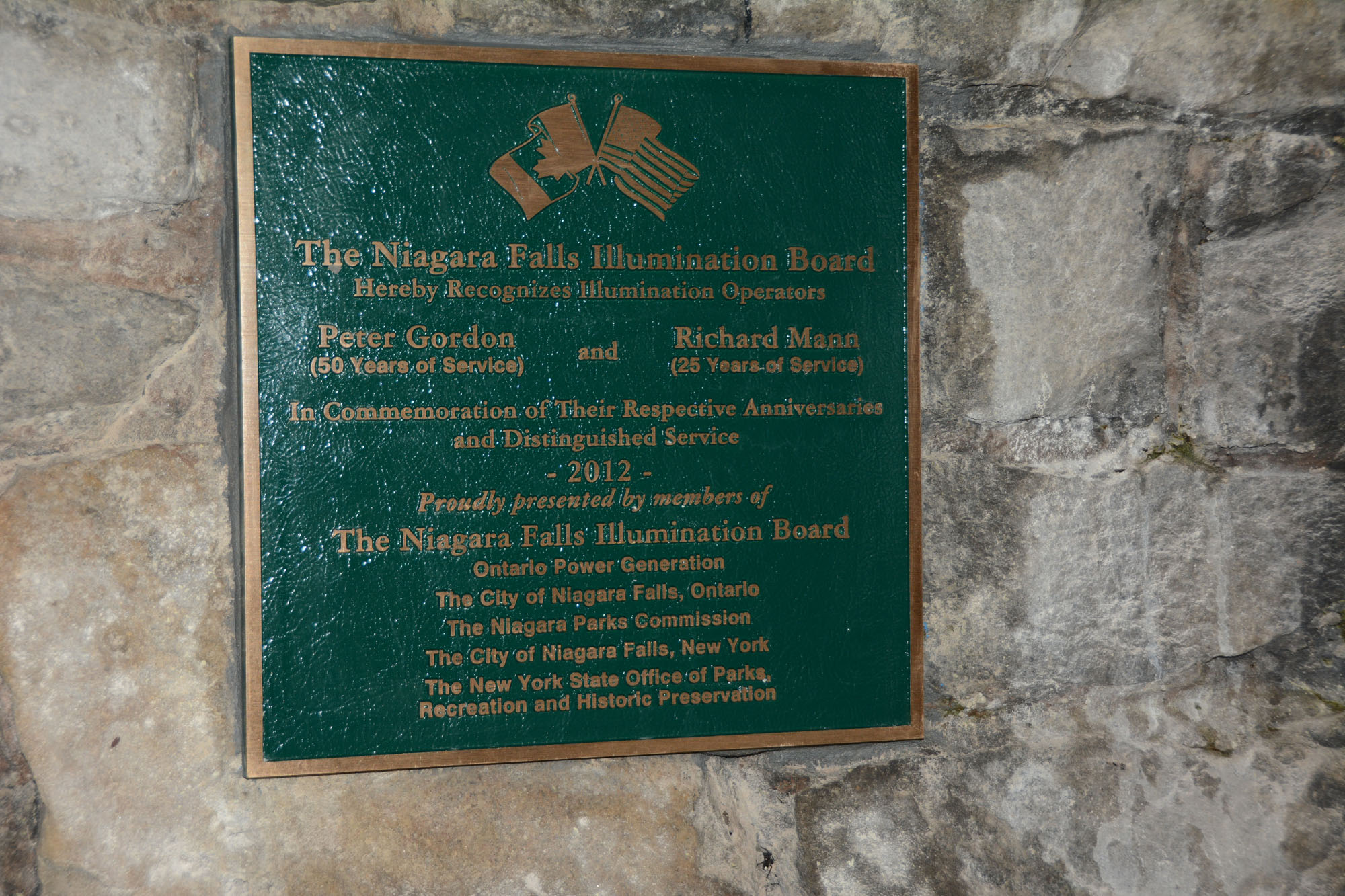
On May 21st 2014 the Niagara Falls Illumination Board erected a bronze
plaque on the wall
of the illumination building light control room
dedicated to the service of long time employees
Pete Gordon & Richard Mann
The plaque is dated 2012
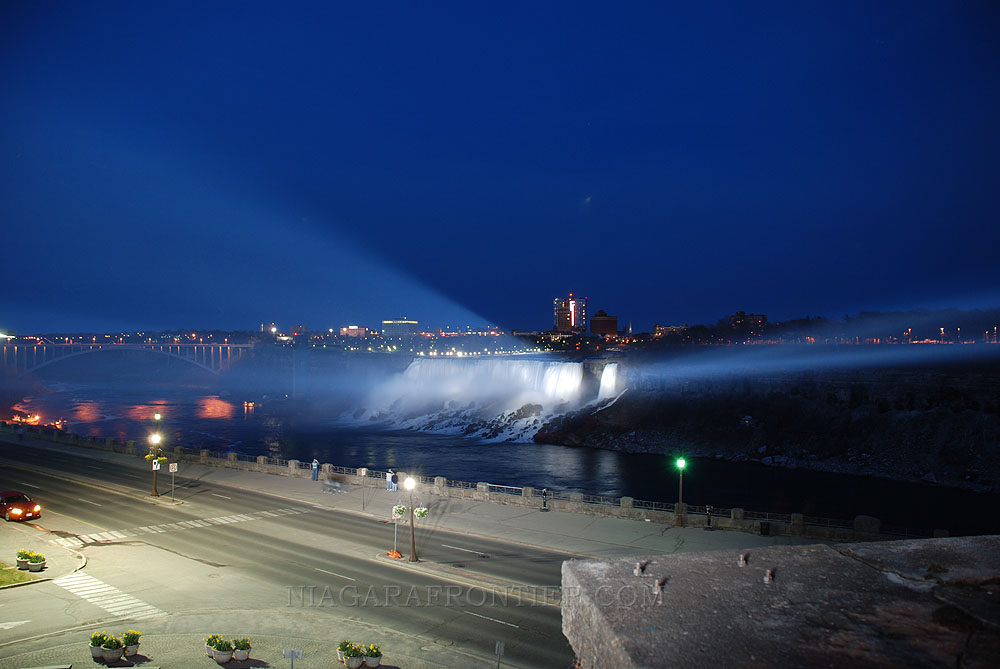
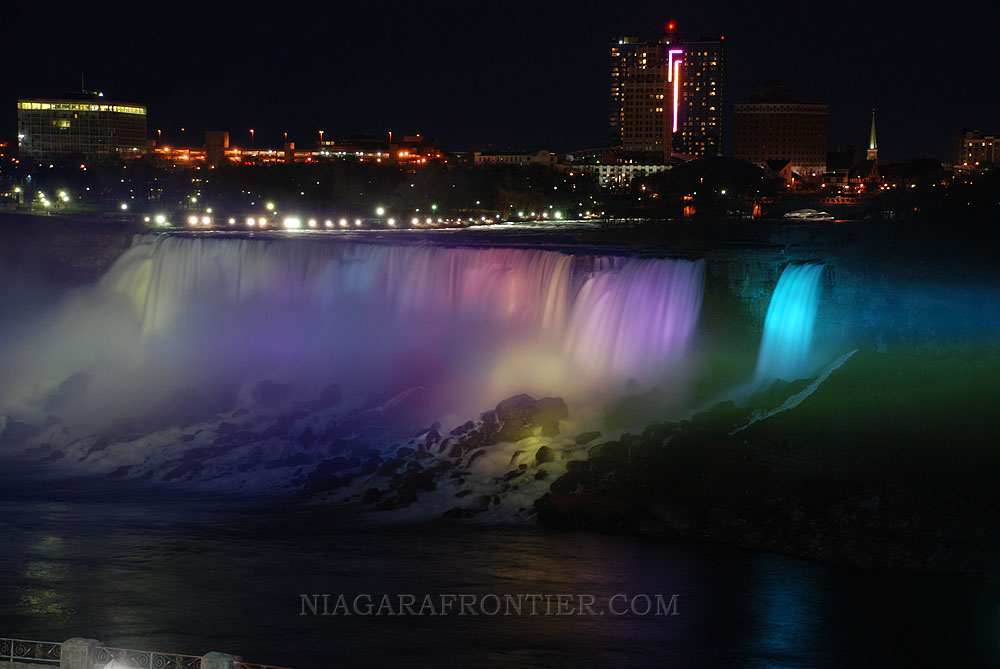


The Illumination of Niagara Falls
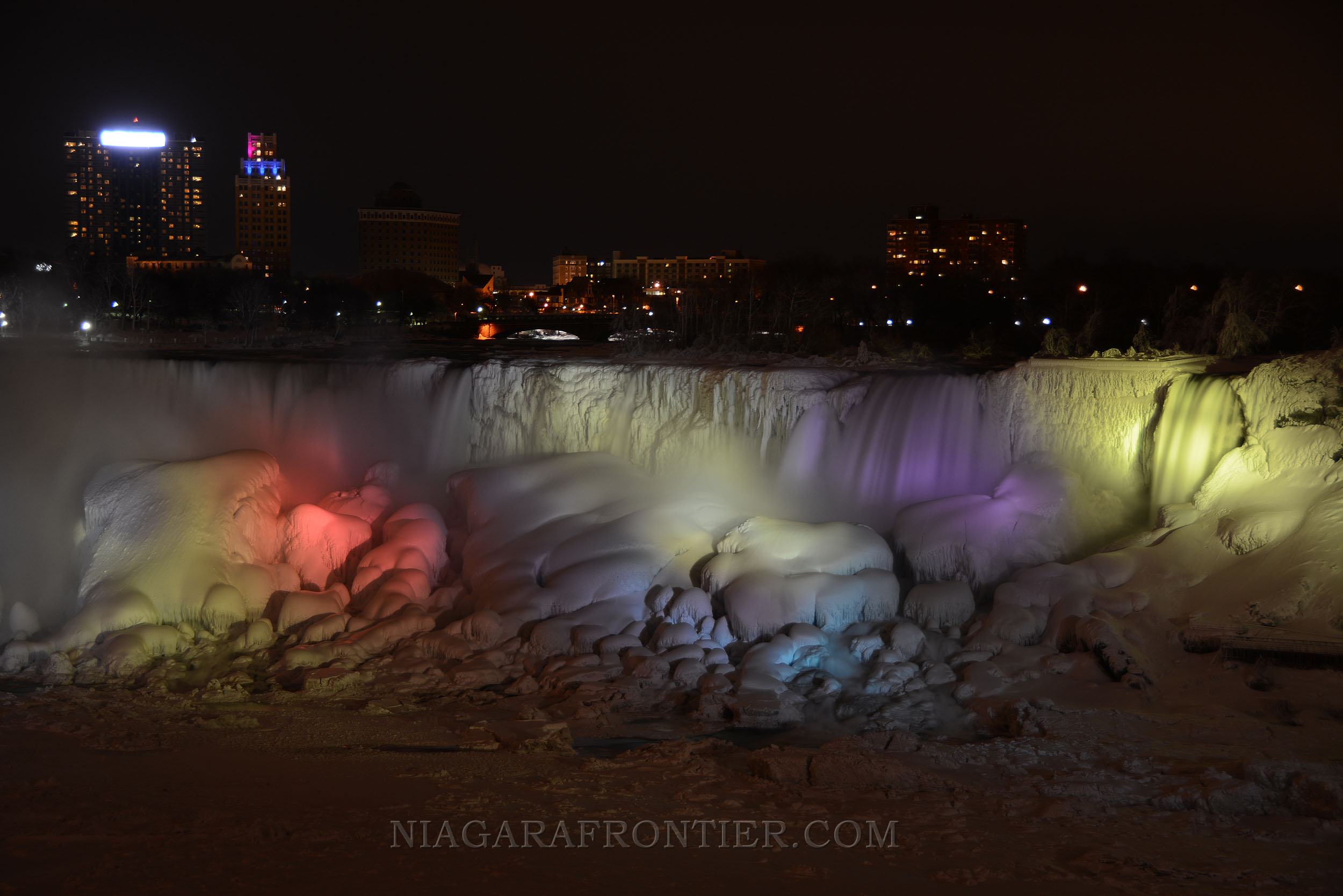
American Falls & Bridal Veil Falls
Niagara Falls State Park
January 30th 2014
Biographies of Pete Gordon and Dick Mann - the Legendary men behind the Lights of Niagara
(click above link)
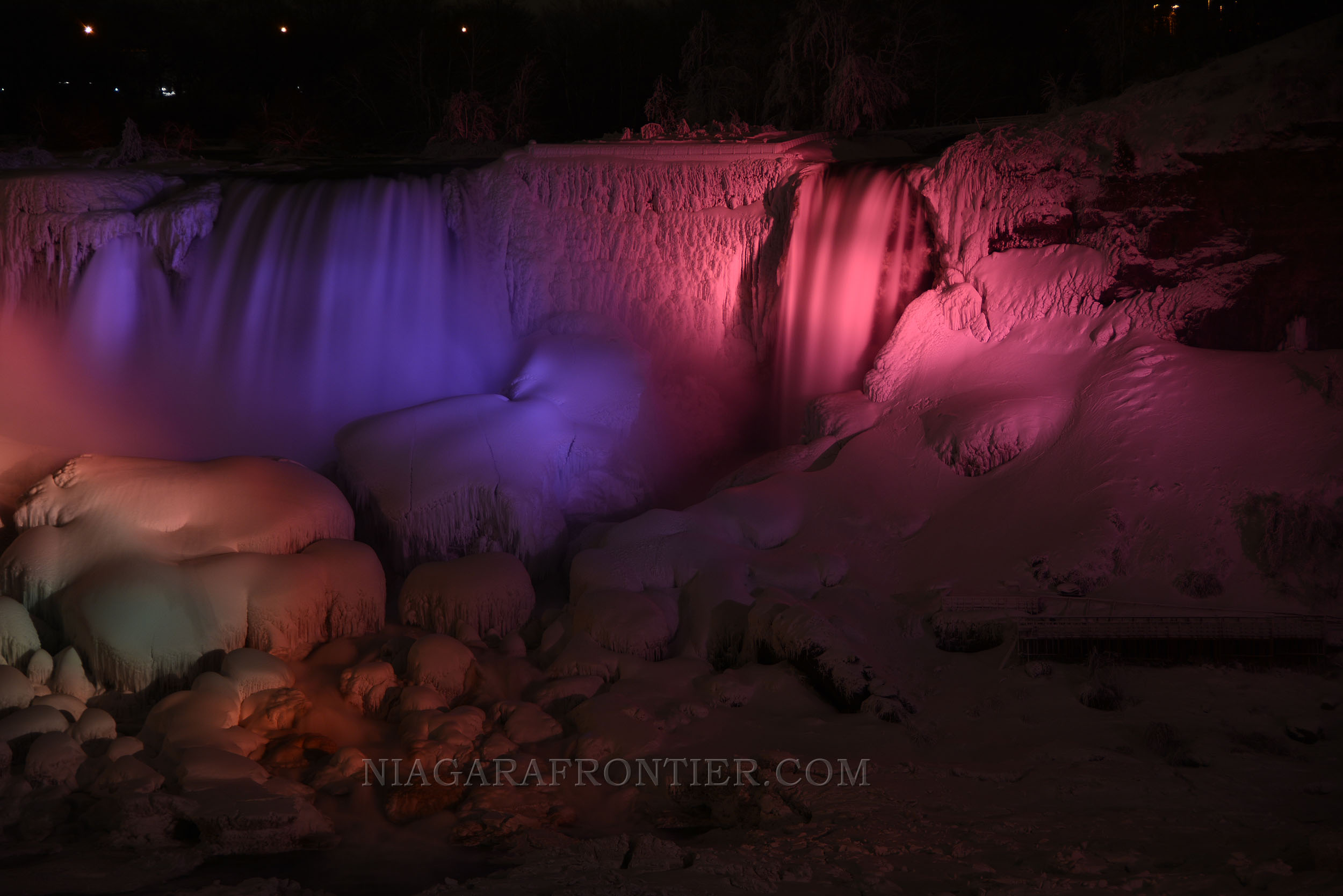
The Bridal Veil Falls
Illumination
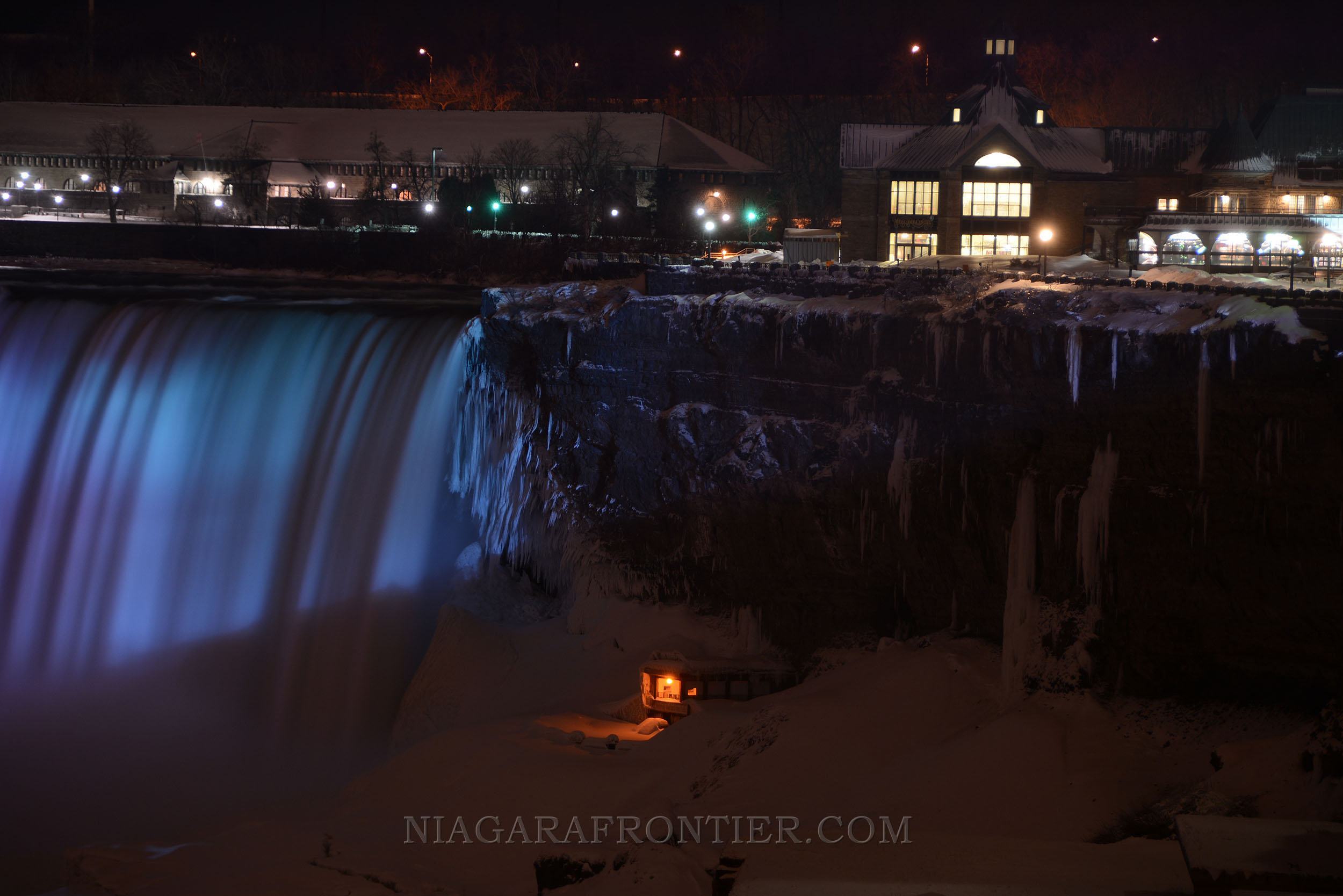
Table Rock Illumination
Niagara Parks
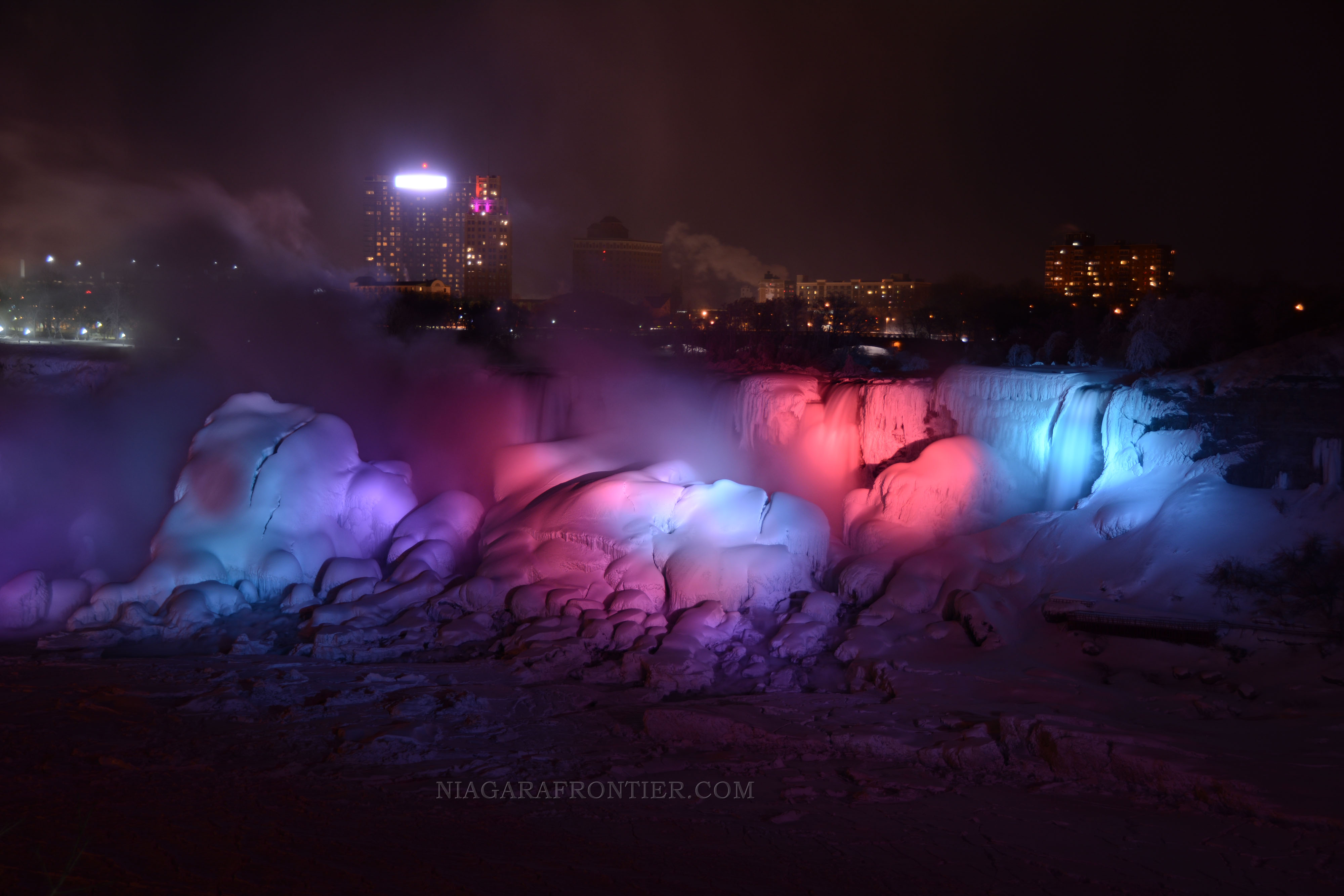
Icy American Falls Illuminated
March 3rd 2014
from
Niagara Parks
The Summer of 1860, Mr. Blackwell of England proposed the Illumination of the Falls in honour of the upcoming visit of the Prince of Wales.
Using two hundred (200) Bengal Lights, he arranged sixty (60) in a row below the high bank on the Canadian shoreline aimed at the American Falls. Blackwell placed another sixty (60) lights under the Table Rock and the remaining eighty (80) lights behind the sheet of water at the Horseshoe Falls.
At 10 p.m. on September 14th 1860, the Falls of Niagara were illuminated for the first time in history in the presence of the Prince of Wales. Although successful, Blackwell's method of illumination wasn't utilized again.
In the late 1860's, calcium "torpedo" lights were utilized to illuminate portions of the Niagara gorge at night.
|
The Manchester Guardian - October 3, 1860
Niagara Falls illuminated
The special correspondent of the Times gives an interesting
description of the scene at Niagara on the occasion of the visit of
the Prince of Wales:-"the Prince's first view of the cataracts was
on Friday night, when he saw them as no man had ever seen them
before, and as they will probably never be seen again-he saw the
falls of Niagara illuminated. At the first idea it seems about as
feasible to light up the Atlantic as these great outpourings of Lake
Erie, and Mr. Blackwell, when he started the idea, was looked on as
well meaning and all that, but chimerical to use the mildest term. Mr. Blackwell, however persevered, and had some 200 Bengal lights made of the largest size which it was possible to manufacture. About 20 of these were placed in a row under the cliffs, beneath Clifton House, and facing the American fall: 20 more were placed under table rock, and 20 more behind the sheet of water itself, the entrance to which from the Canadian side I have already described. At 10 o'clock at night they were all lit and her affect was something grand, magical, and brilliant beyond all power of words to portray. In an instant the whole mass of water, glowing as if incandescent, the intense light, seemed turned to molten silver. From behind the fall the light shone with such vivid brilliancy that the waters immediately before it looked like a sheet of crystal glass, a cascade of diamonds, every head and stream in which leapt and sparkled and spread the glare over the whole scene, like a river of lighted phosphorus. The boiling rapids underneath dimly reflected back the vivid gleam as from a mirror, lighting up the trees and rocks and all the wild torn chasm through which the rapids pour, and showing out the old gray ruins of table rock like a huge dilapidated tower. The smoke, too rose in thick dense masses, spreading upward over the cataracts in a luminous cloud that it seemed as if Niagara was in a blaze from base to summit. But all the grandeur and beauty seemed as nothing to the effect produced when the lights were changed from white to red. Niagara seemed turned to blood in color, but so bright, so lurid in its deep effulgence that a river of seething, roaring, hellish fire seems to have taken the place in an instant of these cold, stern, eternal falls. None could look upon this scene, the huge fiery blood-red mass, dark-looking and clotted in the center, without a feeling of awe. You could not speak, so sublime were it's terrors, nor move your gaze from the blazing cauldron underneath the falls, where the river seemed in its frothy red foam like boiling blood. His Royal highness walked quietly out on table rock and saw the whole of this grand scene to the best advantage."
|
In 1879, Niagara Falls was again illuminated for the Royal visit of Princess Louise and her husband , the Marquis of Lorne - Governor General of Canada. It was the first time in history that the Falls of Niagara were illuminated by use of electricity.
The Brush Electric Company of Cleveland, Ohio used arc lights to illuminate the Falls. A water wheel was located in the rapids upstream of the American Falls. It was connected to a dynamo type generator capable of producing 36 horsepower of electricity to sixteen arc lights. Each light produced 2,000 candlepower for an overall total of 32,000 candlepower. Twelve (12) of the lights were utilized to light Prospect Park while the remaining four (4) lights were positioned at the base of the American Falls.
The Brush light system was only used for one season.
|
Chicago Tribune - October 3, 1879
How Niagara Looks by Electric Light
The illumination of Niagara Falls on the American shore by means of the electric light has now given to this far-famed scenery a doubly attractive aspect. Science by this appliance eclipses even the effects produced by art, and the fantastic display of color through suitable glasses surpasses the most gorgeous tints the painter may throw upon his canvas. The falls, from the terrace of Prospect Park, appear now on a dark night under the rays of a red electric light like an immense swiftly-moving flood of dark red fiery lava, which as quickly changes by turn of the hand of man stationed at the revolving glass in front of the burner into one of bright quicksilver, or again when alternating colors are placed before the dazzling electric flame, as a huge compact of moving rainbow. The foam and spray at the pit of the cascade which the daytime visitor never tires to gaze upon are no longer spray and mist under this nocturnal fairy transformation, but fiery clouds, amid which the rays of the powerful light play with magical effect, somewhat resembling, though more intense, the wondrous phosphorescence of the ocean on a sultry, storm-portending night. The many pleasing small fountains which embellished the grounds of Prospect Park itself throw, for once, in reality, as it were, brilliant showers of silvery spray when exposed to the dazzling glare of any of the nearby electric flames. The most enchanting pyrotechnic displays of the Chinese art are but little shadows in comparison with this spectacle. At will myriads of tiny drops maybe turned either into showers of flashing rubies or sapphires, almost to intense in their splendor, and painful to the eye, through the intense contrast with the pitch black background afforded by the dark mazes of the shrubbery and trees of the park. This is the effect of about only a dozen of these lights. Their weird look could be enhanced beyond calculation if the entire vast scenery of the grand cataract could be lighted up the whole distance from the American to the Canadian shore by means of a few additional batteries placed upon rafts anchored near the foot of the Horseshoe Falls. Such an illumination would eclipse the magical wonders of all the traditional Eastern fairy scenes. They would pale into insignificance before these brilliant hues called into life by the wind of modern science, and if such a display could be viewed on a dark night from a birds-eye view standpoint, the charmed gazer might readily conceive of their resemblance to those antediluvian gigantic out-breaks of fiery level floods, the still imposing ruins of which now confront the visitor to the cliffs of Staffa or the Giant's Causeway. There is no reason why such novel treats on a small scale could not be initiated with advantage elsewhere, and give with less cost more satisfaction than evanescent and costly fireworks.
1880
For the rest, there have been few changes to note since last year, save the successful introduction of the electric light at Prospect Park, then in the process of the erection. The effect of the illumination on the water at night is extraordinarily beautiful. The ridges of the Rapids are made to shine like burnished silver above the black groundwork of the pouring water. The shimmering white falls are changed from blood-red to yellow, blue, green, and all the other hues of the rainbow, by the use of colored glass screens in front of a light stationed at a proper distance, and by the same means the playing fountains within the park are made prismatic. Revolving lights directed across the chasm bring out the various points of interest down the River on the Canadian side and on goat and little islands in panoramic succession. Other lights suspended above the trees spread over the grass and the foliage a radiance as clear, but softer and less fierce, than that of the sun.
1881
The greatest single thing they've done here this season is to light up the falls with electric lights. The apparatus is placed in Prospect Park every fair evening, and the hotels on the Canadian side reap all the benefits of it, for it is only from there that the illumination can be seen at its best. A great many persons cross the river at dusk, and a great many others visit the park to see the effect. Several powerful electric lights are brought to bear upon the falls, but the result is disappointing. The largest lights are so ridiculously out of proportion with the immensity of the falls that the grand effect which might be expected cannot be obtained. When somebody puts 50 of the strongest lights on the Canadian side he will make a good illumination. But nothing short of this will do it, and this will hardly be done, because it would be impossible to fence it in in charge an admission fee. The lights at present used to eliminate the seething pool at the foot of the American fall and glanced diagonally across the face of both falls, lighting up occasional patches here and there. One of the prettiest of facts is made by putting colored glass before the lights. This sends a torrent of red or blue or green water over the falls, and turns it at the foot of a mass of brilliant spray. The electric lights burn until 10 o'clock, and that part of Niagara Falls is as bright as day. When they go out, the falls disappear, nothing is left of them but the roar in rumble in a little drifting spray.
|
In 1892, Frank LaBlond, a co-owner of the Maid of the Mist Boat Company ordered a 4,000 candlepower search light to be focused upon the American Falls from the Maid of the Mist landing along the Canadian shore. He planned to use coloured gelatin plates to give the American Falls the effect of having different colours.
In 1901, during the Pan American Exposition in Buffalo, New York, the Falls were illuminated with spotlights to attract attention of visitors at the Exposition.
One of the searchlights was situated beside the Michigan Central Railway along the high bank at Falls View. Power for this particular light was provided from the International Railway Company in the park below.
In 1907, William D'Arcy Ryan of the General Electric Company of Schenectady, New York designed a new light system to illuminate the Falls. Thirty-six (36) new lights had a strength of 1,115,000,000 candlepower were mounted along the Ontario Power Company access road immediately north of the Ontario Power Generating Station near the base of the gorge. They were aimed at the American Falls. Coloured gelatin film was placed across the face of the light to project colours upon the American Falls. Men were paid 50¢ each to stand beside the lights and change the coloured gelatin films.
The Falls were not normally lighted on Sundays. There were several exceptions. On October 9th 1907, the Falls were illuminated during a visit by the Duke of Cornwall and again on October 18th 1919, during a visit of the Prince of Wales.
In 1920, lights were installed on the roof of the Ontario Power Generating Station located at the base of the Niagara Gorge just north of the Horseshoe Falls. Additional lights were mounted on the Table Rock House. This allowed for illumination of the Horseshoe Falls. The lights were strategically located to conceal their location.
During the early 1920's, a group of businessmen from Niagara Falls, New York formed a group that became known as the "generators". They were dedicated ensuring the continued illumination of Niagara Falls and to improve upon the lighting system. This group began lobbying officials of both American and Canadian Governments. For their efforts, this group received a commitment from both governments to maintain the illumination lights. The "generators" group had raised $58,000 for the purchase and installation of twenty-four new arc lights. Each light was thirty-six (36) inches in diameter.
On February 24th 1925, the Niagara Falls Illumination Board was formed. It had ten original representatives. Niagara Falls, New York had six members, Niagara Falls, Ontario had two members and the Niagara Falls Queen Victoria Park Commission had two members. The board had an initial budget of $28,000 to ensure the management, operation and maintenance of the illumination lights.
The power to supply the illumination lights was being provided for free by the Ontario Power Company (OPC).
In 1938, the Niagara Falls Illumination Board was increased to include two members of the hydro company.
New lights are mounted in a battery (or row) on the Ontario Power Company water surge tank which is located next to the Refractory (Victoria Park) Restaurant just north of the Horseshoe Falls. This allowed lighting of both the American Falls and Horseshoe Falls from the same location. Each light used 4,500 watts and were originally built to search the sky for enemy aircraft over Britain during World War II.
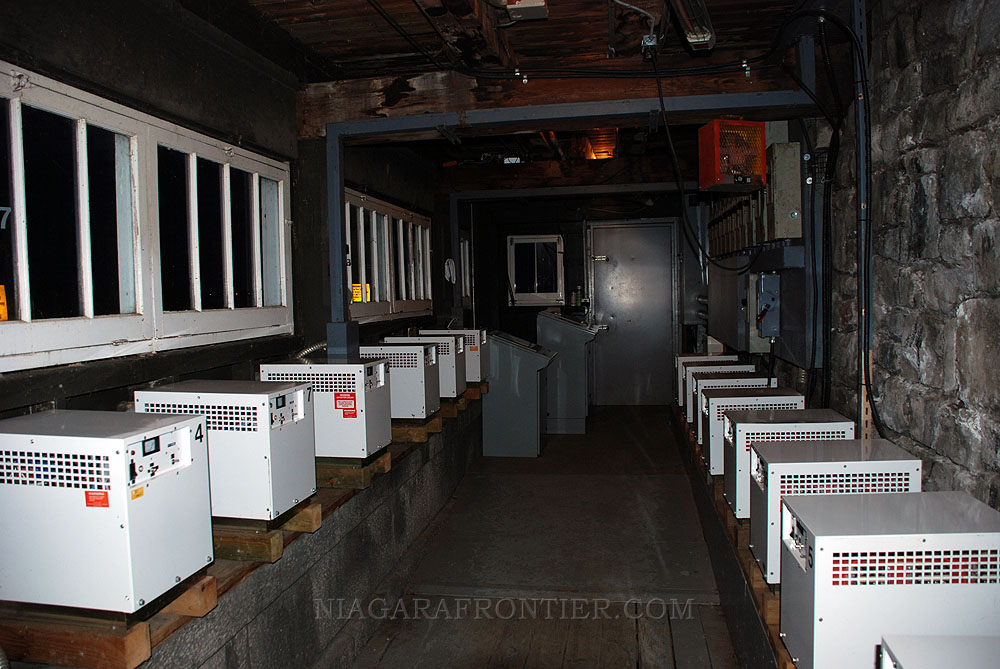
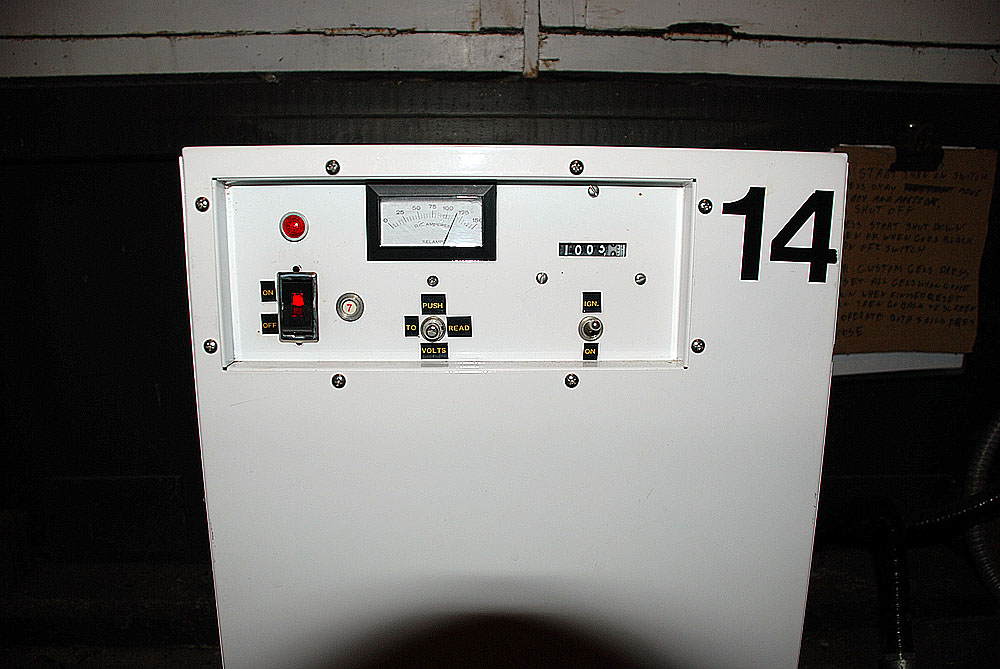
The Illumination Building Control Room
On May 25th 1925, the new lights mounted on the Ontario Power Company surge tank was lit for the first time. A Festival of Lights was planned to coincide with the official dedication of this light system.
The official ceremony took place on June 8th 1925. It included a light parade in Niagara Falls, New York followed by an International ceremony in the middle of the Upper Steel Arch Bridge before the lights were turned on to illuminate the Falls with many spectators looking on.
The twenty-four (24) spotlights were operated by a crew of three men. Colour gelatin films were manually slid into place in front of each light. Each light produced 55 million candlepower. The series of lights generated a total of 1,320,000,000 candlepower.
In 1951, the Niagara Falls Illumination Board negotiated a new cost sharing agreement to allow for the continued illumination of the Falls and lighting system upgrades. In this new agreements costs were allocated as follows:
Niagara Falls, New York pays 50%
Niagara Falls, Ontario pays 6.87%
Niagara Parks pays 25.55%
Ontario Hydro pays 17.58%
In 1953, the Niagara Falls Illumination Board was increased by two members. The new representatives were from the Niagara Frontier - New York State Parks Commission.
On June 20th 1958, twenty (20) new carbon arc lights were installed by the General Electric Company of Canada at a cost of $153,000. Ten lights were aimed at the Horseshoe Falls and five lights were focused on the American Falls. In addition, two lights were aimed at Goat Island and two lights were focused on the Upper Rapids. The new lights each emitted 4,200,000 candlepower generating a total of 84 million candlepower. The new system included white lights and a combination of fifteen possible colours.
Colors the Illumination lights use are white, red, amber, green, and blue.
|
September 13, 1957 Falls to Boost Its Illumination
Night visitors to Niagara Falls next year will see the cataracts
brightened by more than 4 billion candlepower. The Niagara Falls
Illumination Board today ordered 20 new lamps each with 210 million
candlepower. The lights will be delivered by the Amalgamated Electric Company of England at a cost of $153,000.
August 10, 1957 Board Plans to Replace Falls Lights The density of the illumination of the falls will double in the next few months under plans of the Niagara Falls Illumination Board. The 24 searchlights which have been used since 1925 will be replaced by modern lamps twice as powerful at an estimated cost of $100,000. The present lights cost $60,000 when they were installed 22 years ago. Each light is 55 million candlepower. Lamps of new design will be demonstrated by two companies on the night of September 5 following a dinner meeting of the Illumination Board. The board is headed by Calvin Keller, Mayor of Niagara Falls New York. Automatic changing devices for the colour medium and polished aluminum reflectors instead of glass mirrors are reported to be among the features of the new lights. The Illumination Board has a reserve fund of $50,000 for the replacement of the lights. The balance of the cost will be borne by Niagara Falls New York, the Niagara Parks Commission, and the city.
May 20, 1958 Eight of 20 New Lights Are Installed at Falls - 300% Boost in Illumination May 19th - installation work on a new bank of lights, which will increase illumination of the cataracts by more than 300% is more than half completed. Each of the 20 lights, which will total 210 million candlepower, have been installed in Queen Victoria Park here and another 8 were delivered in Toronto over the weekend. 17 new lights are being installed on a lower bank and three above. All are made in London England by the Amalgamated Electric Company, and shipped here via the St. Lawrence River and Toronto. The project will cost $153,000. Dedication ceremonies for the new lights have been scheduled for 10 pm on June 20th. High officials from Canada, the Province of Ontario, the United States and New York State have been invited to attend. The lights, 42 inches in diameter, will flood the Horseshoe Falls on the Canadian side of the border and the American Falls with 20 colour combinations. Each lamp has five colours built in which can be changed by a manual push button control. The lights will replace the present lamps which throw 55 million candlepower each on the two cataracts. The control of the lights is supervised by the Niagara Falls Illumination Board. Members include persons from Niagara Falls New York, and the city. Mayor Calvin L. Keller of Niagara Falls New York is the board chairman.
June 20, 1958 3000 See New Lights at Falls Amid pomp and circumstance, the much publicized Niagara spotlights flashed across the Niagara gorge tonight to illuminate the American and Horseshoe Falls. More than 3,000 spray-drenched visitors witnessed the historic event from the edge of Victoria Park. The 20 new lamps - triple the strength of the 24 old lights - were installed under the auspices of the Niagara Falls illumination Board. A series of American and Canadian dignitaries, speaking at dedication ceremonies, stressed the fact that the installation was a joint enterprise of the two countries.
Floodlights in Colour for Niagara Falls By our Industrial Staff - Manchester Guardian June 20th 1958 The new colour floodlighting system now installed at Niagara Falls will be switched on tonight. The system is entirely British and has been designed and supplied by the General Electric Company Ltd. of England, through its Canadian Associate Company, the Amalgamated Electric Corporation, Ltd. The £55,000 contract was won in September 1957, against strong American competition. In the new system 20-colour floodlighting projectors will be mounted on the Rotunda in the Queen Victoria Park, from where there is an unequalled view of the falls. The Canadian Horseshoe Falls, which are 2,600 feet wide and 1,700 feet from the Rotunda, are being illuminated by ten projectors; three more projectors light the Upper Rapids; two light the rock face at the base of Goat Island—which joins the two falls - and five projectors "throw" their light 3,000 feet to the 1,000 feet wide American Falls. The falls can be illuminated in fifteen different hues. The system was devised by G.E.C. Lighting Engineers working with the company's research laboratories at Wembley. It was first presented to the Niagara Falls Illumination Board in November 1956, by two representatives of the Amalgamated Electric Corporation. Early in the summer of 1957, representatives of the Niagara Parks Commission attended a large-scale working demonstration of a specially designed G.E.C. prototype Projector in a field near Stanmore, Middlesex. A distant hill, chosen for its topographical similarity to the falls at Niagara, was camouflaged, and smoke and water were used to represent the falls. A supply of smoke bombs was obtained from the producers of the film "Dunkirk,' and from Merchant Taylors' School Combined Cadet Force, and an 80 foot column of water was supplied by hoses from a number of the company's fire brigades. The Prototype projector and colour change mechanism was demonstrated in Canada in September 1957. The high-current density carbon-arc was chosen by the company as the most effective light source for flood-lighting the falls. The colour for each projector is selected by an operator seated at a remote control console in view of the falls.
|
On September 1st 1984, a new cost sharing agreement among the members of the Niagara Falls Illumination Board was signed. The new agreement stipulated that the cost of power used by the board be paid by Ontario Hydro (Ontario Power Generation) and deducted from any total operating budget and the balance be divided equally among the following four participating agencies namely the:
City of Niagara Falls, New York
The Niagara Parks Commission;
The Niagara Frontier State Park Commission;
City of Niagara Falls, Ontario.
In 1990, the Niagara Falls Illumination Board was incorporated. An amendment was
also made to an earlier agreement related to the membership of the board to
include Ontario Hydro (now known as Ontario Power Generation) as a member with
equal representation and financial responsibilities.
Today this illumination project continues to be administered and funded by a five member International Board known as the Niagara Falls Illumination Board Incorporated. Board members currently consist of representatives from:
the City of Niagara Falls Ontario
the City of Niagara Falls New York
The New York State Office of Parks, Recreation and Historic Preservation
the Niagara Parks Commission
Ontario Power Generation (Niagara Group)
Each member of this group of five contribute approximately $39,000 per year to fund the yearly illumination and to save for future lighting replacement/improvements.
In 1970, three (3) Xenon lights were installed on the lower river bank to illuminate the Bridal Veil Falls (Luna Falls).
In 1974, eighteen (18) Xenon gas spotlights were put into use. Each light is 30 inches (76cm) in diameter and each generate 250,000,000 candlepower.
In 1979, three Xenon lights were positioned just south of the Canadian Niagara Power intake and shine on the plume of mist from the Falls. Currently, these three lights are no longer utilized since area hotels complained of the lights shining into nearby hotel rooms.
A battery of three Xenon lights were built to shine directly on the American Falls from a location along the Ontario Power Company access road on the Canadian shore. Both satellite locations are operated by remote control.
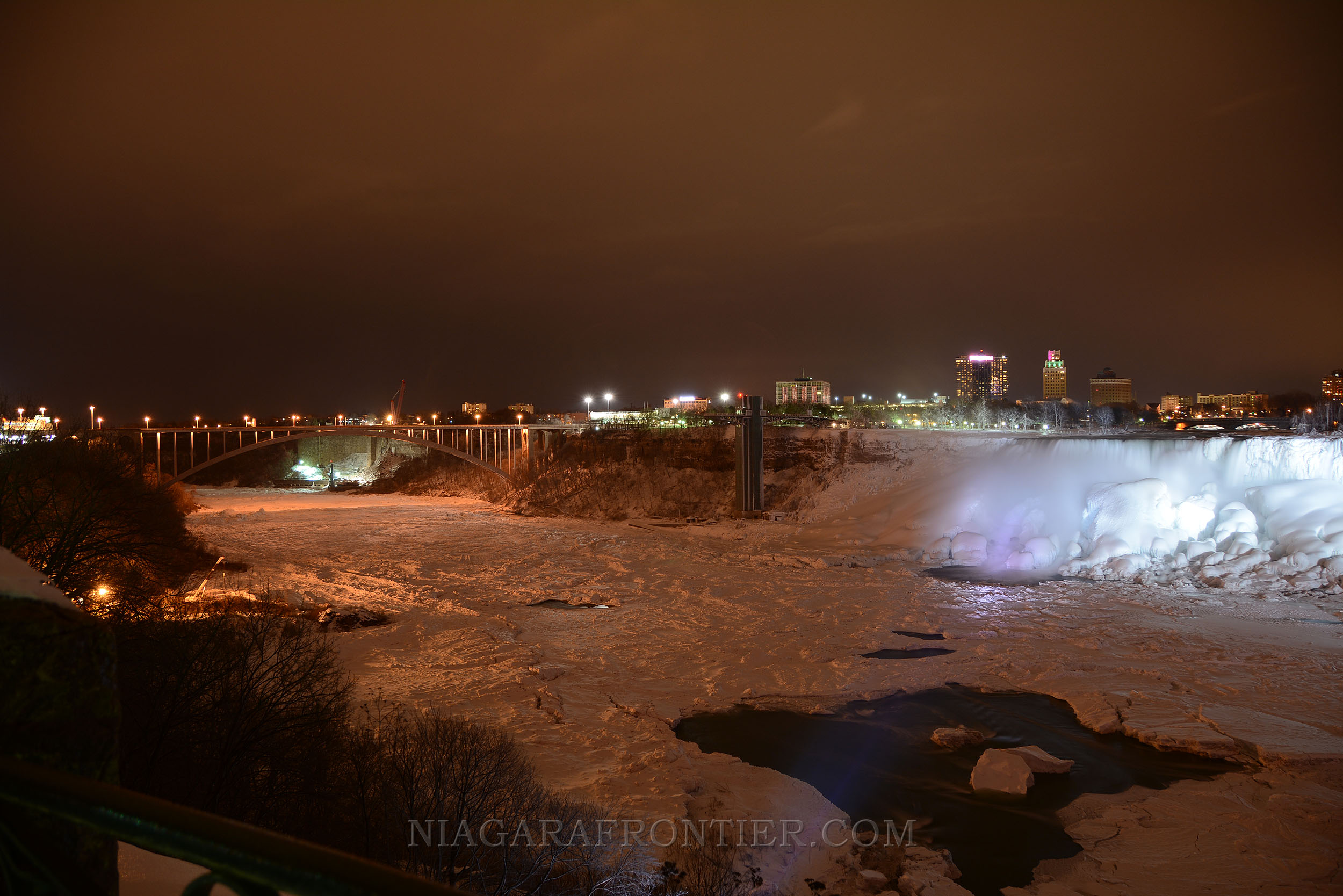
Great Gorge Ice Bridge
at Night
Niagara Parks
By the mid 1990's, the Illumination Lights were in need of a modernization overhaul. Complaints had been received that the current lights were too weak and ineffective to properly illuminate the Falls.
In 1995 the Niagara Falls Illumination Board hired lighting expert and consultant, Linus MacDonald to redesign and improve the illumination of the Falls. MacDonald was the lighting engineer for CFTO Television in Toronto a part of the CTV Television Network. In this capacity, Linus was responsible for the special effects lighting for earlier television productions covering the New Year's Eve party in Queen Victoria Park broadcast on the CTV Network.
Linus MacDonald redesigned, retro-fitted the aluminum light projection shells and installed a new, efficient and modern lighting system that continues in service today.
MacDonald selected the OSRAM 4,000 watt lamp bulb because it was best suited to highlight the illumination of the Falls. Although OSRAM builds bulbs up to 10,000 watts which would turn the night time waterfalls into daylight, there wouldn't be the ambience and colours that goes along with the softer illumination. According to MacDonald there is a stark contrast between lighting the Falls and Illuminating the Falls. Lighting the Falls would be much brighter and harsher and much less photogenic and eye appealing. Interestingly, the current intensity of illumination was specifically chosen to be far superior than it's predecessors yet more photogenic and eye appealing. The current illumination configuration is best viewed from a distance rather than close-up in order to obtain the best possible visual impact.
The center of the Horseshoe Falls is not illuminated because of the waterborne mist that rising from the base of the falls, high into the air above. The water molecules of the rising mist form an impenetrable wall that reflects the light and does not allow the light to penetrate to the waterfalls behind it.
As part of a 1997 upgrade, work began in the Spring to replace old illumination lights with a new 21 light system that will allow 60 - 70 percent more illumination. At a cost of $150,000, the first ten lights were replaced during that year. The new lights use only 4,000 watts - low voltage illumination lights generate an enormous 8.2 billion candlepower. Each bulb is rated at 1,100 hours or one season and cost approximately $1,400 each to replace. The lamp bulbs are supplied by OSRAM GmbH of Germany, one of the world's leading lamp manufacturers. OSRAM produces state-of-the-art lighting solutions that light up people's lives all over the world. The new lamps produce twice as much light as the previous lighting installations and consume 10 per cent less power.
The remaining eleven lights were replaced in 1998. The old lights were to be sold or used for spare parts.
In December 1997, five more lights were replaced with the much brighter and more economical new lights.
The illumination lights have operated continuously since their inception in the late 1800's till now. Throughout the years there have been only several interruptions. During periods of WWI & WWII the illumination lights were not turned on. The other interruption occurred in January 1938, when a major ice jam shut down the Ontario Power Company Generating Station at the base of the gorge. The lights remained off until the power station resumed operations.
Today illumination of the Falls of
Niagara occurs every night throughout the year.
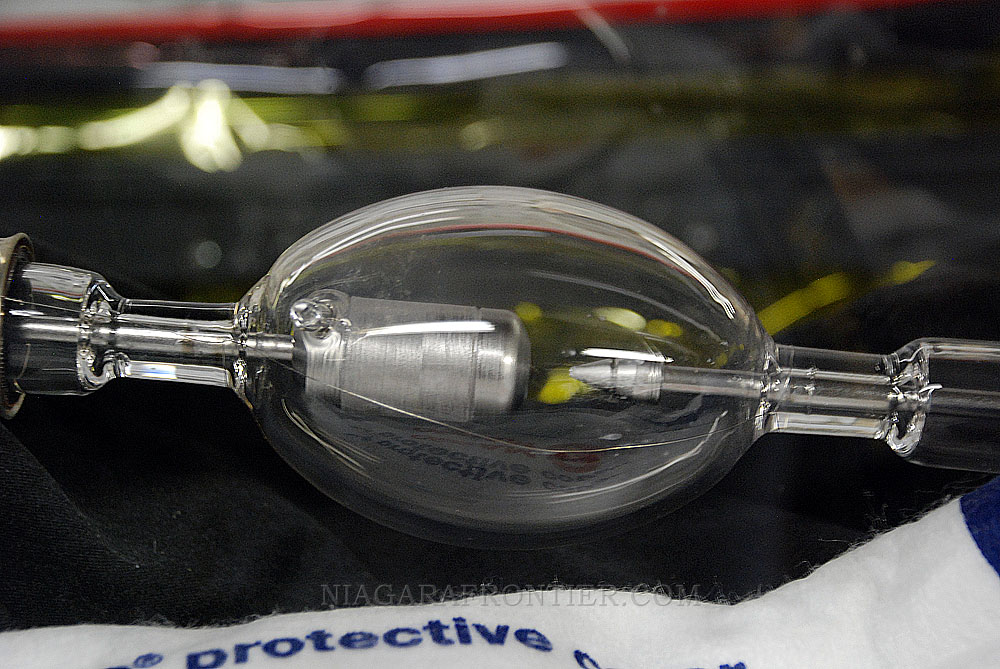
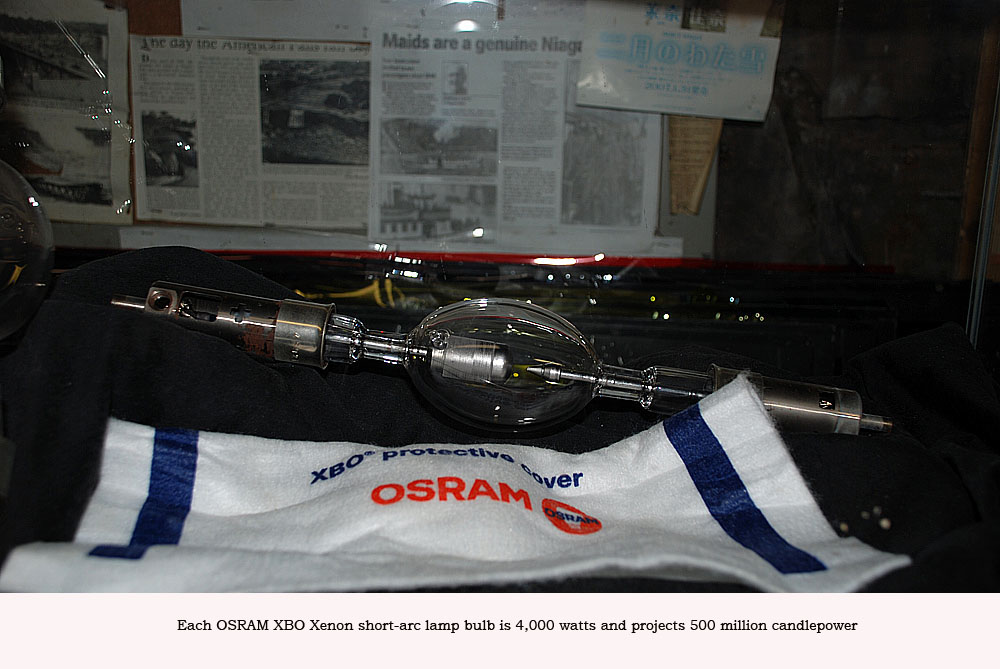
The Osram Xenon Light Bulb
used to Illuminate the Falls
each bulb is 4,000 watts and project 500 million candlepower
Linus MacDonald continues to maintain all the lights that illuminate the Falls of Niagara each and every night.
Each of the Osram Xenon Light Bulbs used to Illuminate the Falls are replaced yearly and have lasted 1,300+ hours. Each 4,000 watt bulb must be handled with extreme caution and only by an expert. The internal pressure within each lamp when cold contains 7½ times the normal atmospheric pressure and when hot, the pressure within the lamp exceeds 14 times the normal atmospheric pressure. These internal pressures make the lamps extremely explosive and dangerous to handle. When handling the lamps, MacDonald using a factory felt like wrapping when carrying the lights. The wrapping is designed to limit the high velocity shards of glass if the lamp breaks while being handled or repaired. In addition, MacDonald wears a ballistic vest and full face protective shield while working with the lamps.
The Niagara Falls Illumination Board currently employ two operators on staff to conduct the nightly illumination of the Falls. The light show is controlled by a single operator, who by remote control changes colour of the lights by changing the combination of the coloured gelatins in front of each light. The standard colour of each light projector is white.
The entire operation is run from a small control panel in an elongated room overlooking the illumination lights with a vista of the American Falls and Horseshoe Falls. The operator will change the lights every five to ten minutes.
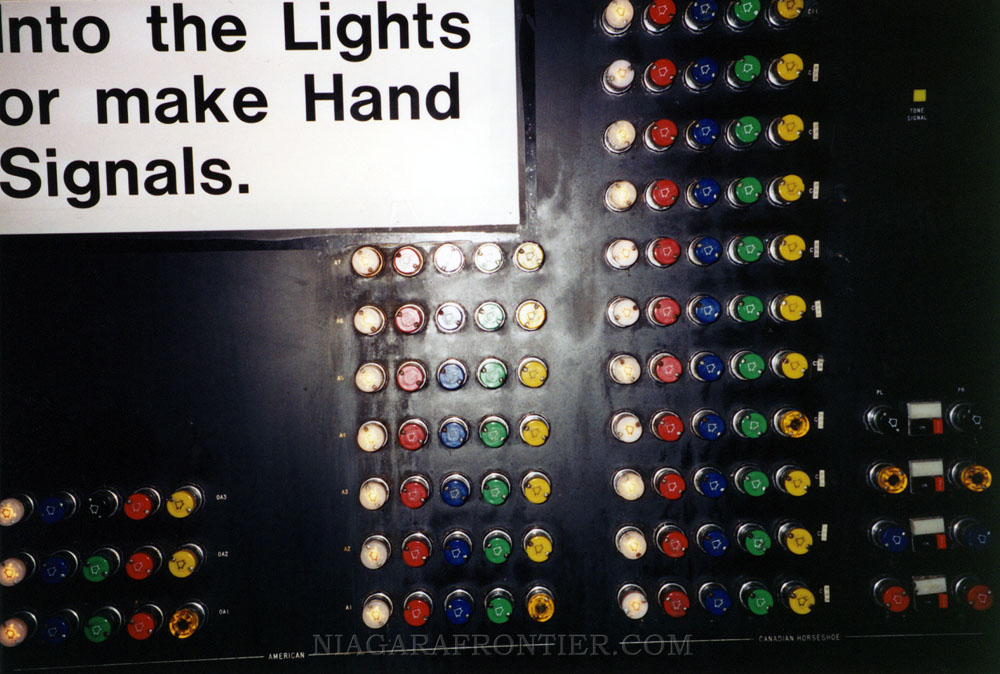
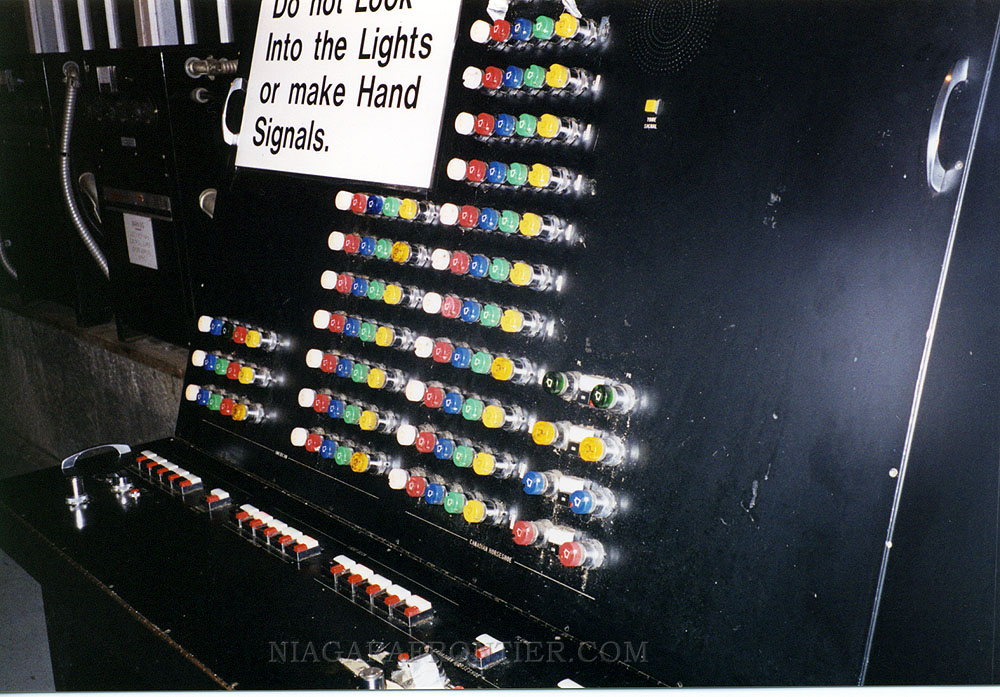
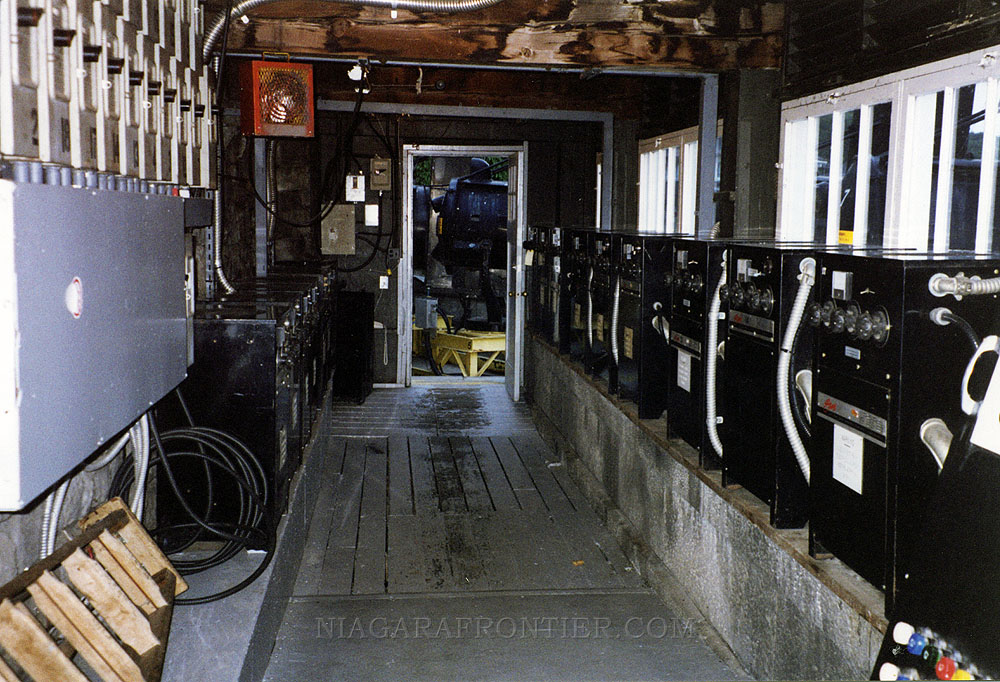
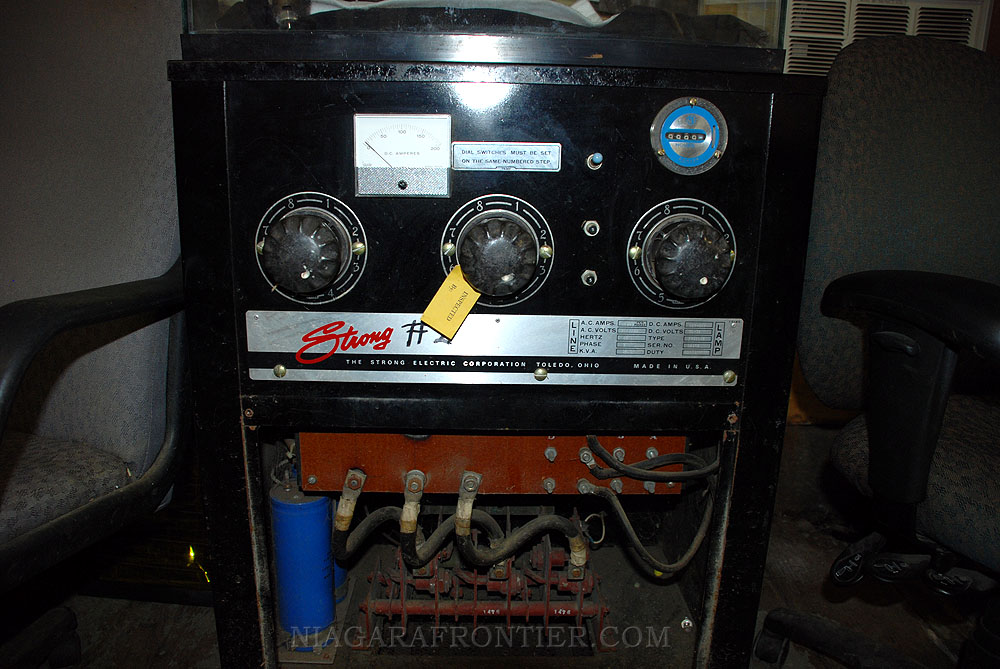
The Old Control Panel and Rectifier
Until the autumn of 2009, the operator changed the light colours by manually turning a series of four colour coded (red, blue, green, yellow) round shaped toggle switches for each of the twenty-one lights. With each turn of any of these switches, a large coloured panel (or any combination of the four panels) housed in the section above the actual light drops down in front of the lights or rises as the case maybe in order to create the rainbows of colour shining upon the Falls.
In late 2009, the rectifier/control room was modernized. New modern and much smaller rectifiers were installed. These rectifiers are used to transform alternating current to direct current for the light projectors. The former light control panel was replaced with modern computerized "touch screen" activated screens. Touching the colours on the new computer screens automatically changes the gelatin colour panels in the light projectors.
The four primary gelatin colour panels (red, blue, purple, amber) are secured to 4 feet by four feet square metal panels within each projector light. A mixing panel allows the operators to mix a combination of one or more colour gelatin panels creating additional colours of green and orange. It takes less than 15 seconds to change the colour of any light. The gelatin colour panels are replaced approximately four times a year and cost about $25 each.
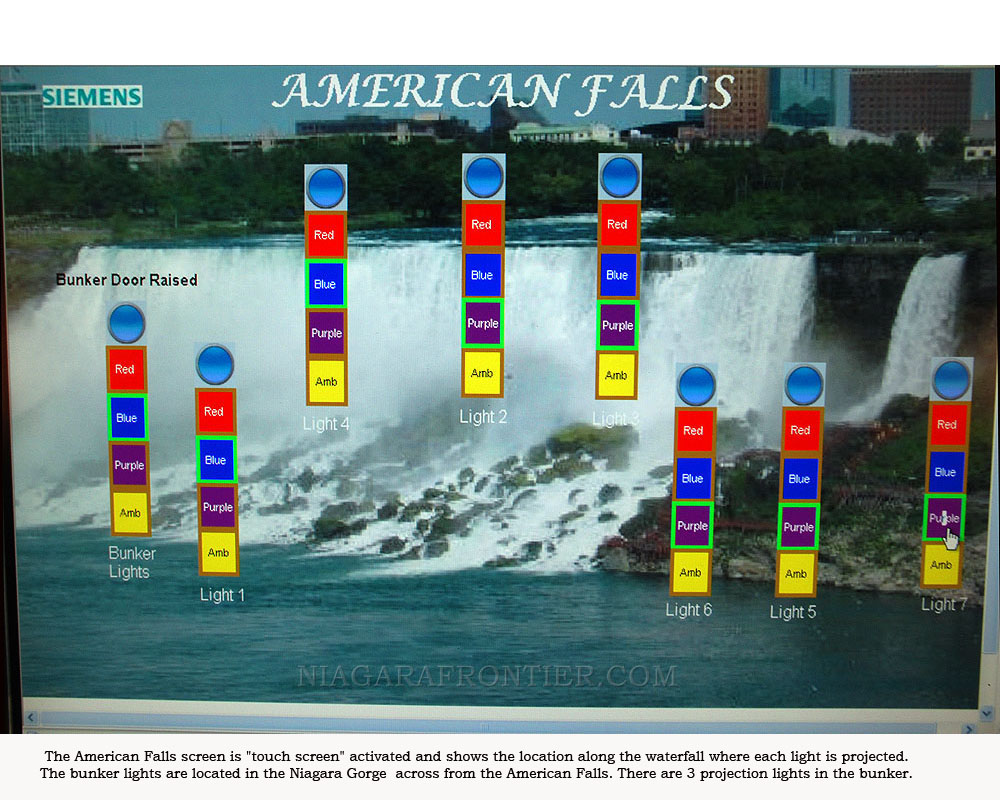

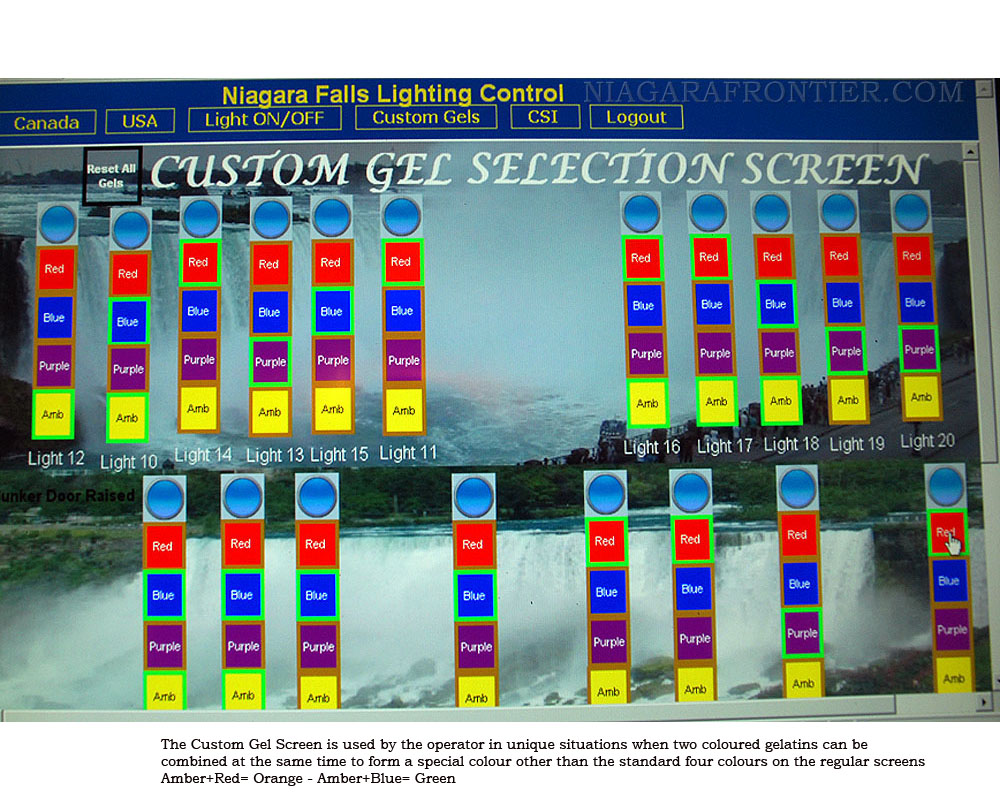
The new computerized "Touch Screen" activated projection light control panels
There is no automated program that dictates the colour sequences that shine upon the Falls. The operator working creates the kaleidoscope of colours by calling upon their experience and artistic talents.
The operator also controls a battery of three Xenon lights by remote control, that were built to shine directly on the American Falls from a location along the former Ontario Power Company access road on the Canadian shore.
Power is supplied by the City of Niagara Falls (Ontario) Hydro Commission. It is estimated that the cost of illuminating the Falls including the services of an operator is approximately $85 per hour.
|
October 24th 2014 Niagara Falls Illumination Board Issues RFQ to Examine Enhanced Lighting of the Falls
December 4th 2014
April 2015
May 1st 2015 Peter Gordon Retires
June 2015 Companies Bid on Light Contract In June 2015, there were seven companies on a world-wide basis still vying to become the contractor of choice for the new Niagara Falls Illumination contract. All the companies thus far are working on LED light concepts to light up the Falls of Niagara rather than the current Xenon bulbs. The LED lights would be required to have twice the output of the current illumination lights. At this point in time, there is no current LED system in existence so that perhaps the future of illumination of this type has yet to be invented. As time goes on the current supply of Xenon bulbs become more and more scarce to locate and hence much more expensive to purchase.
February 2016
|
|
Past & Present Light Operators Charles Male
|
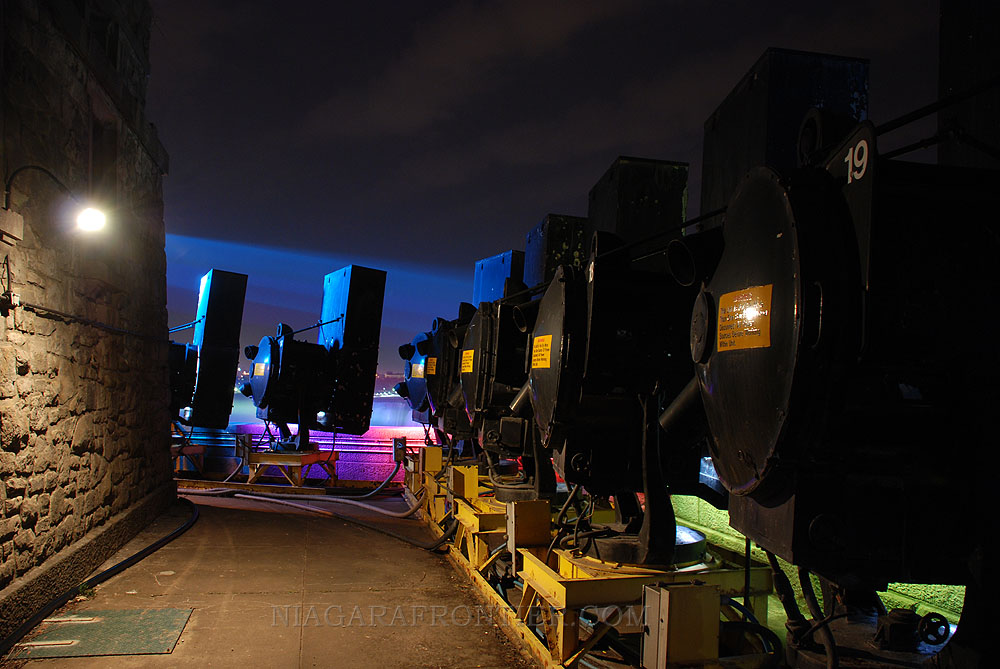
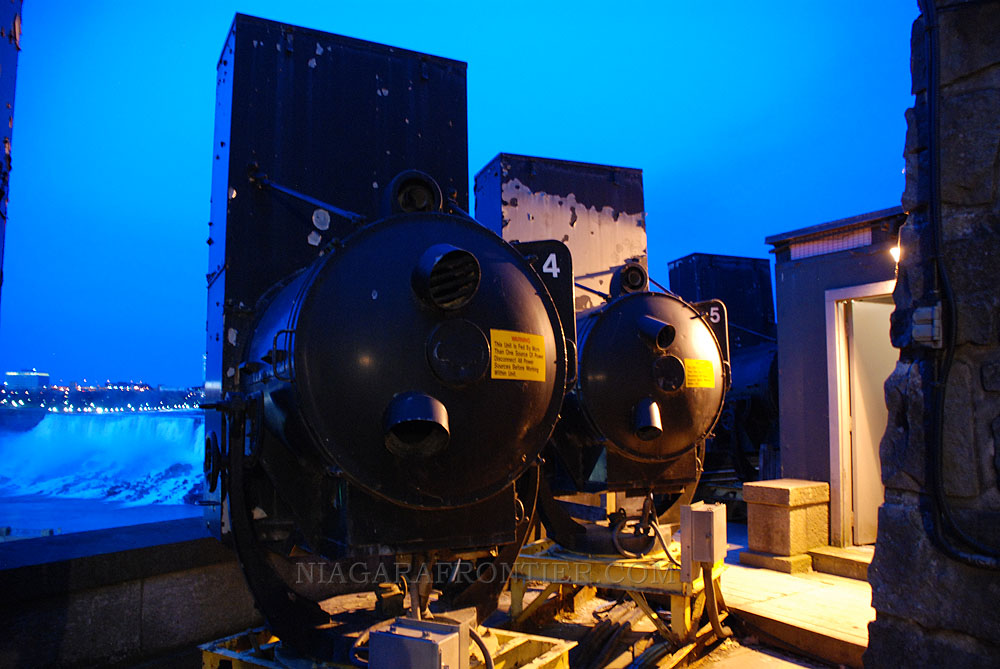
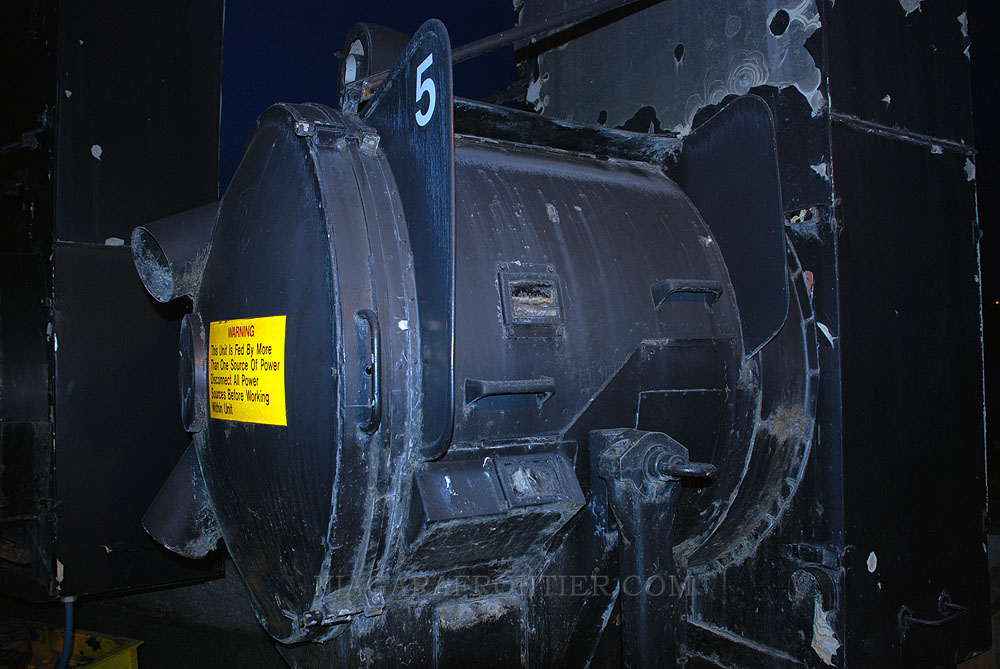
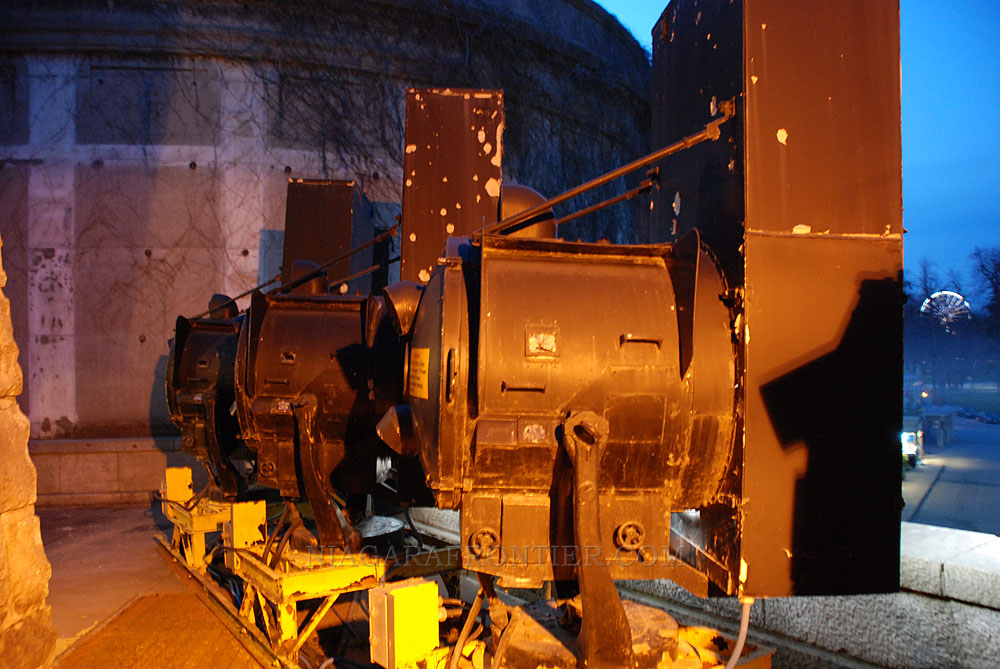
The
Illumination Lights Battery
ILLUMINATION SCHEDULE |
date |
hours |
| January 1st - January 31st | 5:00 p.m. - Midnight |
| February 1st - February 28th | 6:30 p.m. - 11:00 p.m. |
| March 1st - March 7th | 7:00 p.m. - 11:00 p.m. |
| March 8th - March 31st | 8:30 p.m. - 11:00 p.m. |
| April 1st - April 30th | 8:30 p.m. - 11:00 p.m. |
| May 1st - August 13th | 9:00 p.m. - Midnight |
| August 14th - September 30th | 8:30 p.m. - Midnight |
| October 1st - October 31st | 7:00 p.m. - Midnight |
| November 1st - December 30th | 5:00 p.m. - Midnight |
| December 31st | 5:00 p.m. - 1:00 a.m. |
| During the month of March and April the Illumination of the Falls is extended until Midnight every Friday, Saturday and Sunday | |
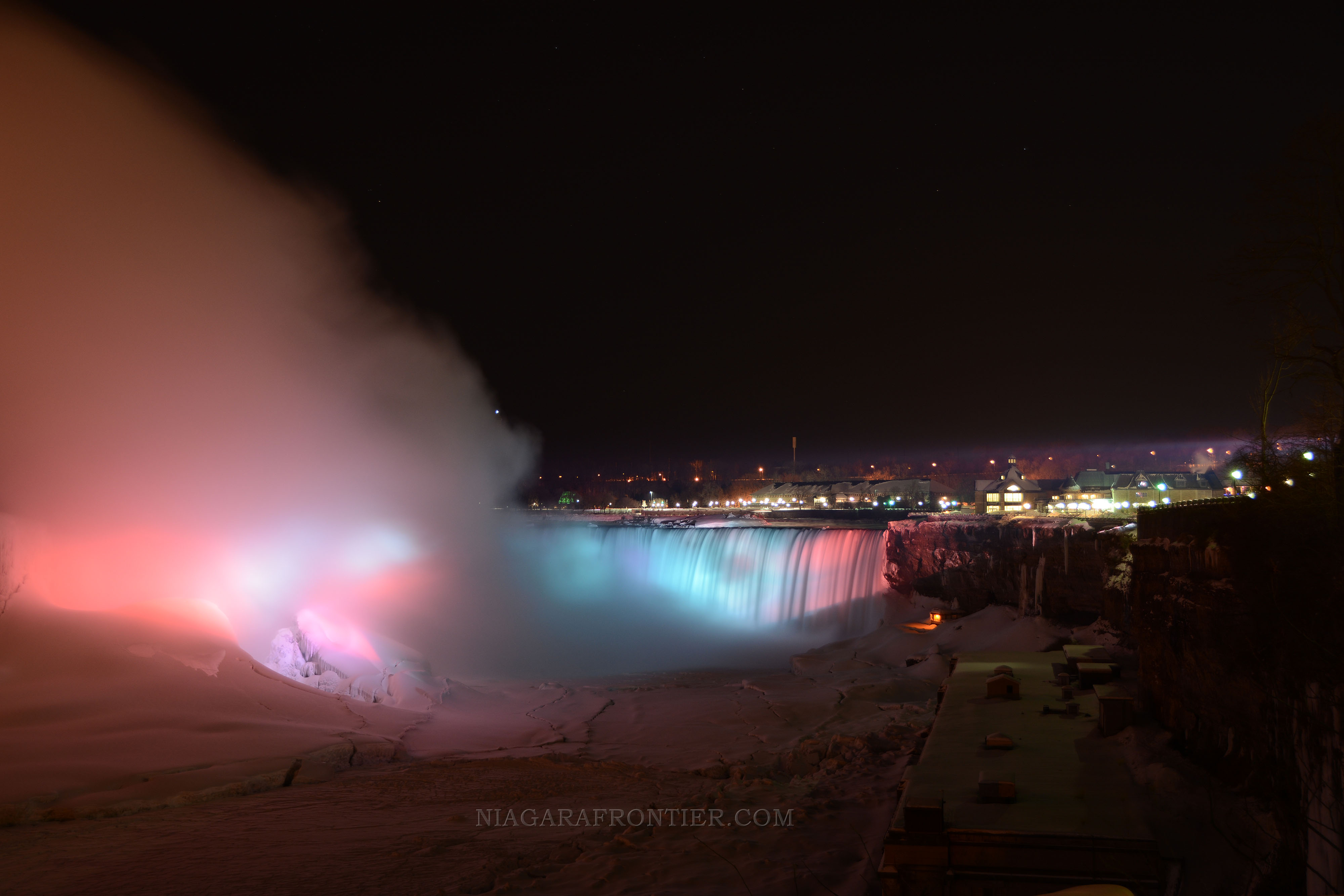
Table Rock & Horseshoe Falls Illuminated
March 3rd 2014
Niagara Parks
| NIAGARA FALLS THUNDER ALLEY NAVIGATOR | ||
| SITE MAP | ||
Date last updated:
January 31, 2017
THANK YOU FOR VISITING THE
ILLUMINATION OF
NIAGARA FALLS
PAGE