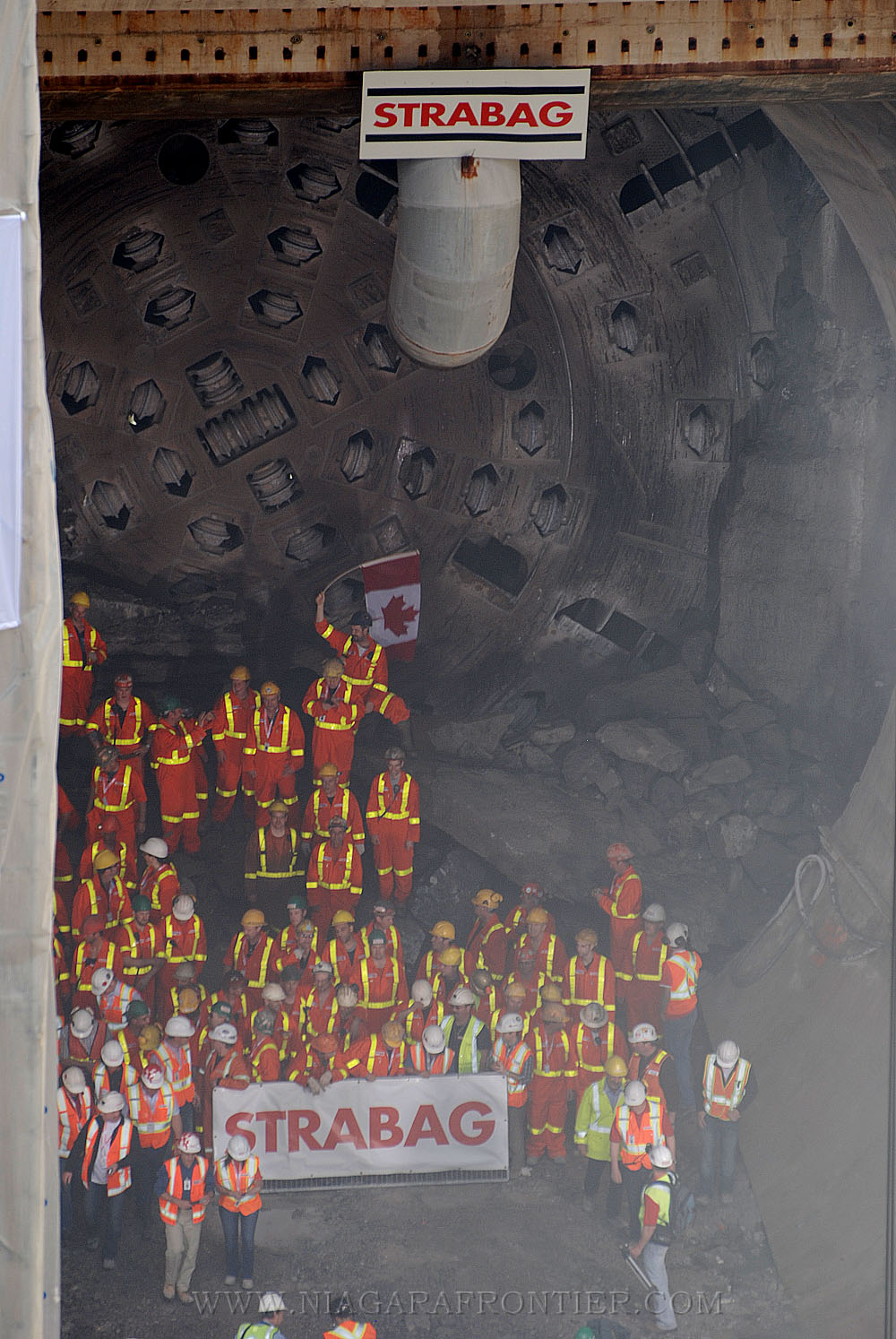
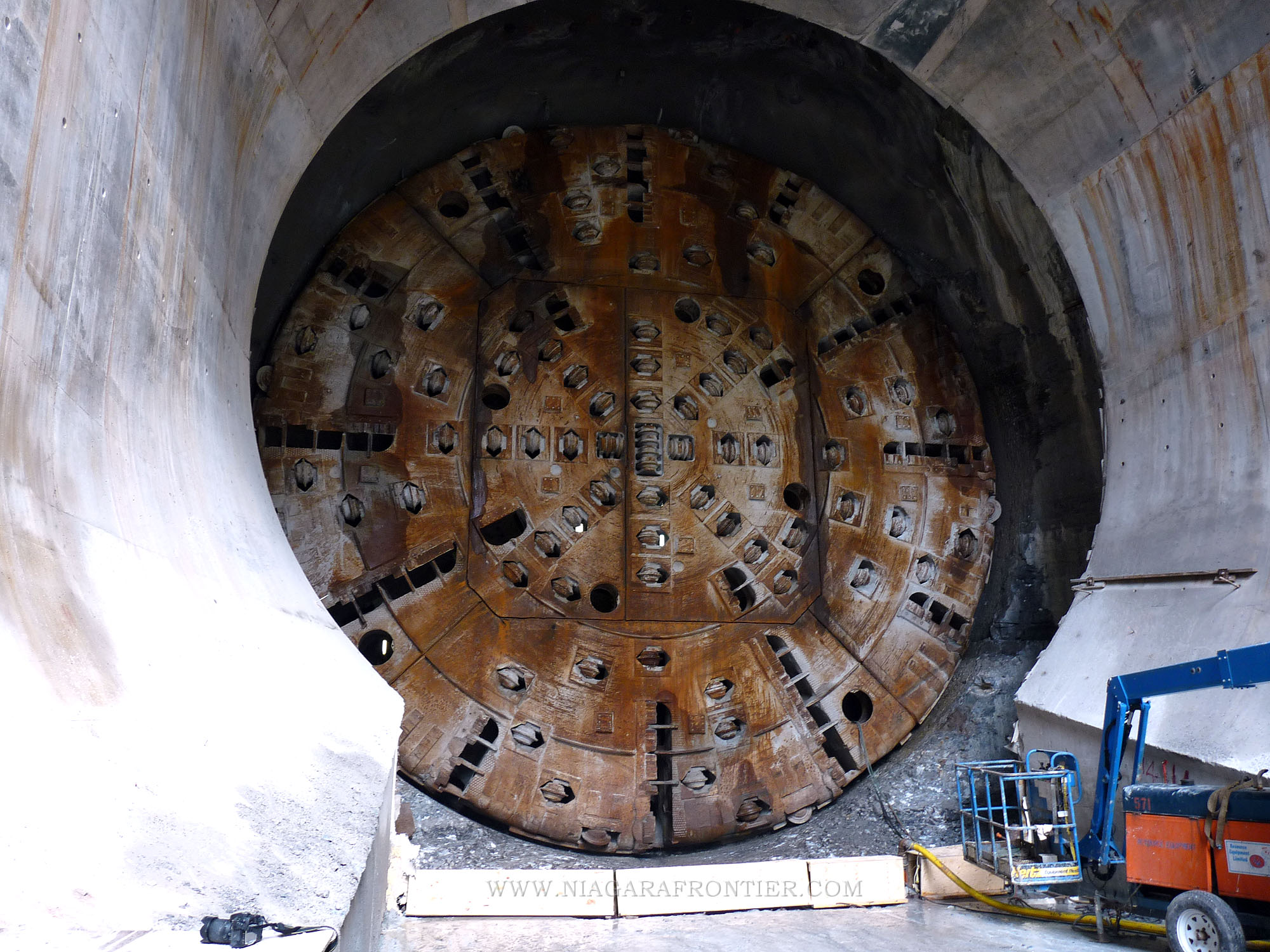
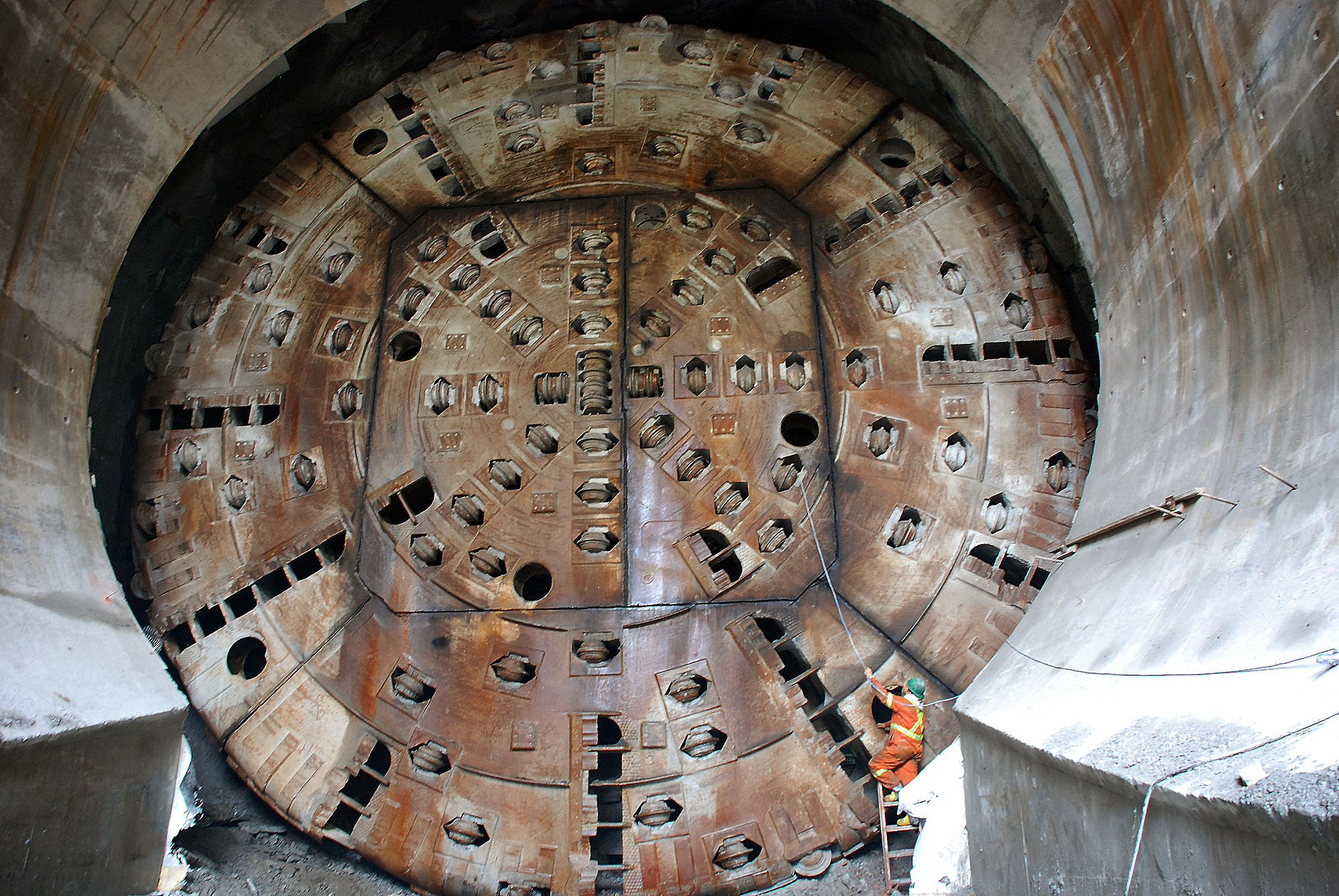
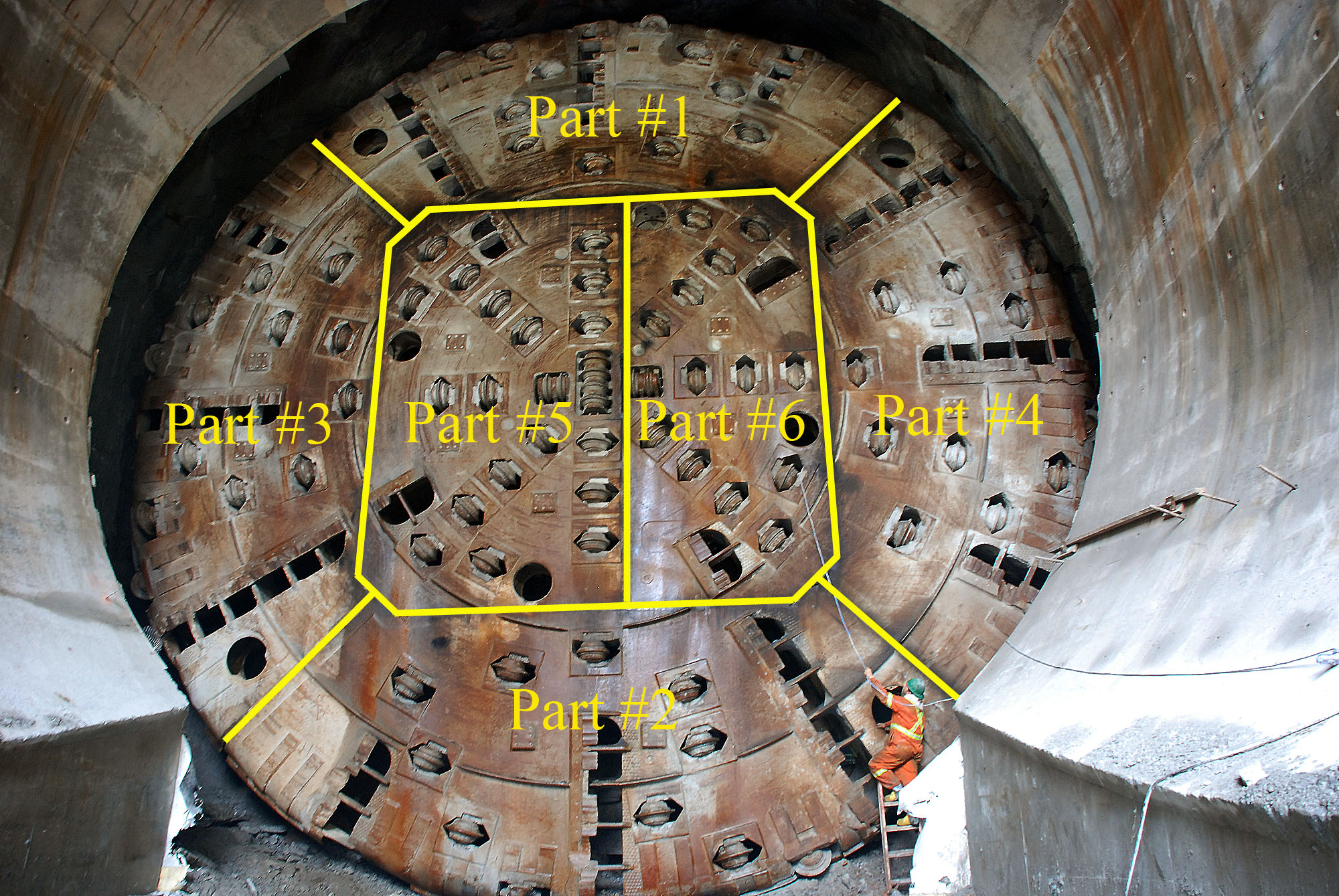
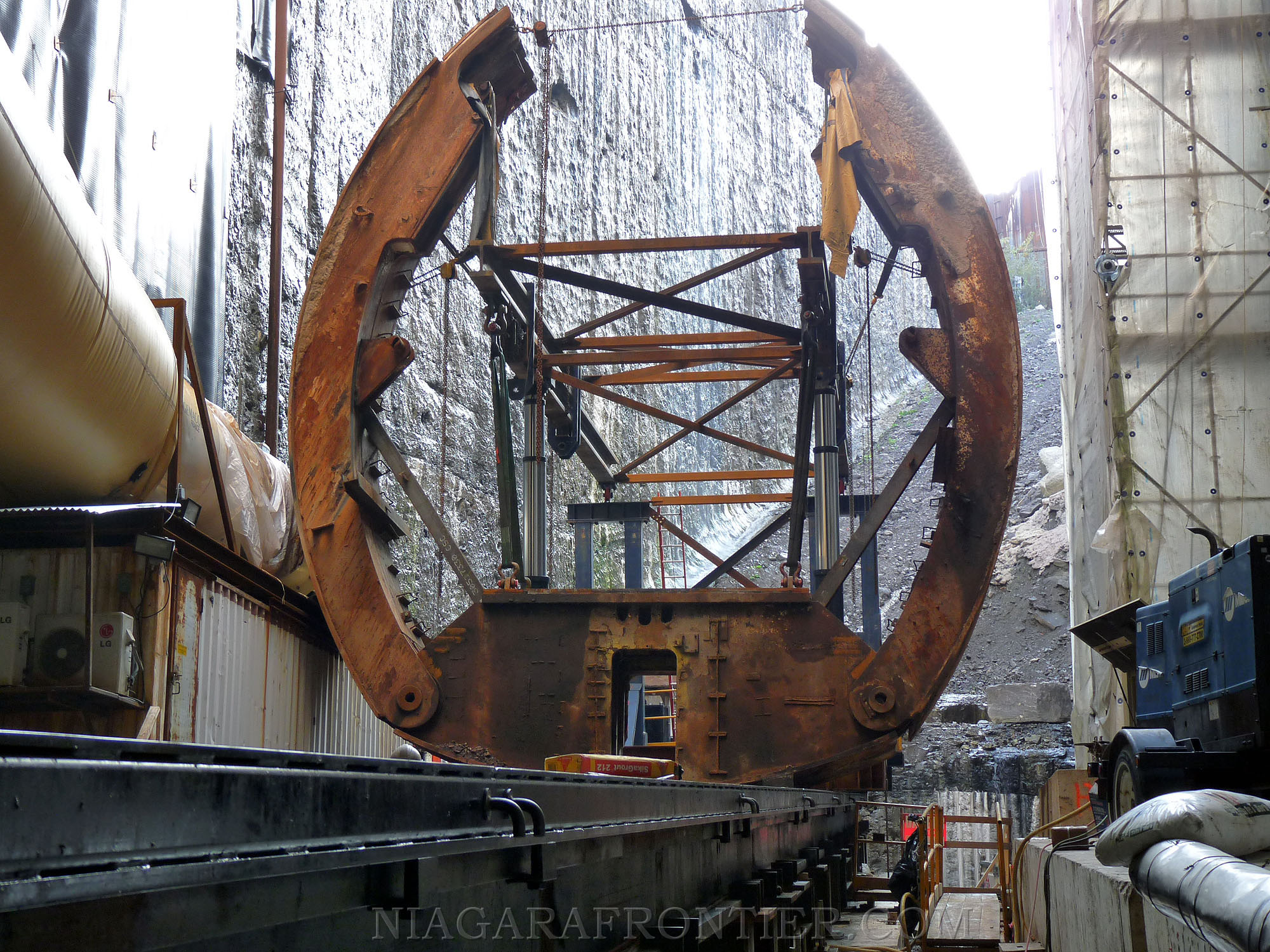
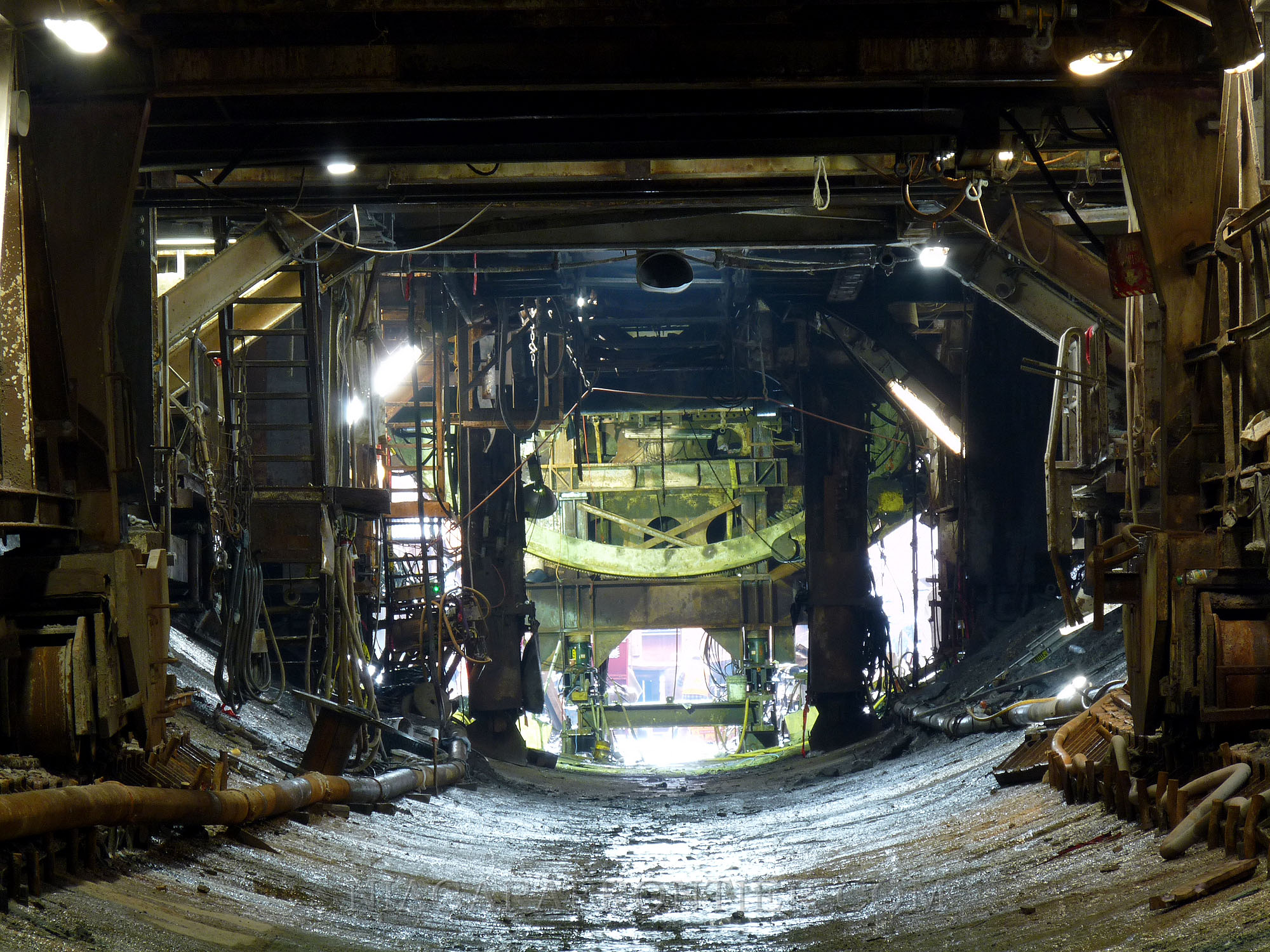
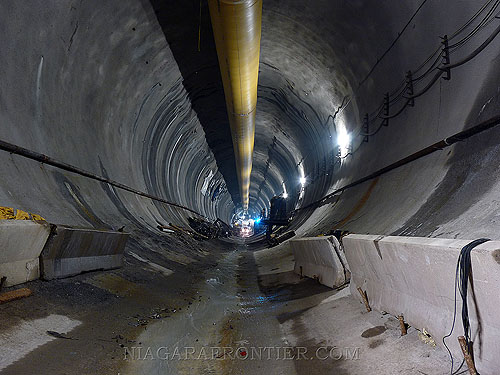
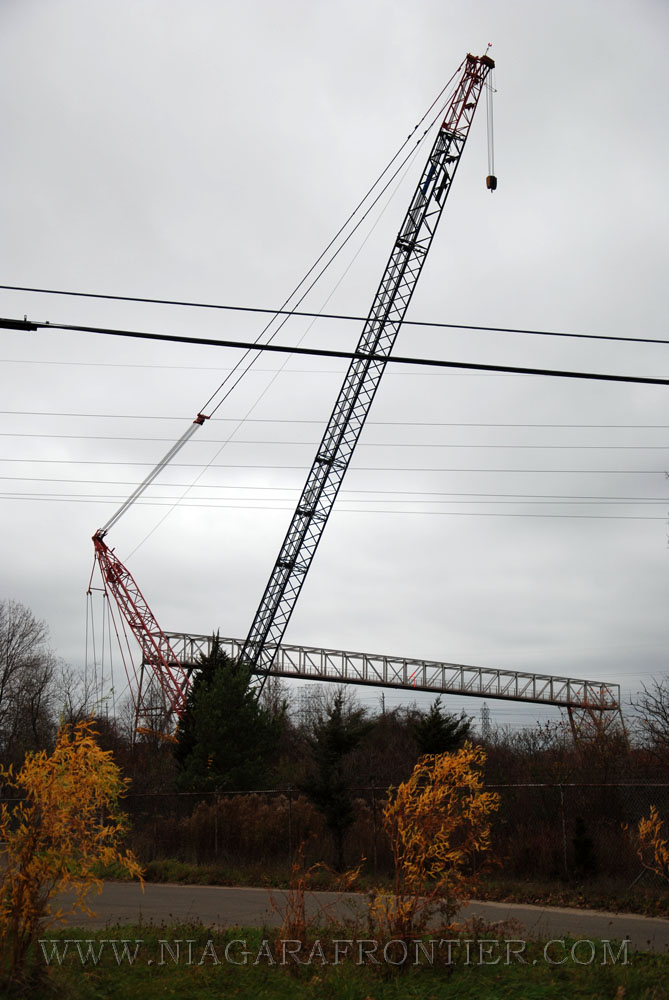
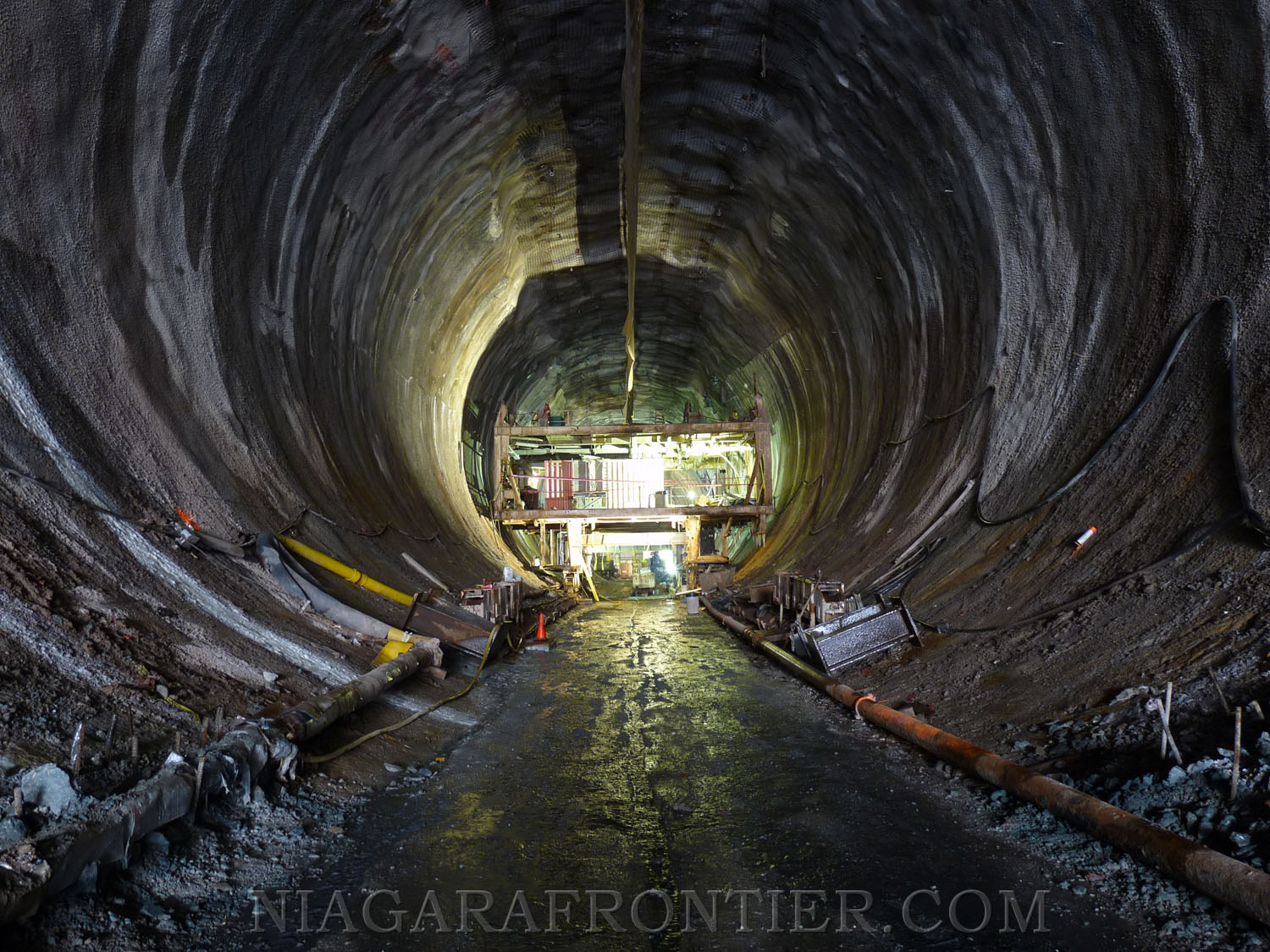
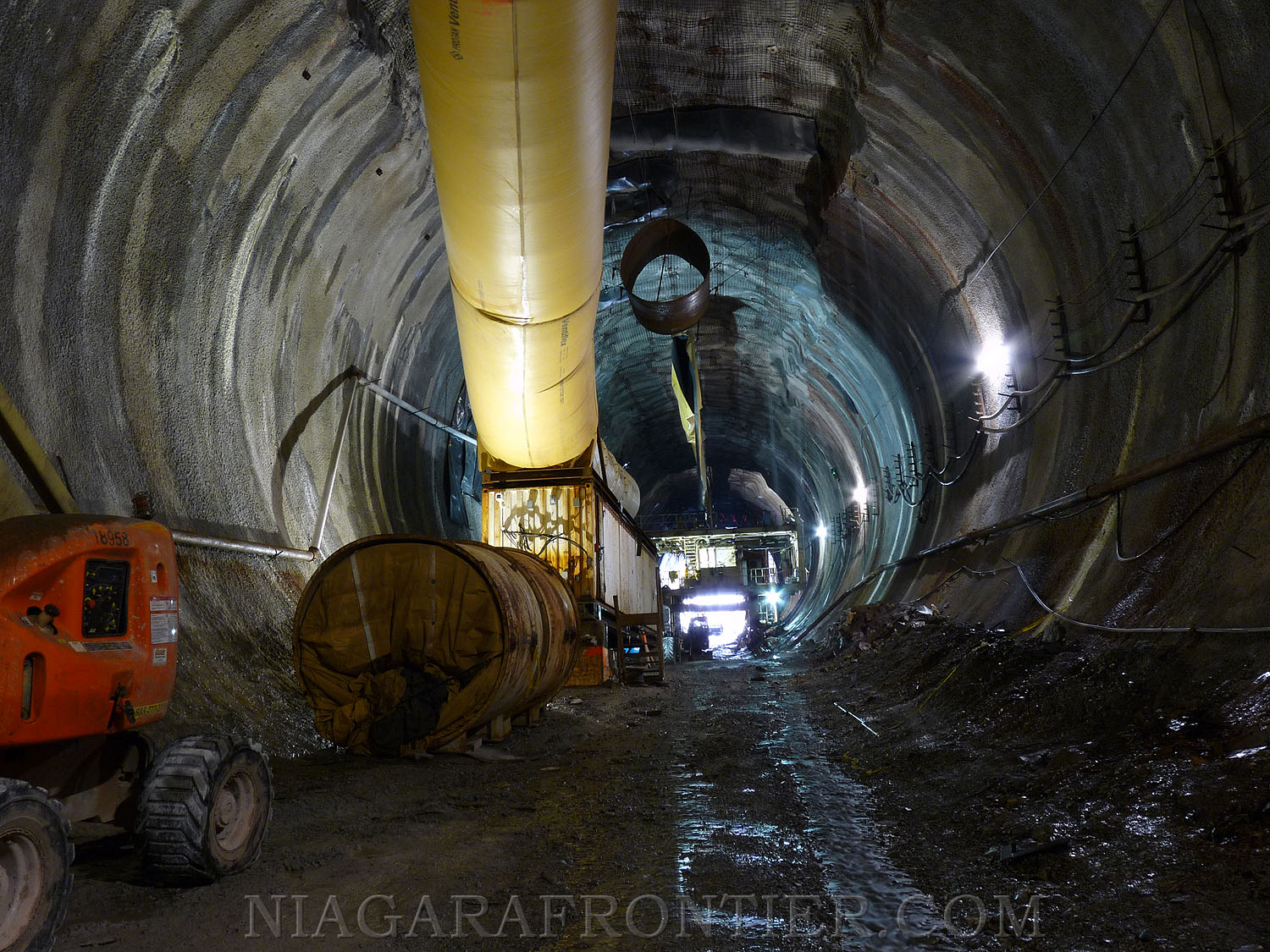
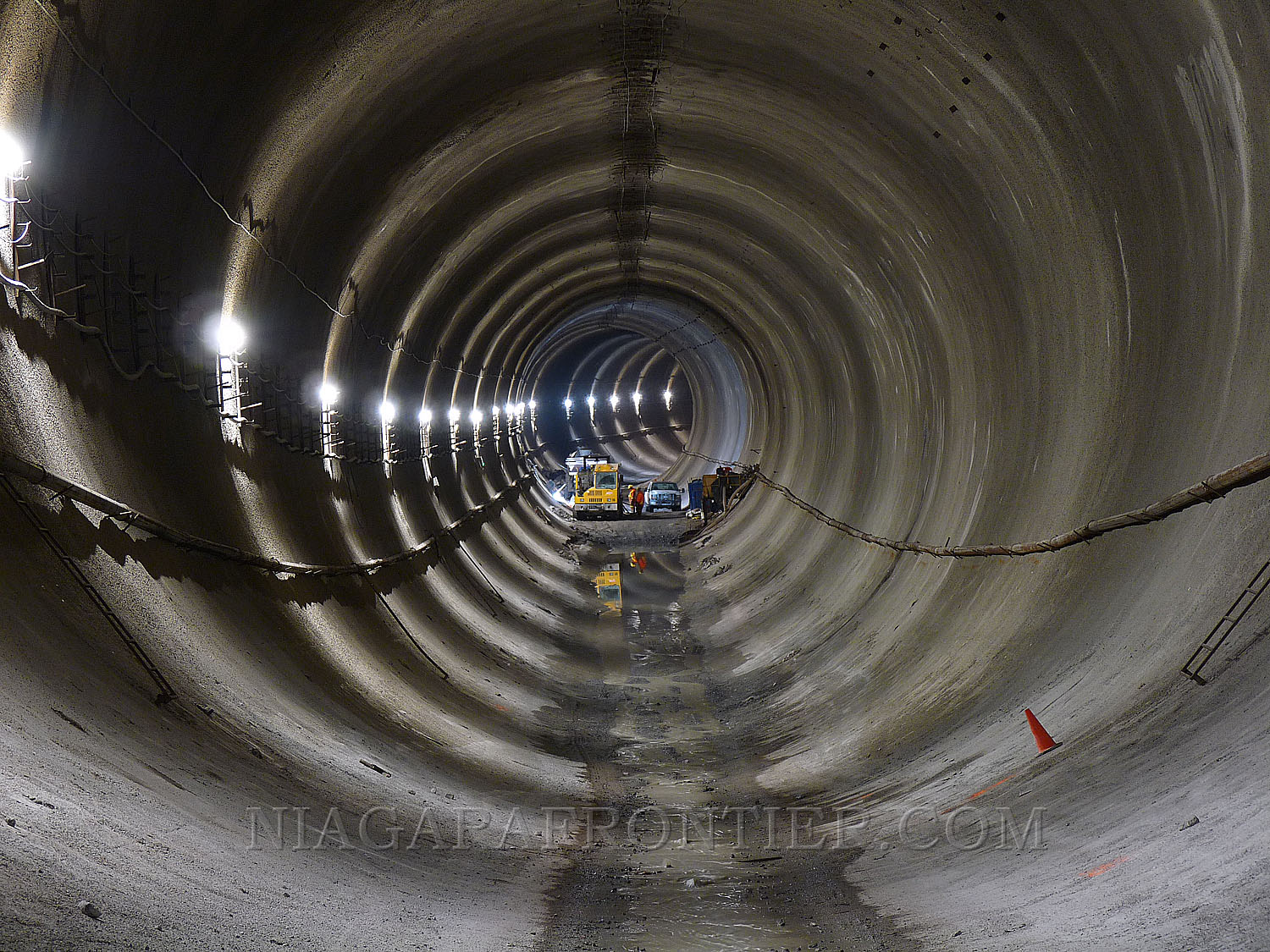
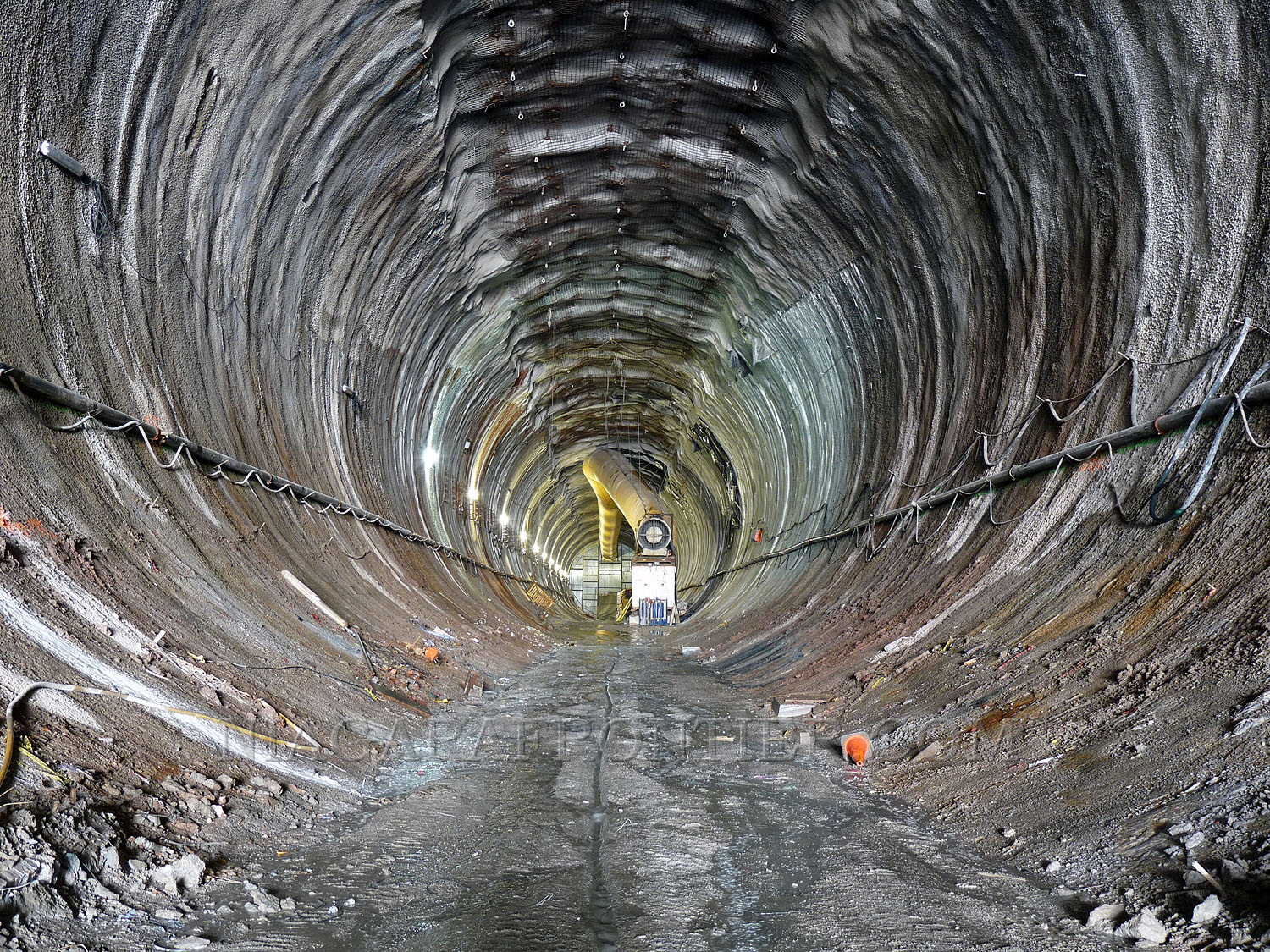
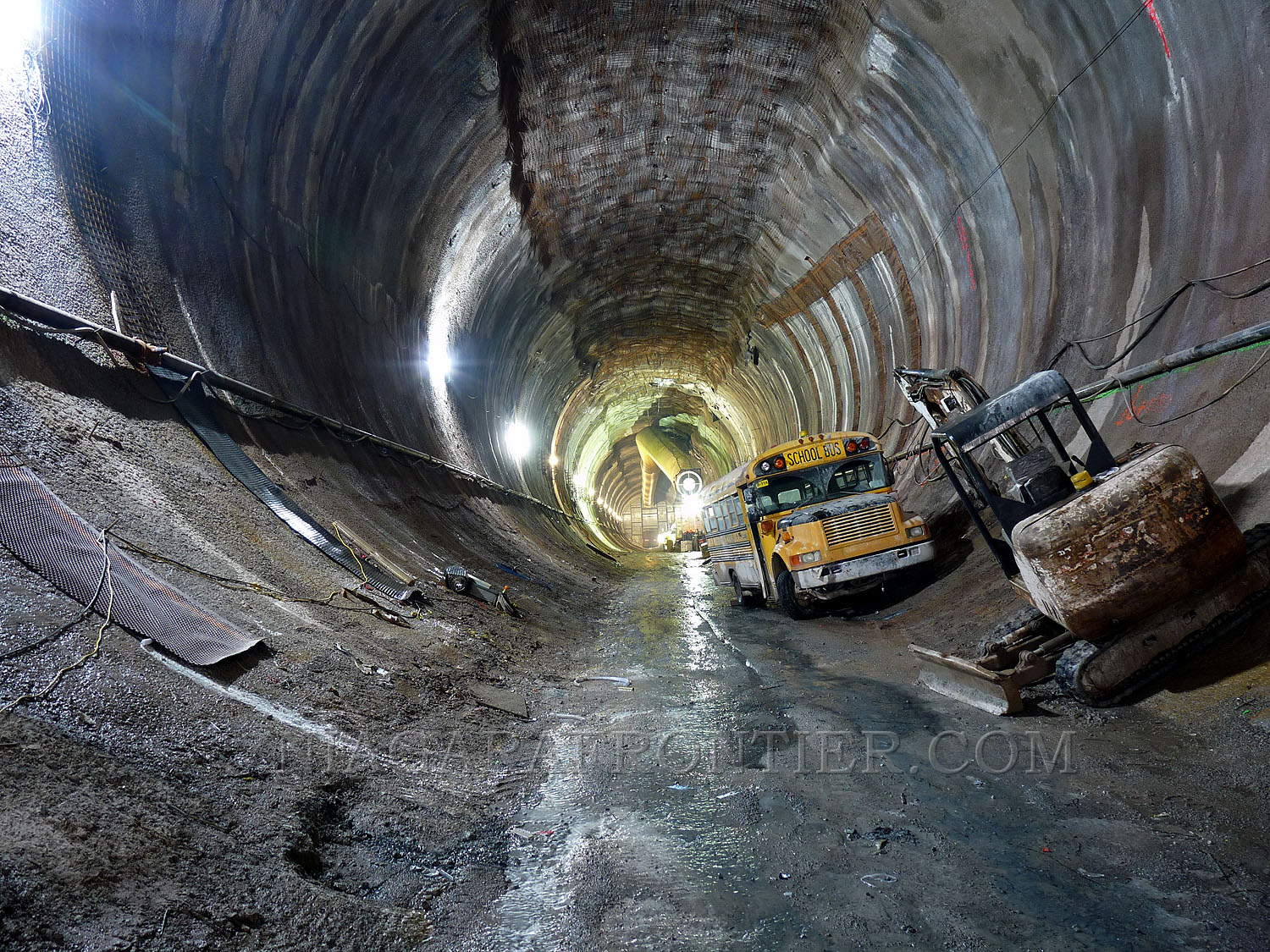
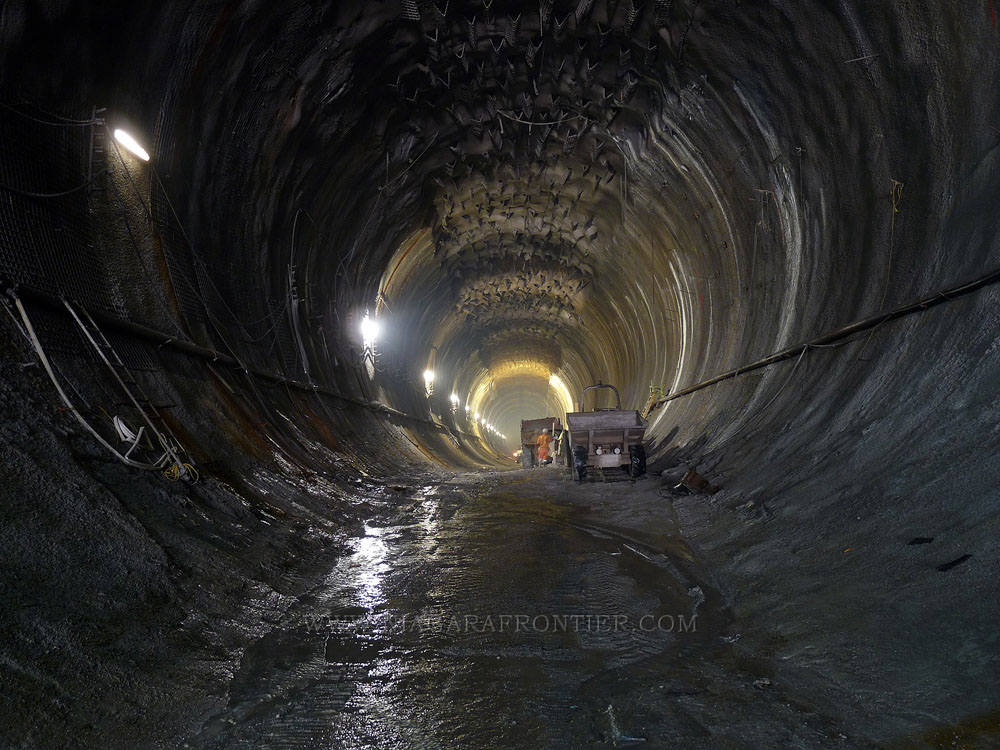
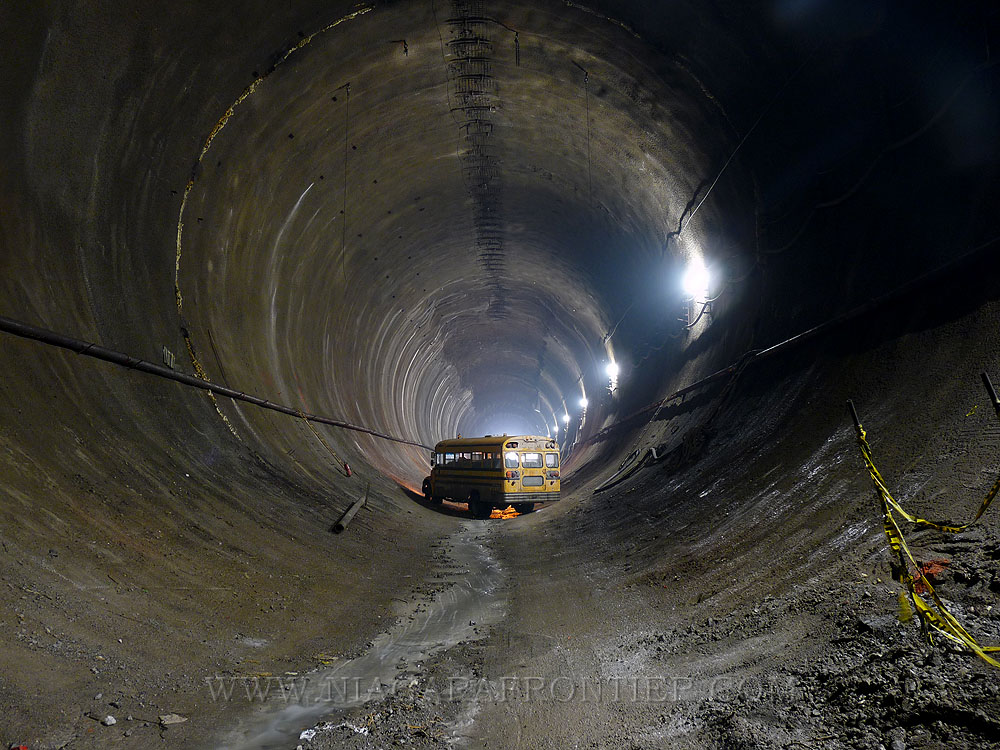
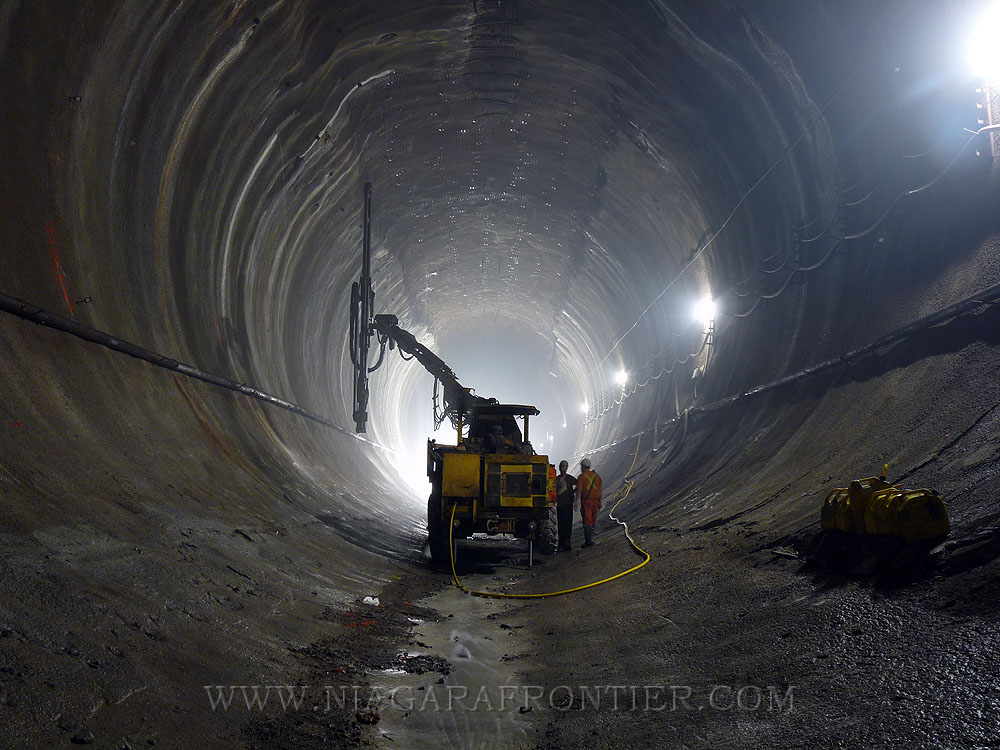
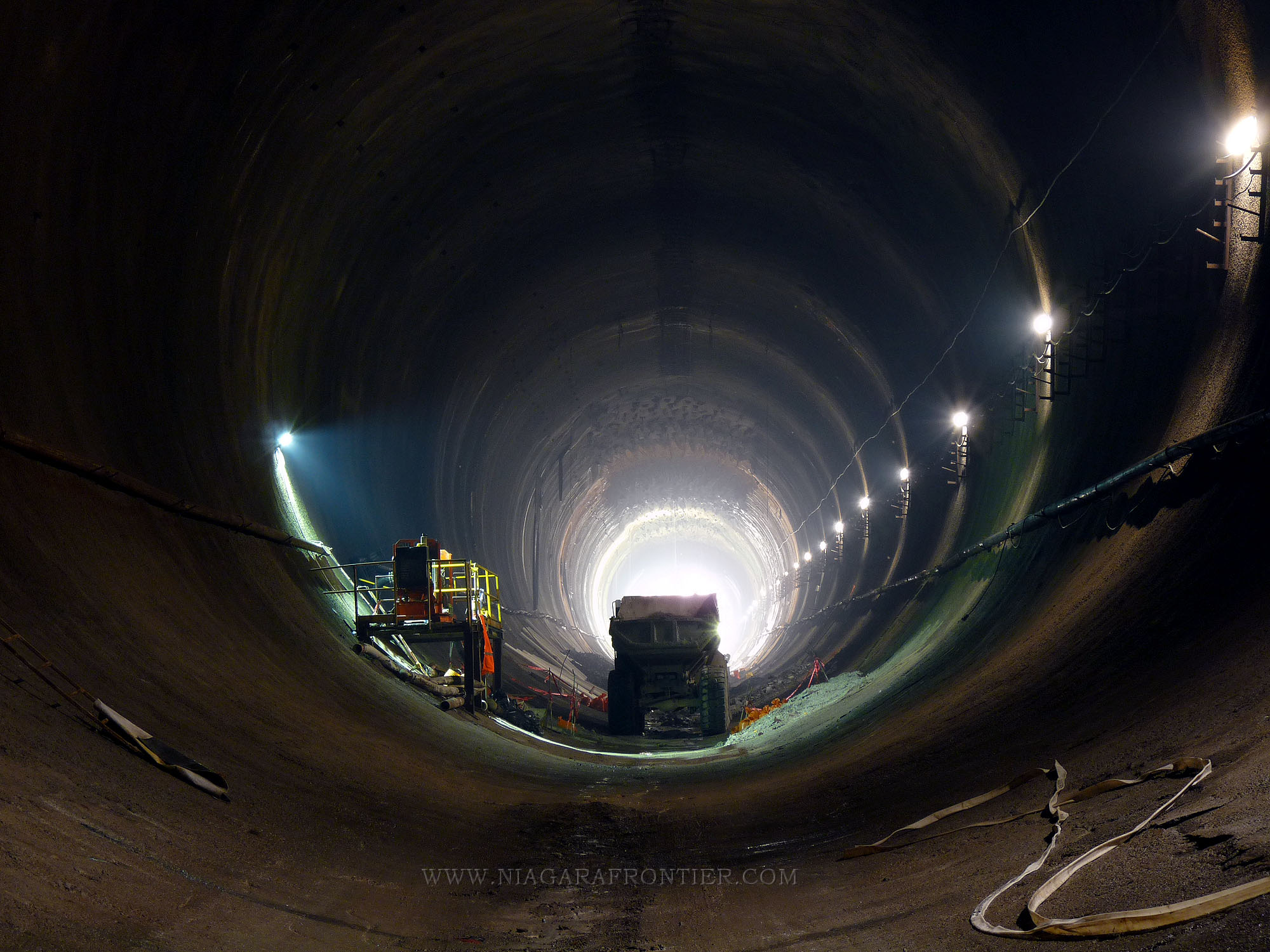
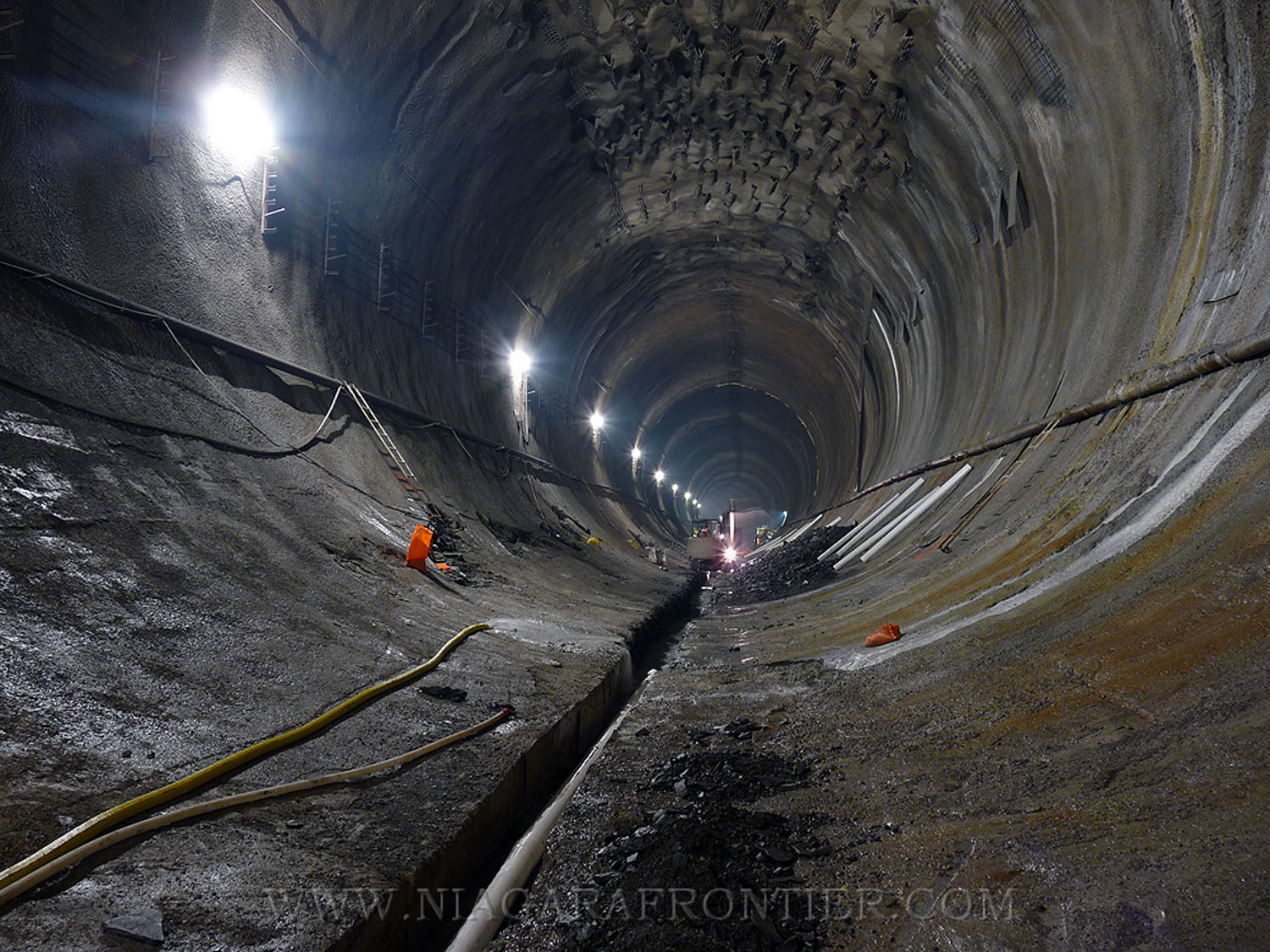
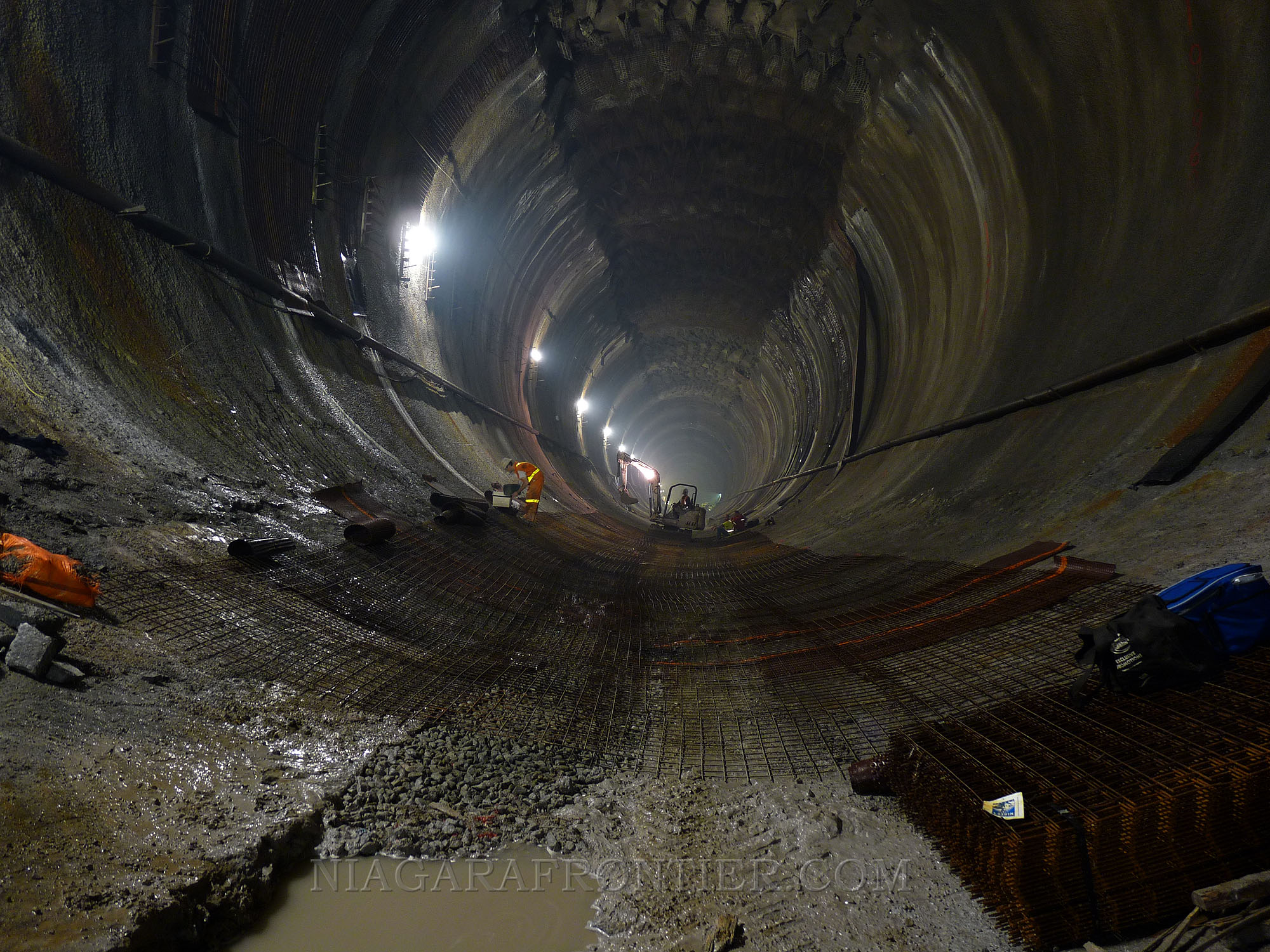
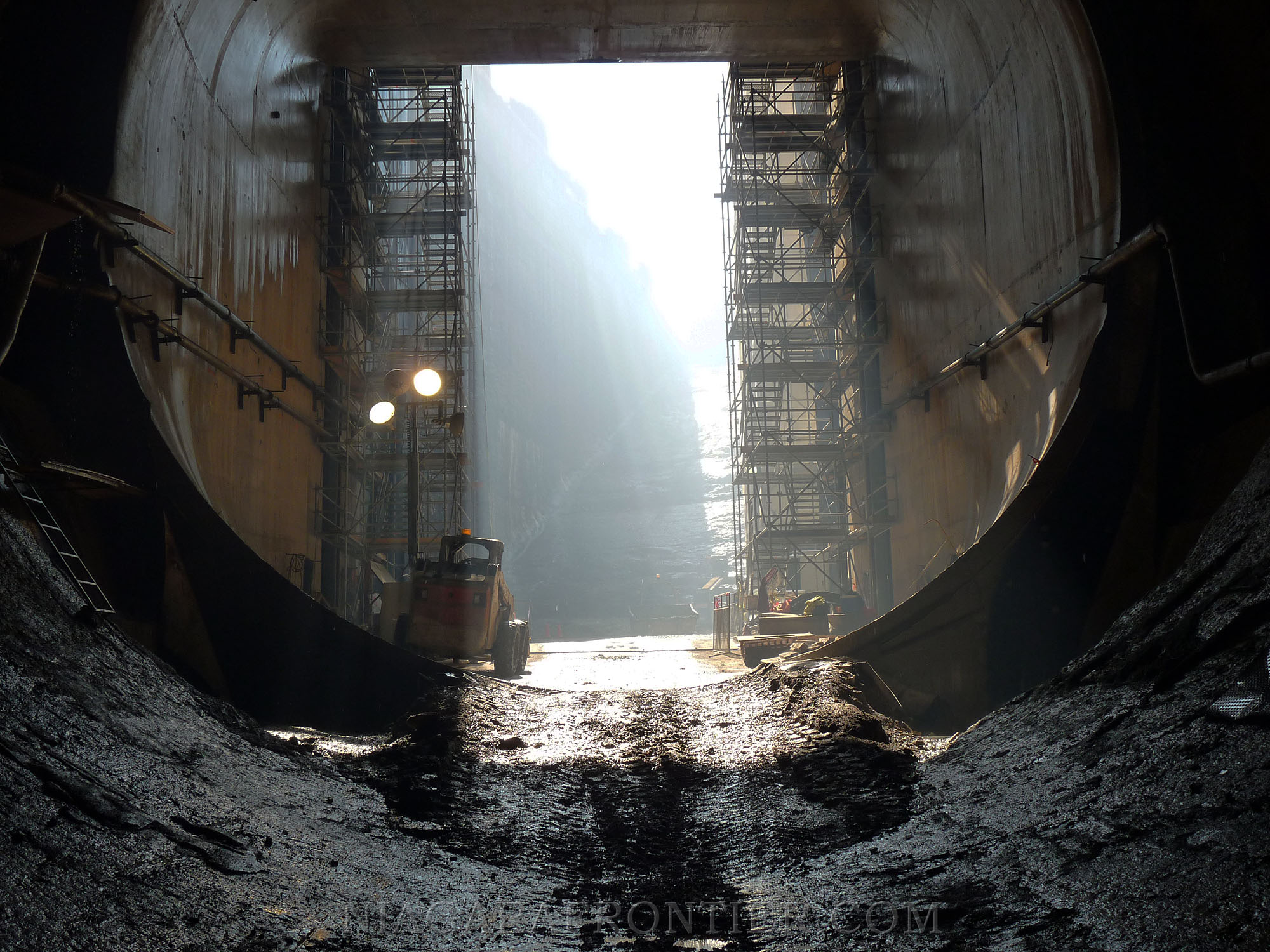
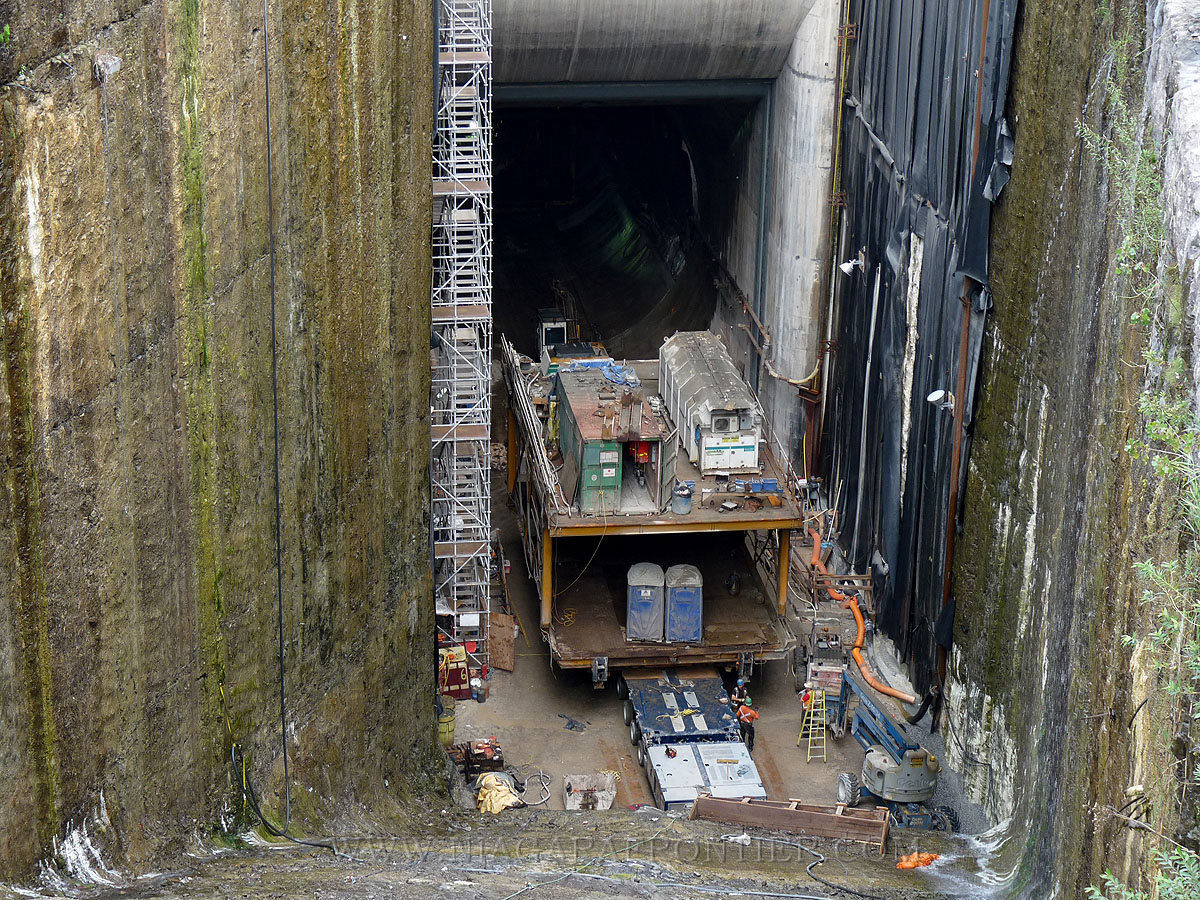
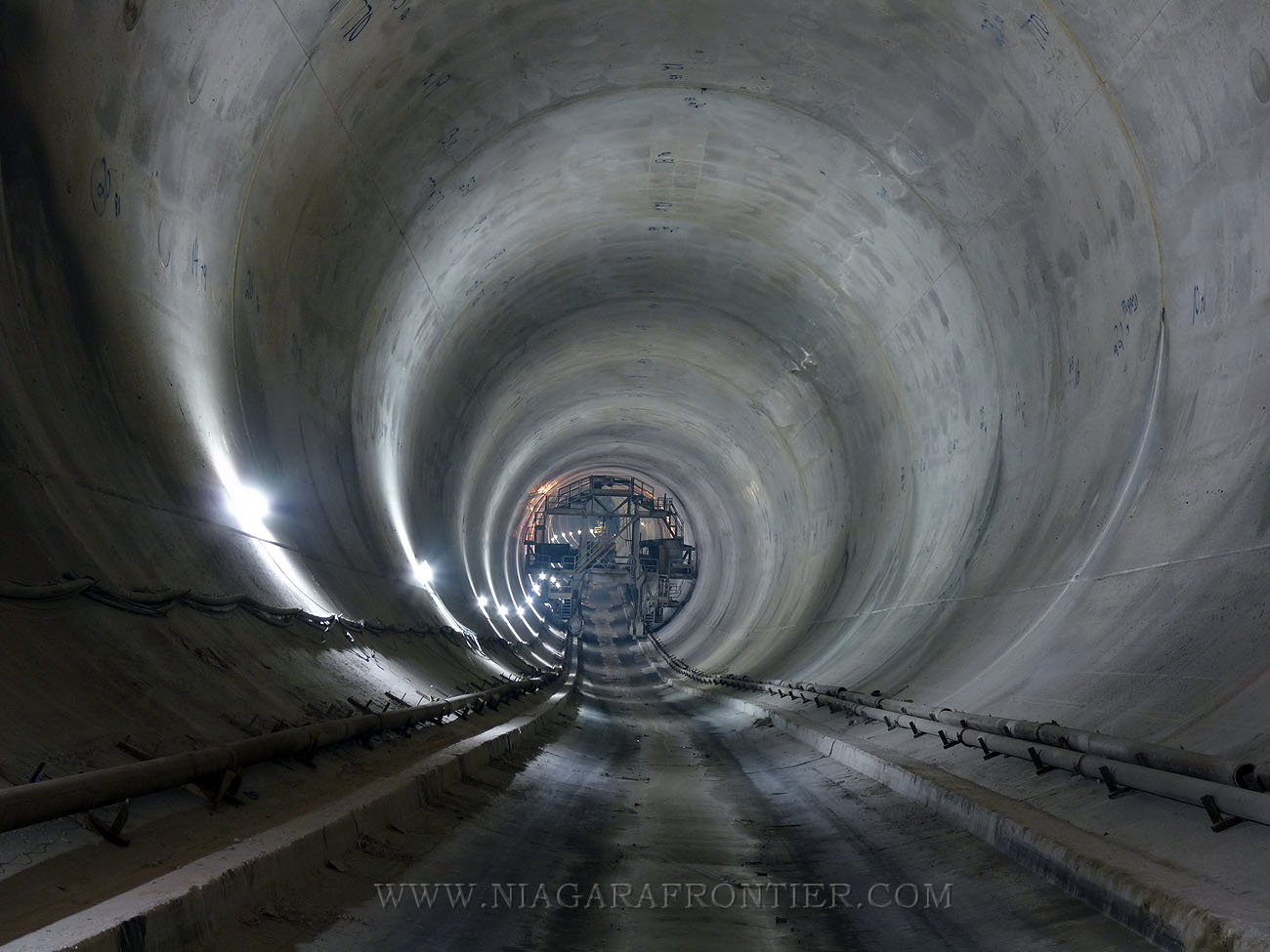
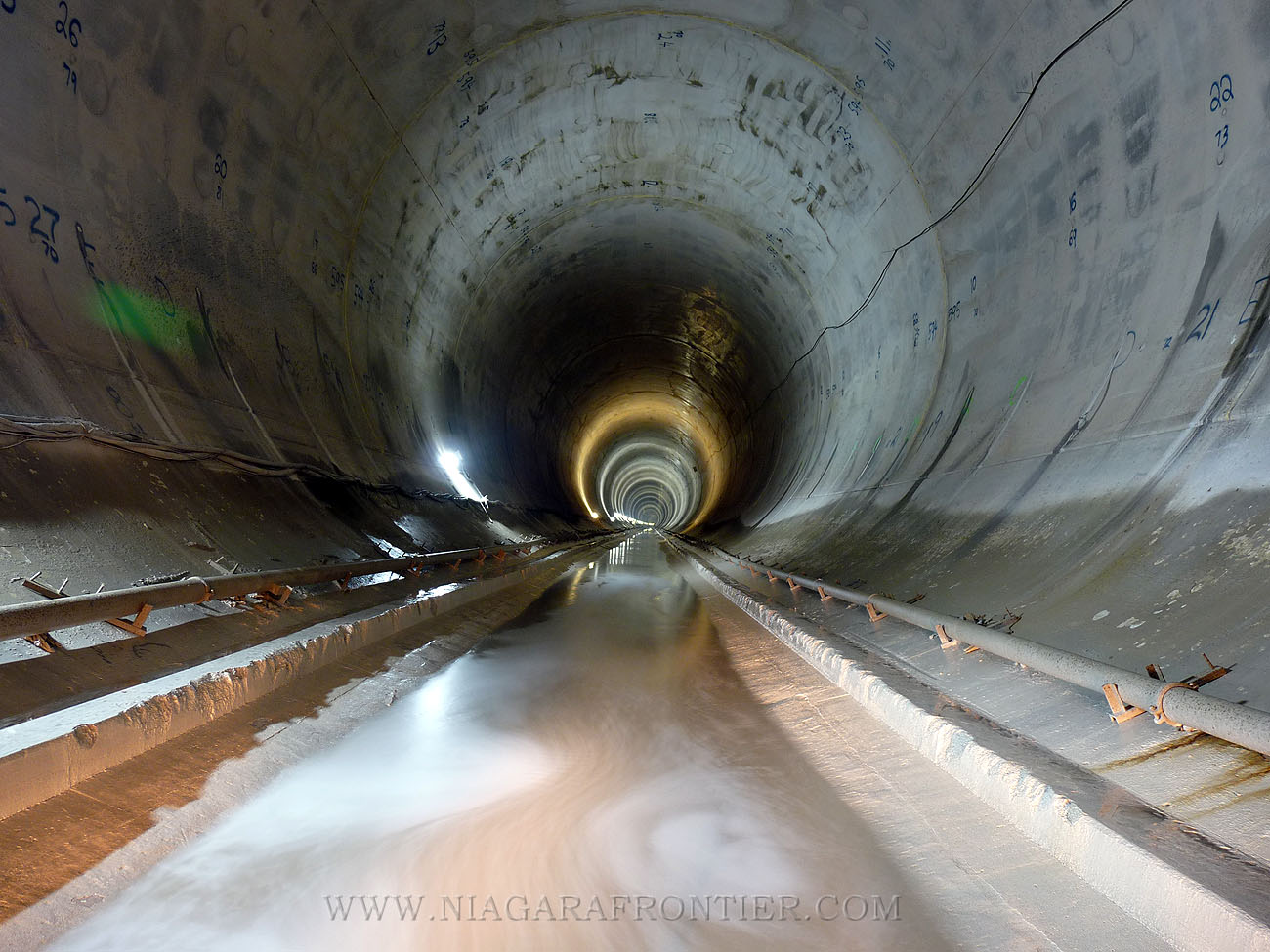
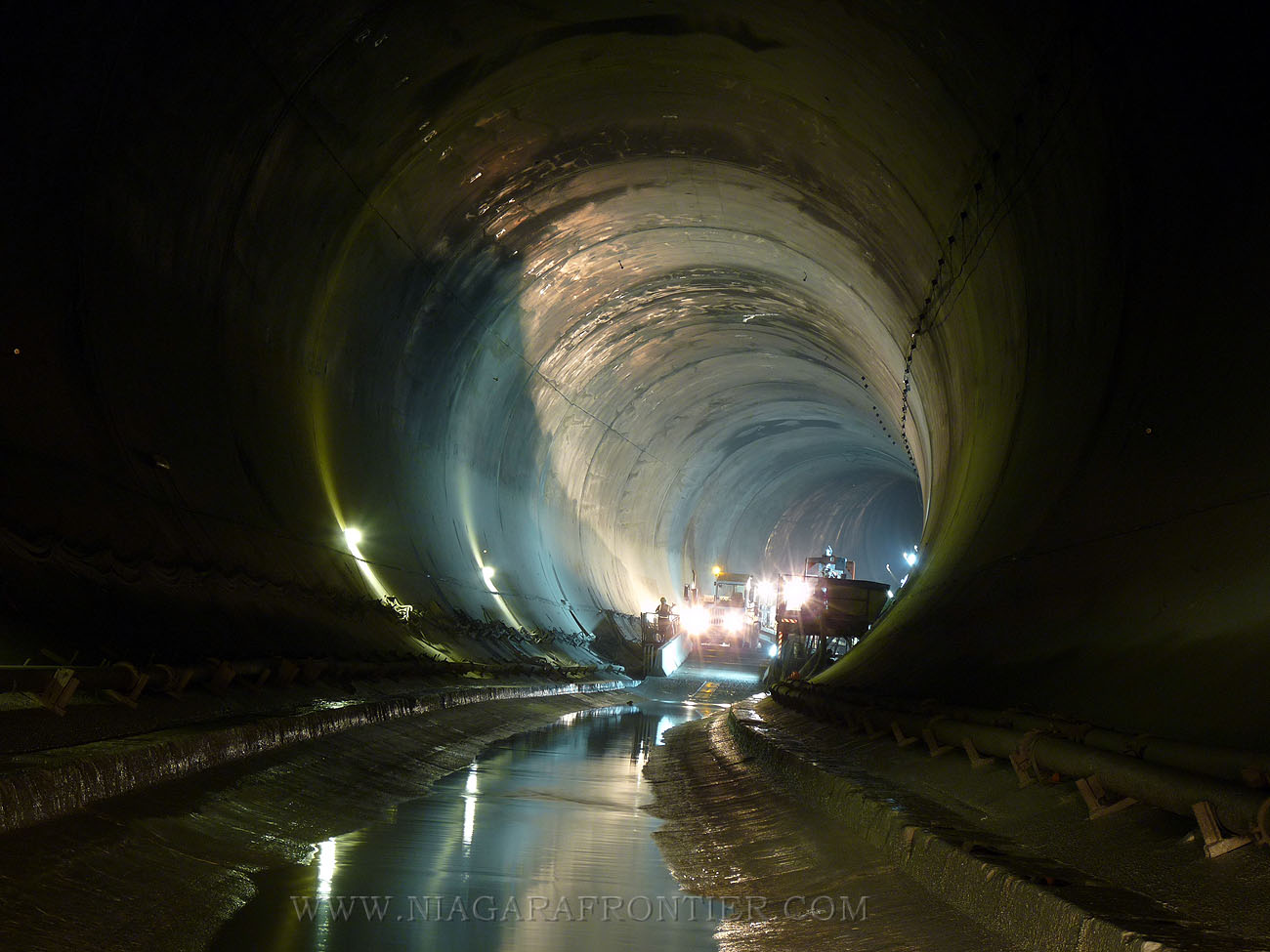
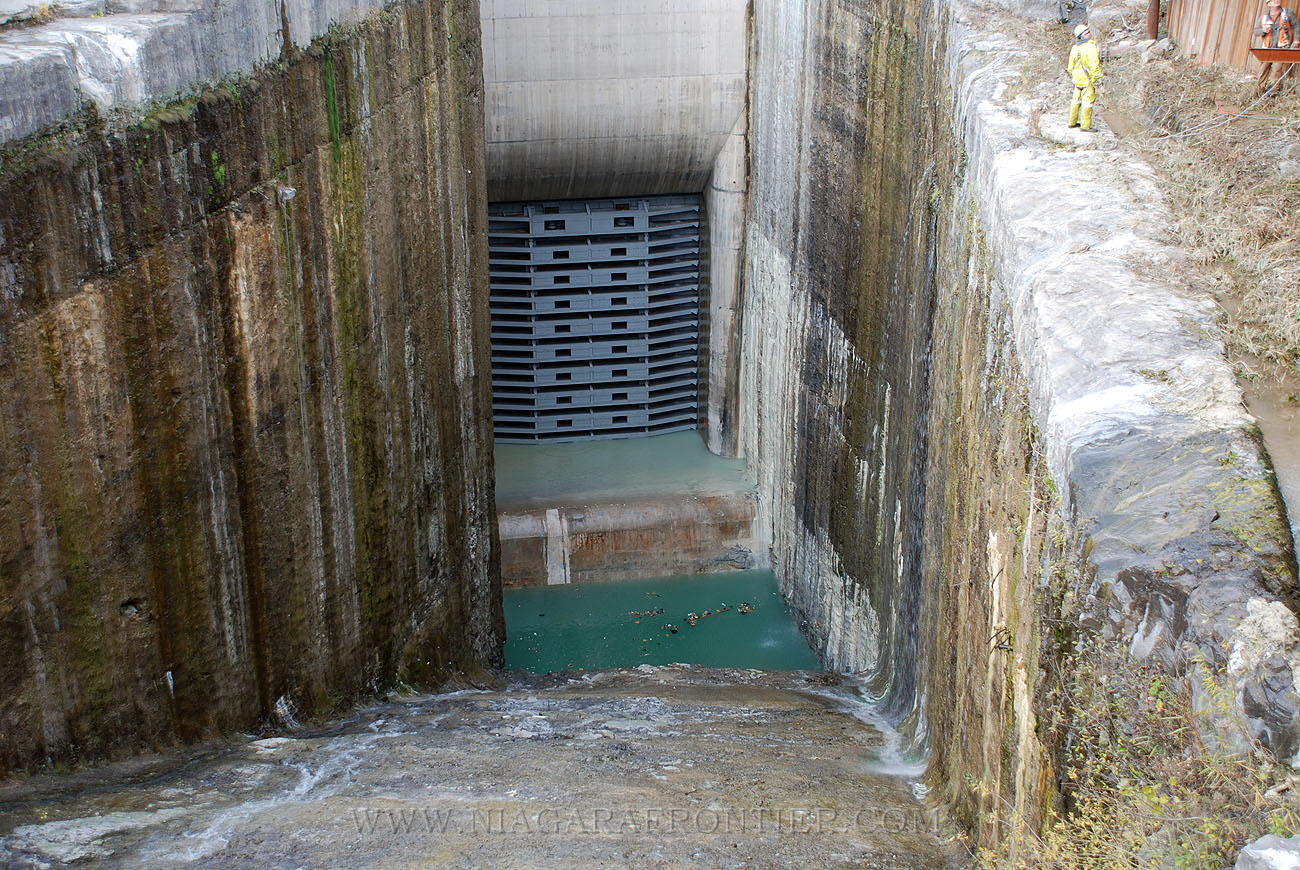
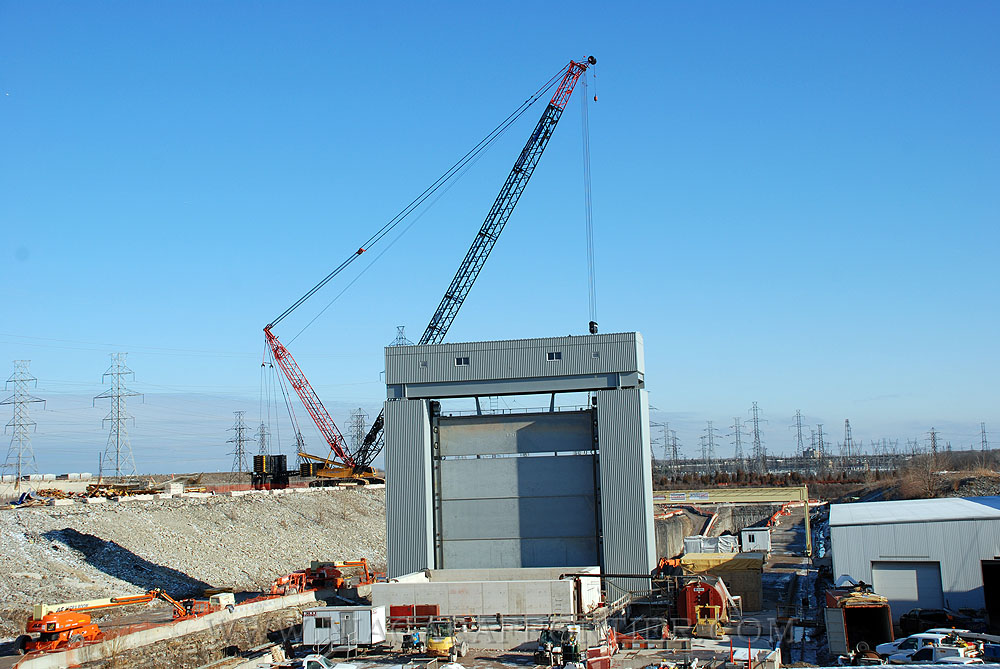
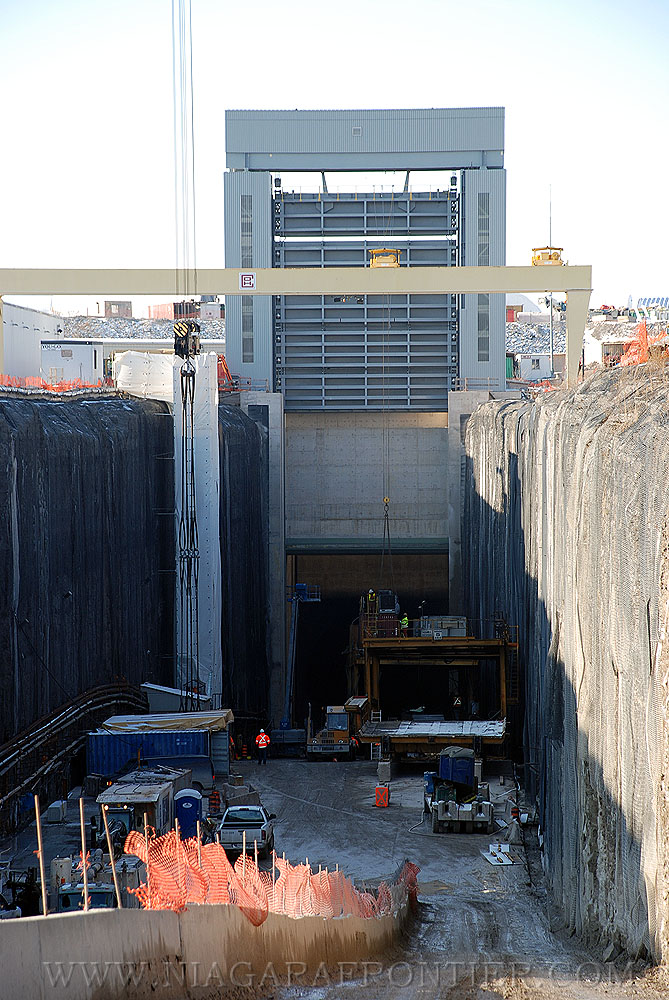
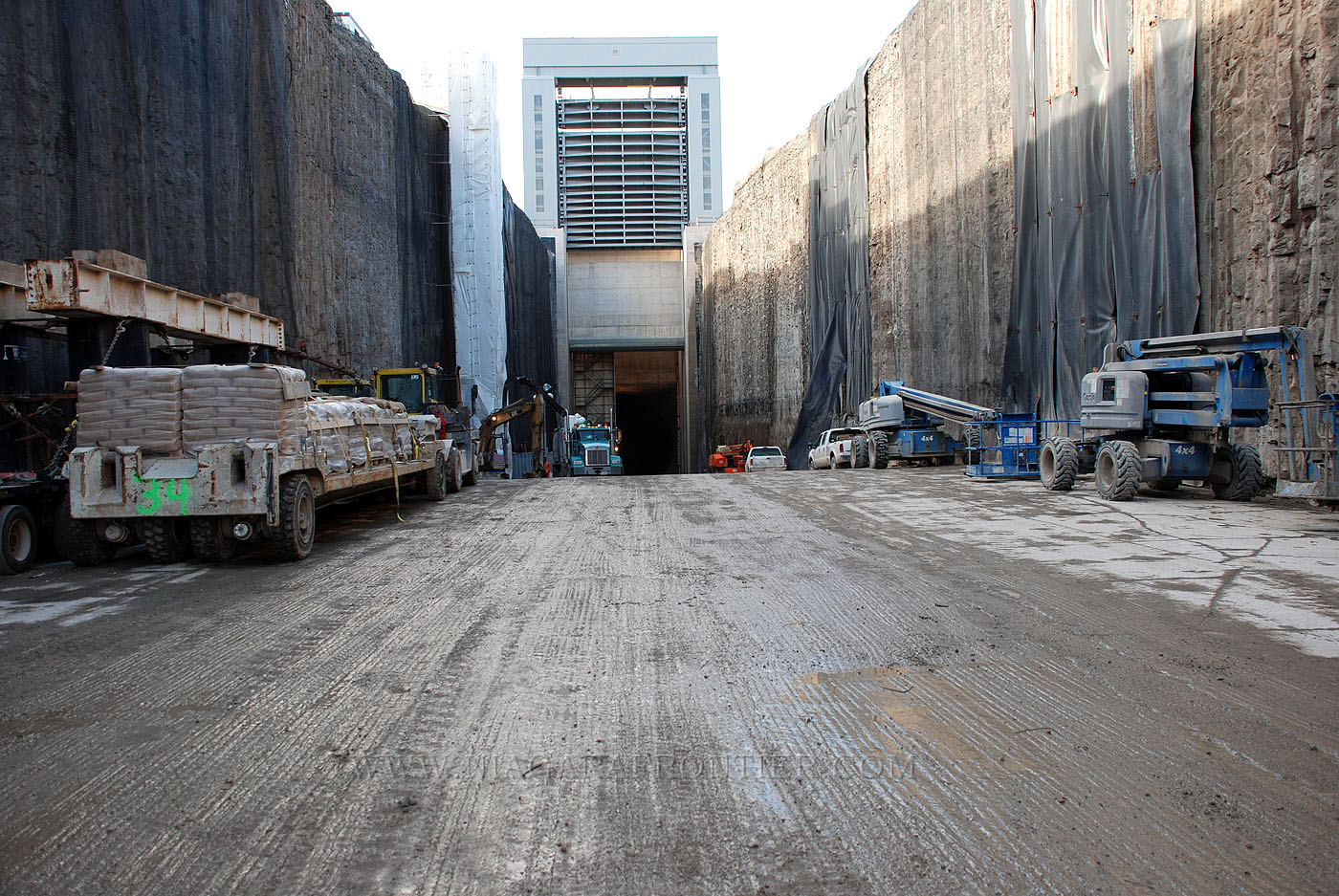
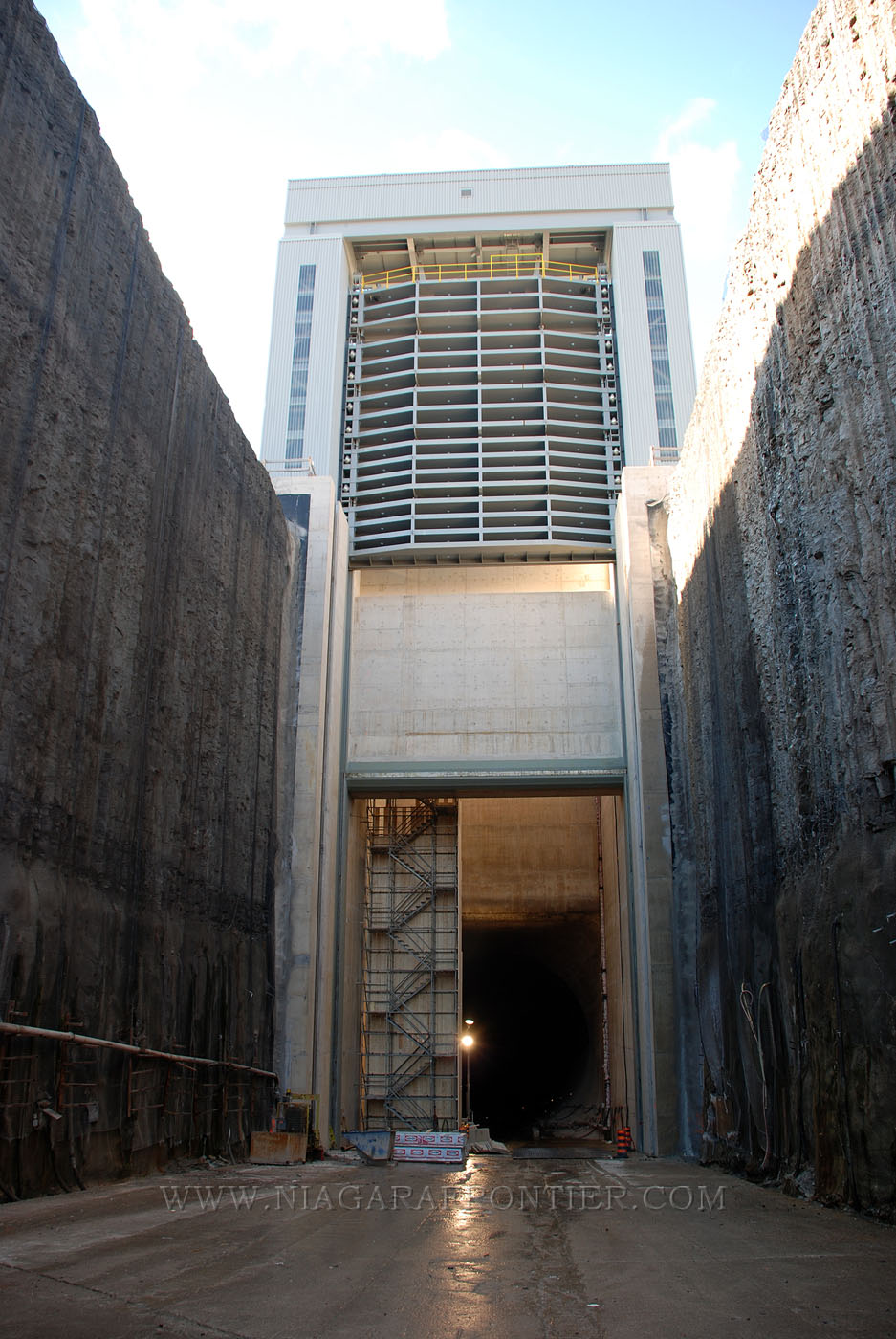
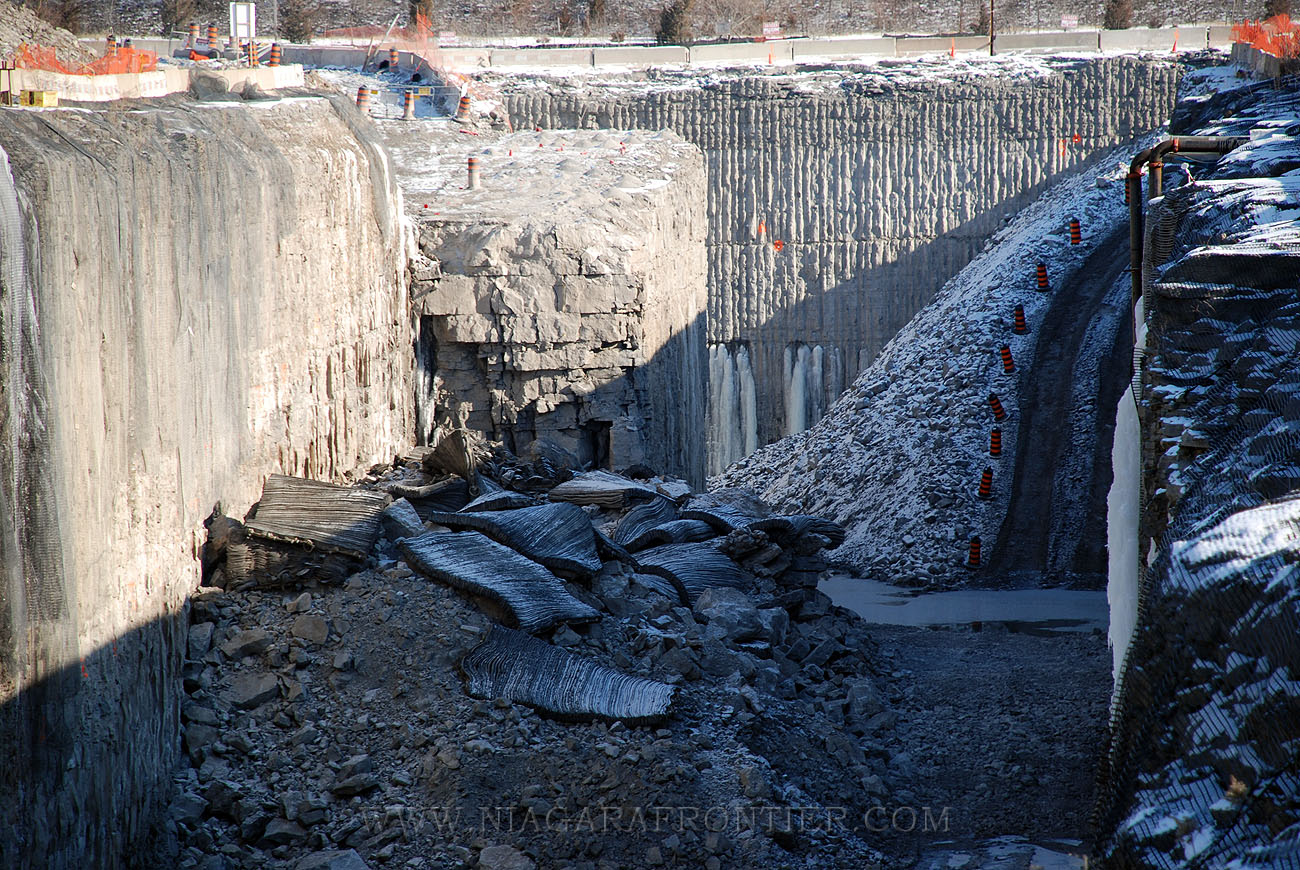
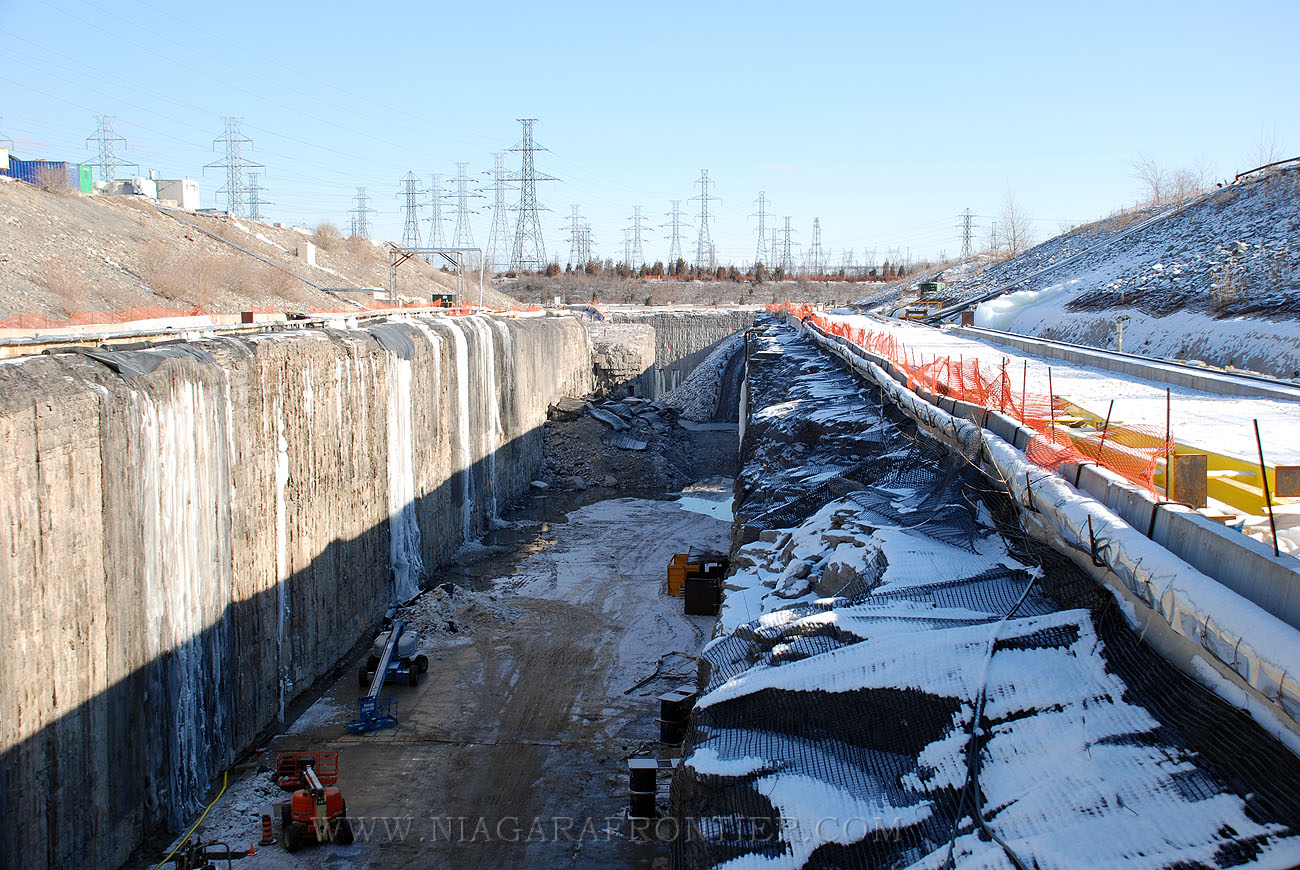
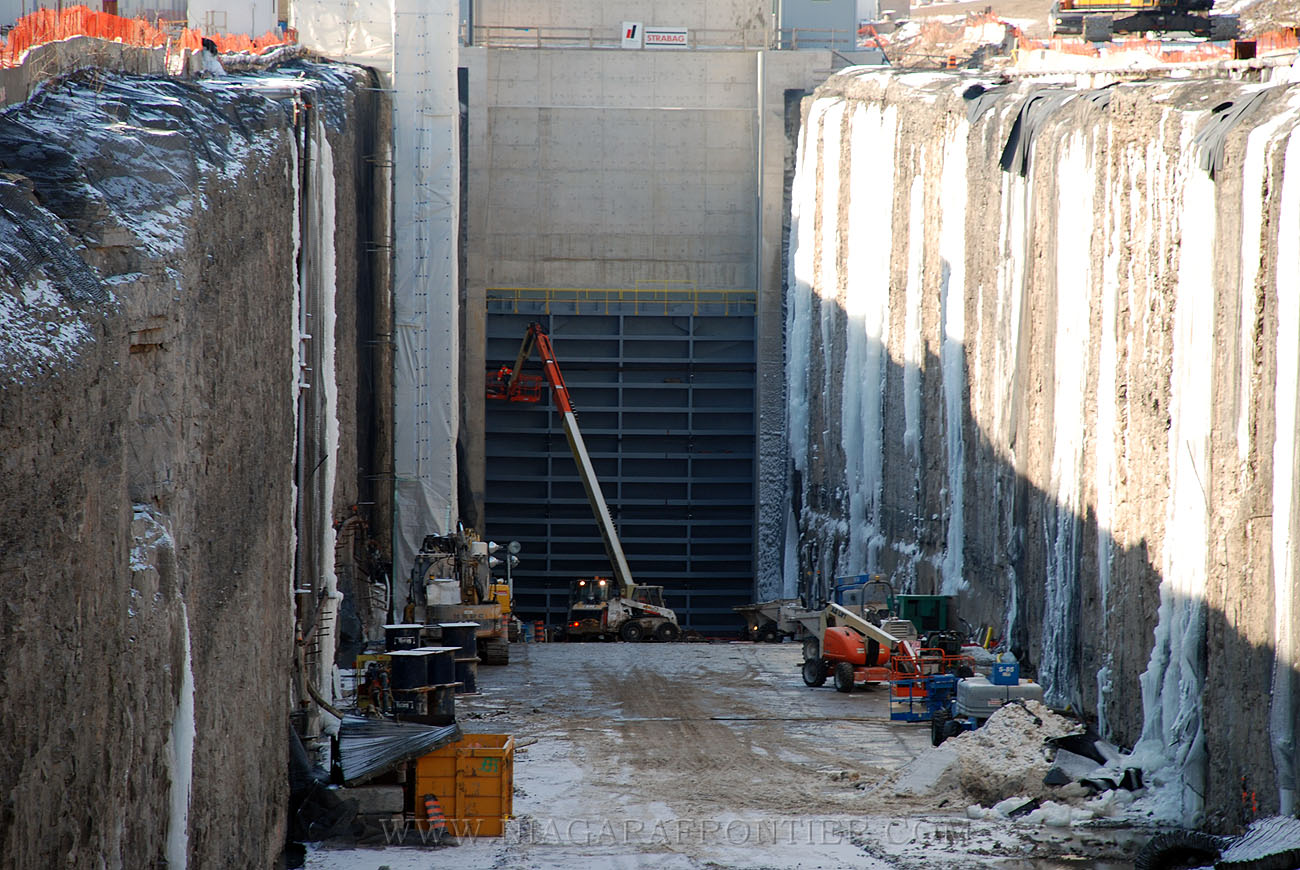
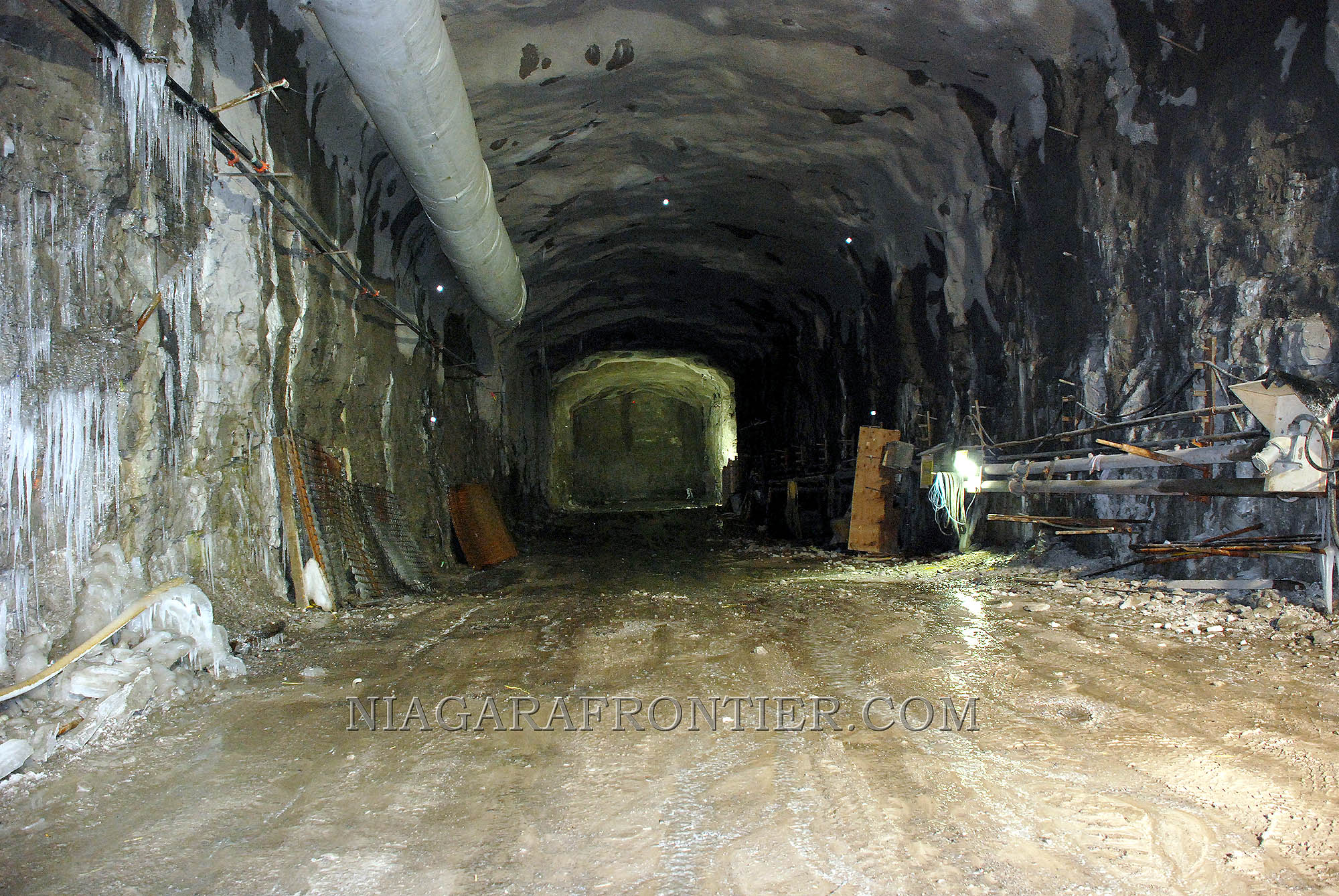
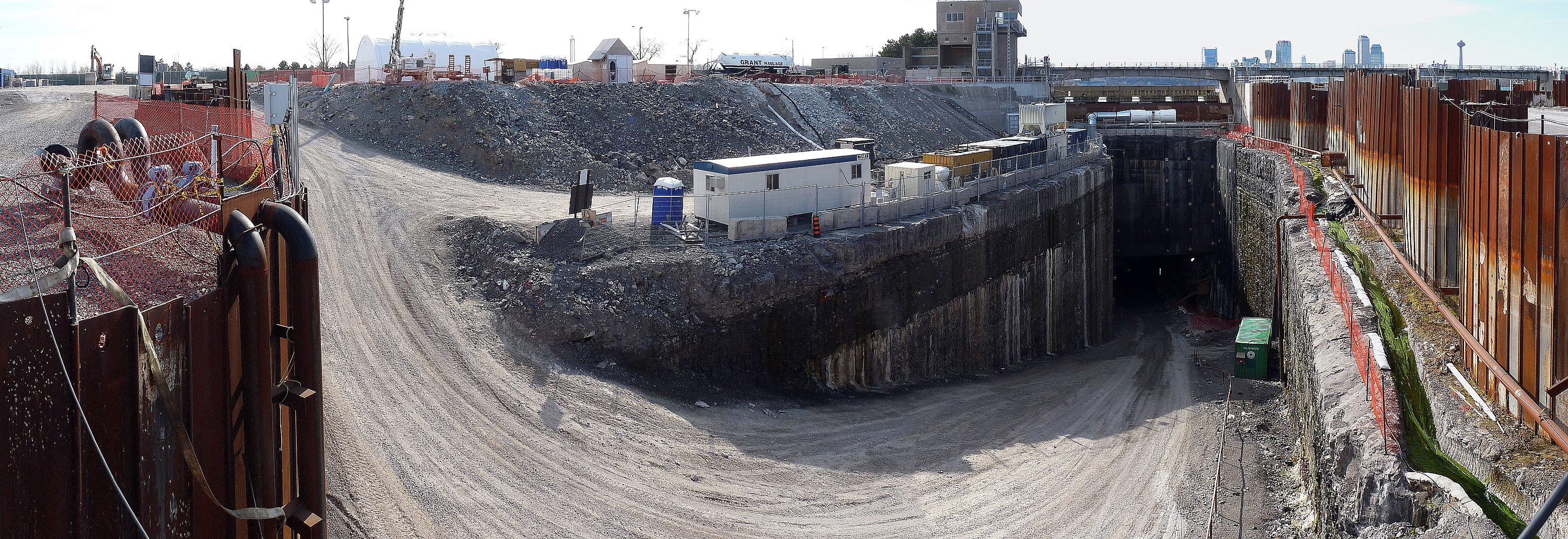
Ontario Power Generation awarded a $600
million dollar contract to Strabag AG Company to design and build the new Niagara Tunnel.
Award of the Design/Build Agreement for construction
of Ontario Power Generation’s (OPG’s) Niagara Tunnel Project was made
after an intensive 8-month international procurement process. The 14.4-m
diameter × 10.4-km long rock tunnel will divert 500 m3/s of water from
the Niagara River to the Sir Adam Beck hydroelectric generating complex.
The procurement process and Design/Build Agreement included features to
address the owner’s requirements regarding risk allocation and cost and
schedule certainty, while encouraging innovative ideas from the
industry, both technically and commercially. The process included an
international expression of interest and prequalification, followed by
an invitation for design/build proposals to qualified proponents, and
comprehensive proposal evaluations and negotiations with several
respondent proponents. An honorarium was provided to the unsuccessful
participants in the proposal stage. The resultant negotiated
Design/Build Agreement includes Owner’s Mandatory Requirements,
negotiated contract terms and conditions, performance incentive bonuses
and liquidated damages for schedule and water delivery performance, a
multistaged Geotechnical Baseline Report, joint risk management,
references to pre-existing community impact agreements and measures to
reduce impact on tourism. It also addresses regulatory approvals and
permits, an owner controlled insurance policy that required reference to
the International Tunnelling Insurance Group (ITIG) Code of Practice for
Risk Management as a condition of coverage, site specific safety,
security and environmental plans, formal team building, a dispute review
board, and escrow documentation.
September 14th 2005
-
Ontario Power
Generation announced the start of construction of its $985 million dollar,
10.4 kilometer (6.46 mile) Niagara Tunnel project to increase the output
of power from Niagara Falls. The Niagara Tunnel project is estimated to cost
$600 million dollars and $385 million dollars for remedial and other work costs.
The project involves boring a tunnel 14.4
meters ( 47.24 feet) at a depth of up to 140 meters (459.3 feet) below the City
of Niagara Falls . The tunnel will enhance the original engineering
accomplishment of the Sir Adam Beck Hydro-Electric Generating Stations - Niagara
Group in transporting water from a location up river from the Falls of Niagara
to the power stations at Queenston to increase its power output.
The new tunnel will complement the upgrading
of the 16 generators at the Sir Adam Beck Power Station #2. This 9
year upgrading project cost $220 million dollars increased the potential peak
output by 194 megawatts.
When the new Niagara Tunnel project is
completed, it will enable the Beck Power Group to produce an additional 1.6
terawatt-hours of electricity for at least the next ninety (90) years. It will
allow enough energy production to serve an additional 160,000 homes and increase
power output at Sir Adam Beck by 14%. - enough to meet the annual needs of a
city of 700,000 persons.
Currently 1,800 cubic meters of water per
second (63,566 cubic feet of water per second) are available to be
diverted to the Sir Adam Beck Generating Stations for power production. The new
Niagara Tunnel will allow an additional 500 cubic meters of water per second
(17,657.2 cubic feet of water per second) when available to be diverted for
power generation.
On average, the Niagara Tunnel project will
employ approximately 230 workers however this number will peak to about 350
employees.
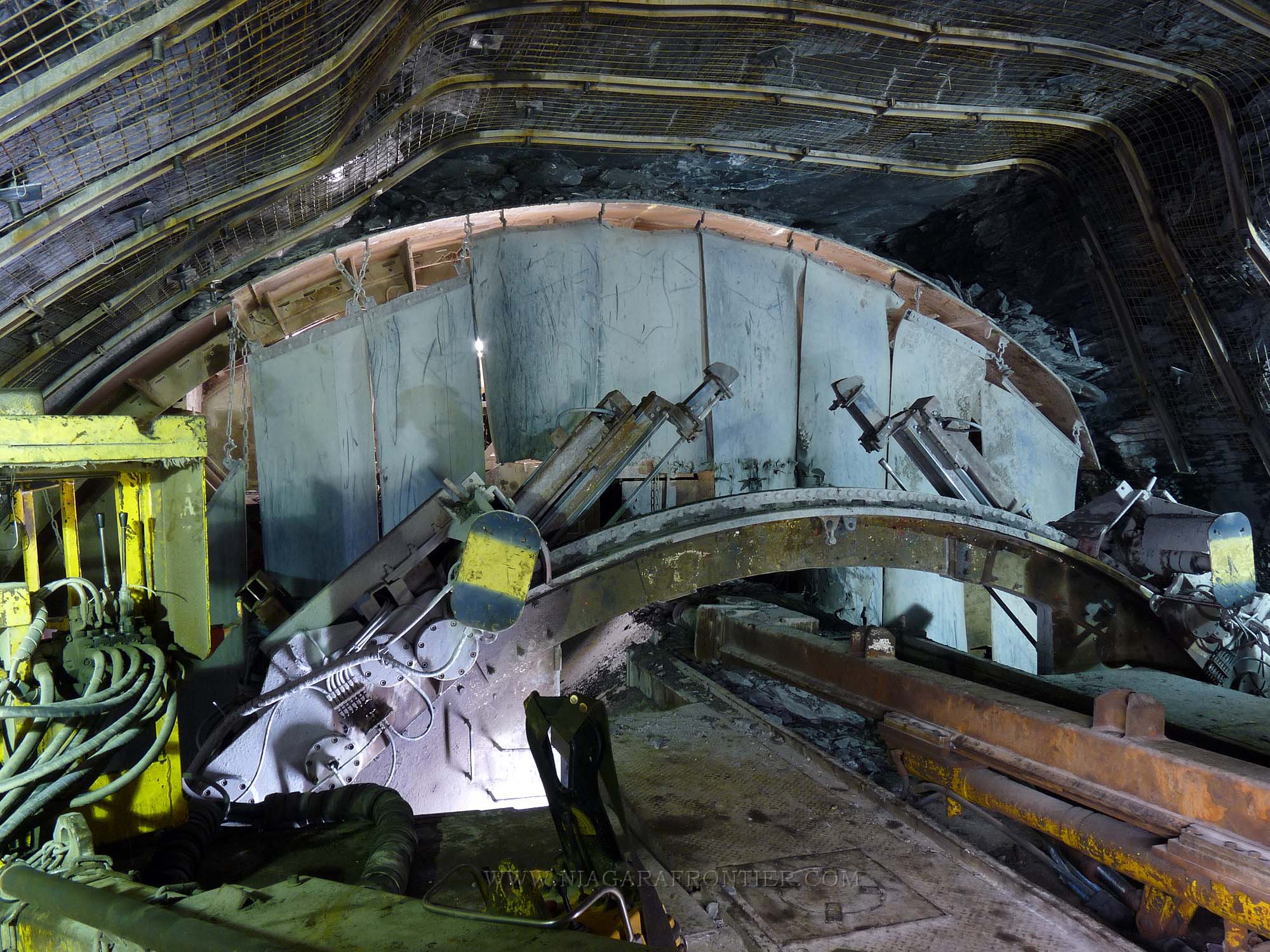
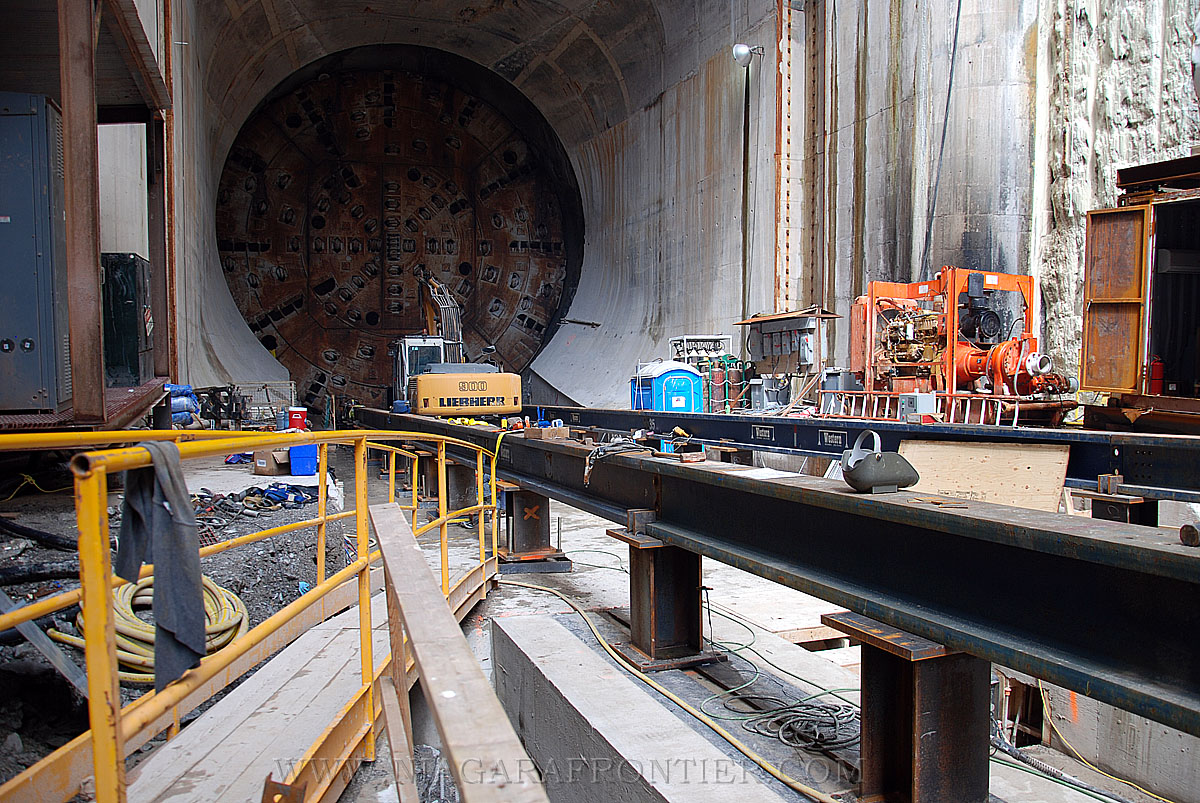
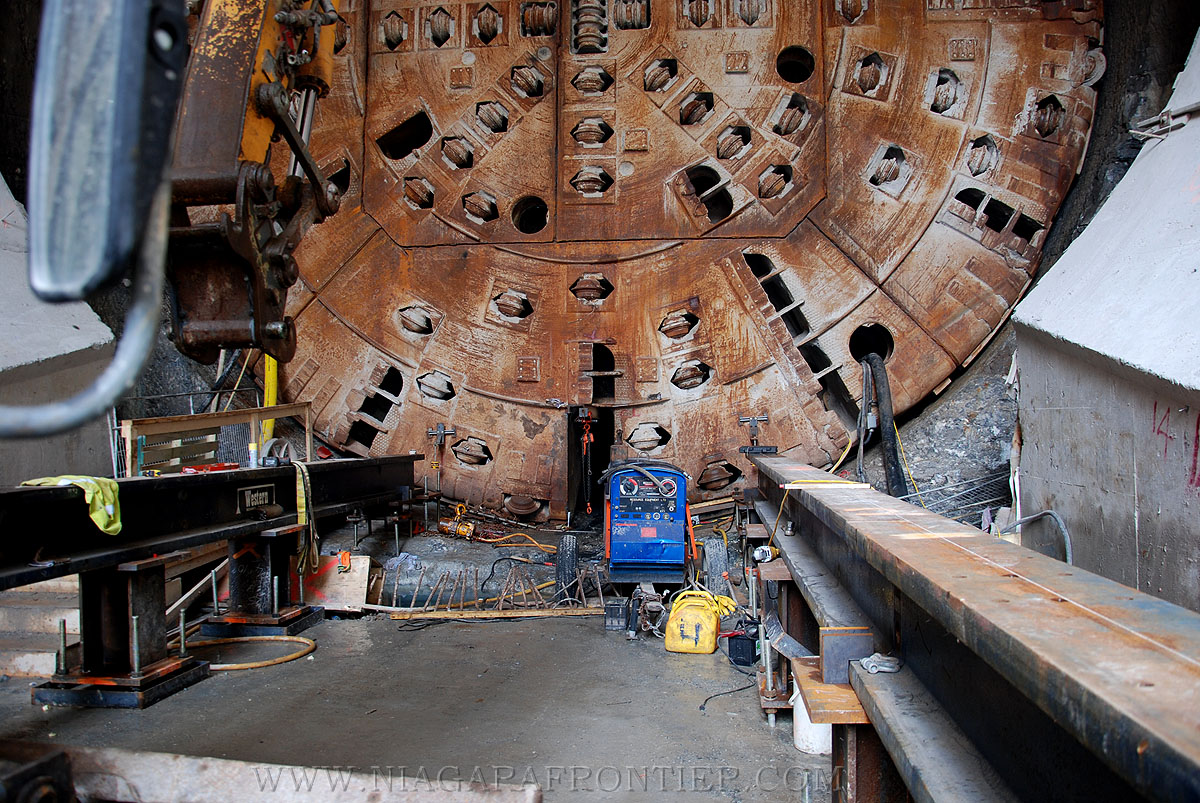
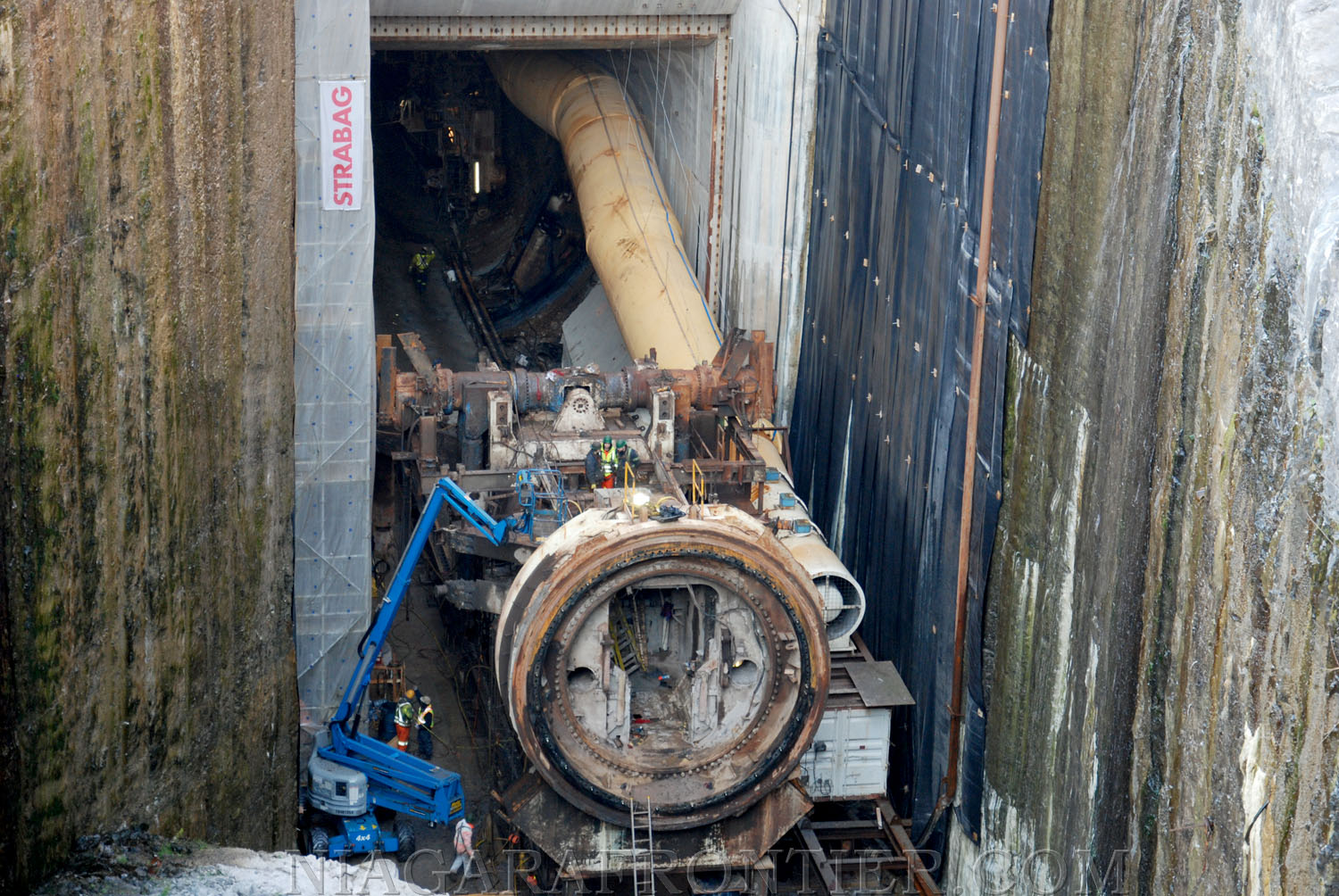
The Tunnel Boring Machine (TBM) to be used
on the Niagara Tunnel project will be 14.4 meters (47.2 feet) in diameter and will be one of the largest to be
used in the world. In comparison the Robbins TBM will be 2½ times the size of the Toronto
Subway
tunnel and 1½ times the size of the English Channel tunnels.
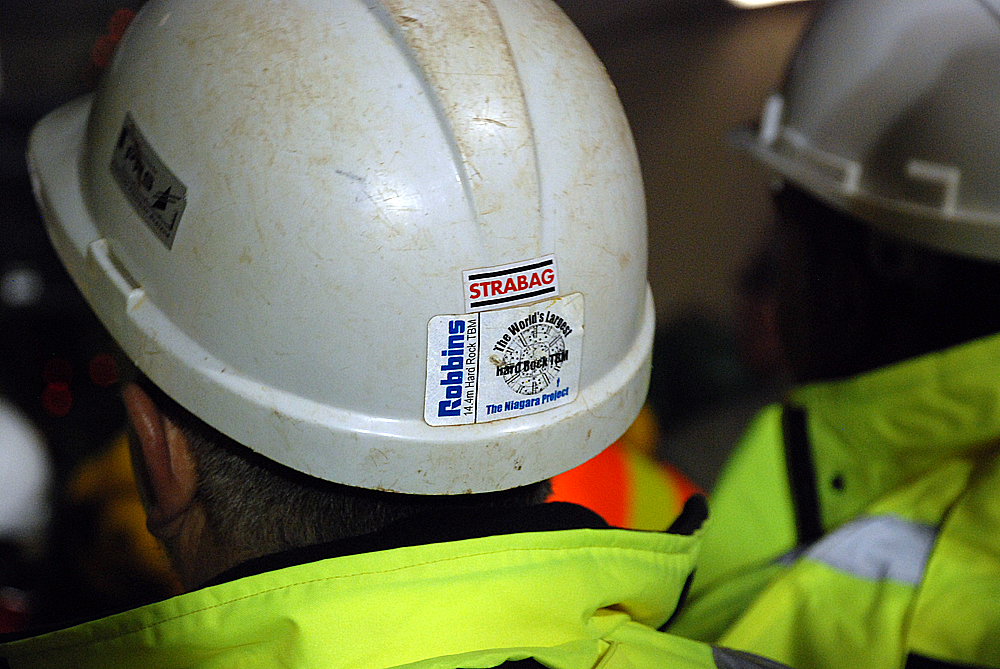
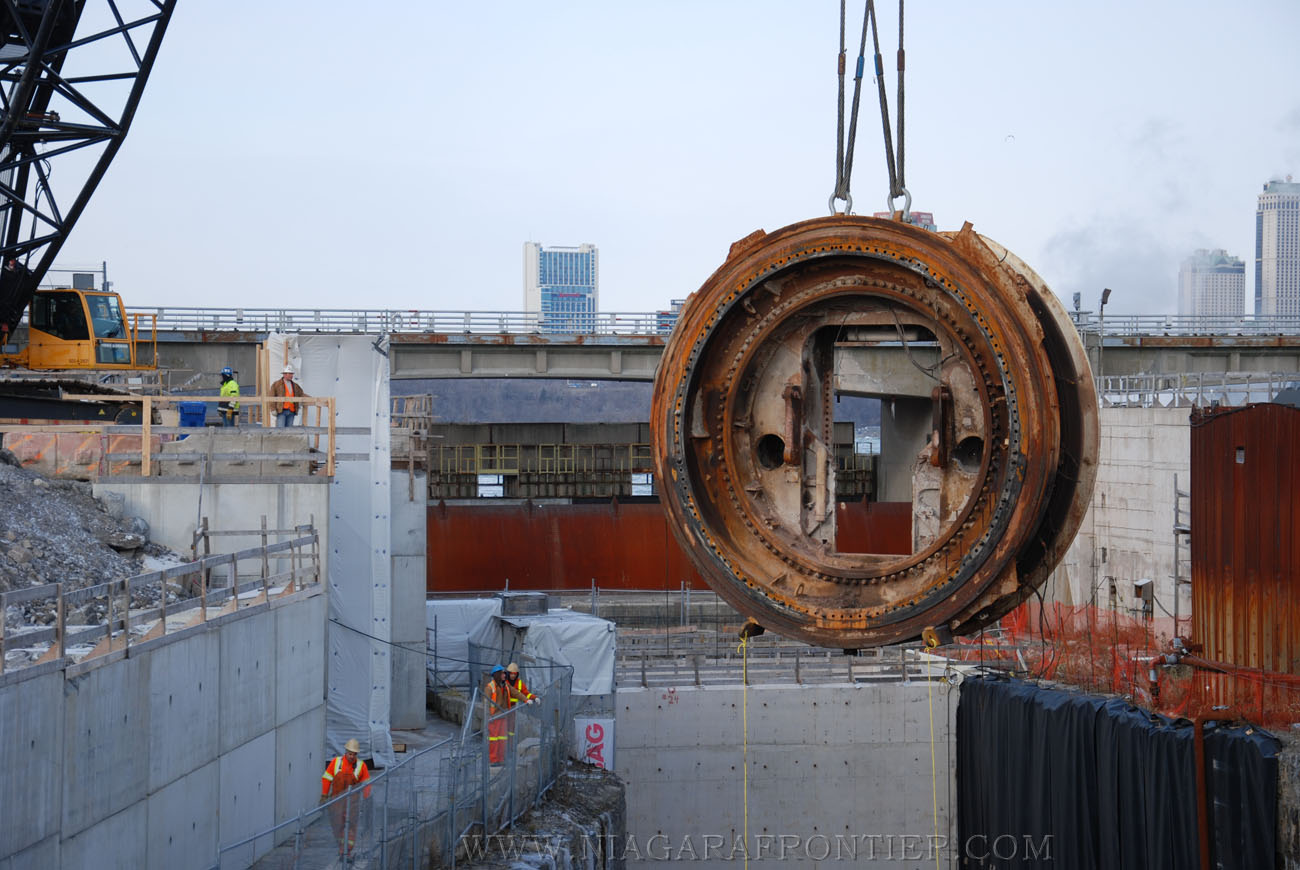
The Robbins Company will design and manufacture the
largest hard rock TBM in the world for the Niagara Tunnel project. It will be an
open, hard rock, main beam TBM that utilizes the Robbins floating gripper
design. The TBM will be equipped with a state of the art ground support system.
The cutter-head will be powered with a 4,725 kW variable frequency drive system
that can be increased to 5,040 kW. For optimum performance Strabag has chosen to
use Robbins 20-inch cutters mounted in a back-loading cutter-head. Alternately,
Robbins 19-inch cutters can be used without modification of the cutter-head. The
cutting head will typically revolve at 4 to 10 revolutions per minute (rpm).
The geology is varied consisting of limestone, dolostone,
sandstone, shale, and mudstone. The rock strength ranges from 15 to 180 MPa,
with most of the rock in the 100 to 180 MPa range. With the exception of
sandstone, the geology is basically non-abrasive. Most of the rock debris
(80%) removed
from the tunnel will consist of Queenston Shale.
The Niagara Tunnel is expected to advance at
a daily rate of 10-15 meters (32.8 feet - 49.2 feet). Approximately 1.6
million cubic meters of material excavated from the tunnel will be dumped on
Ontario Power Generation property between the two existing canals.
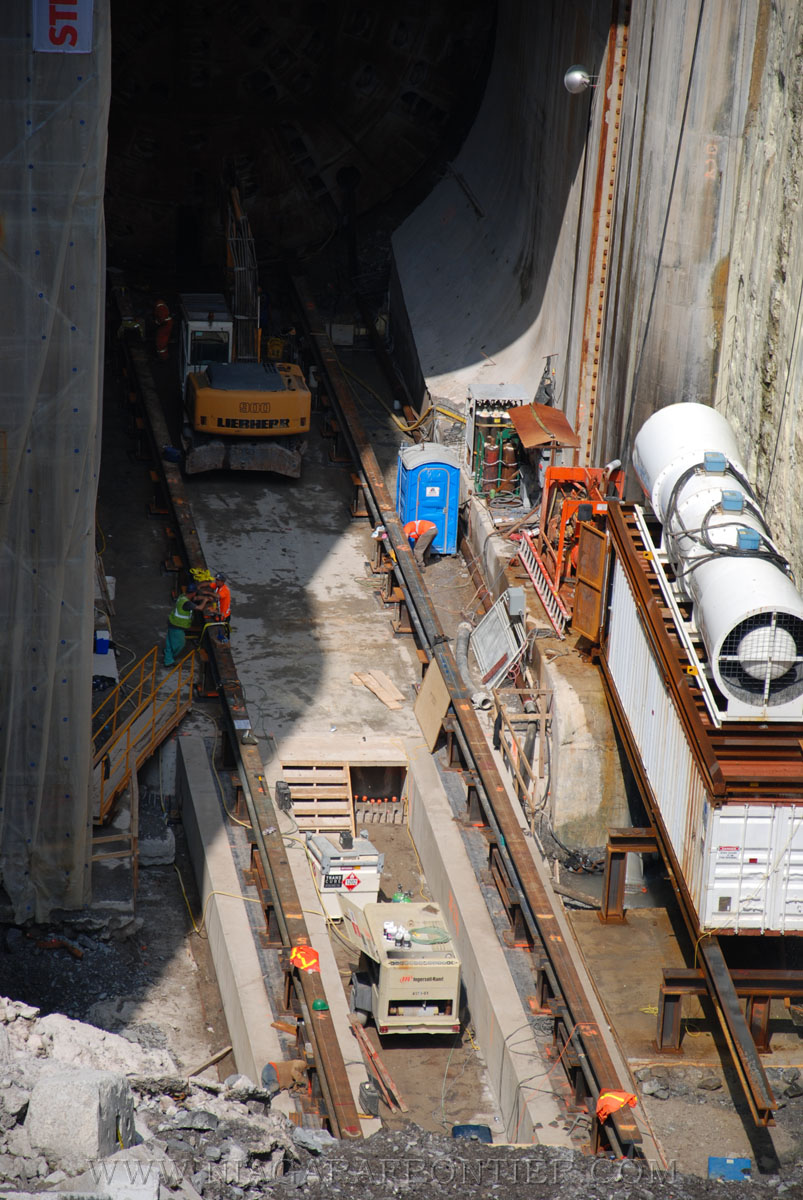
The new Niagara Tunnel will follow the same basic route as
the existing two tunnels parallel to Stanley Avenue. The new tunnel starts on Ontario Power Generation property at
Queenston with a -7.82% drop over a length of approximately 1,500 meters
(4,921 feet) reaching a depth of up to 140 meters (459.3 feet) below the City of
Niagara Falls. Here the tunnel proceeds with a relatively horizontal plane
over a distance of approximately 7,400 meters (24,277.9 feet). The
alignment will follow a horizontal curve radius of over 1,000 meters (3,280.8
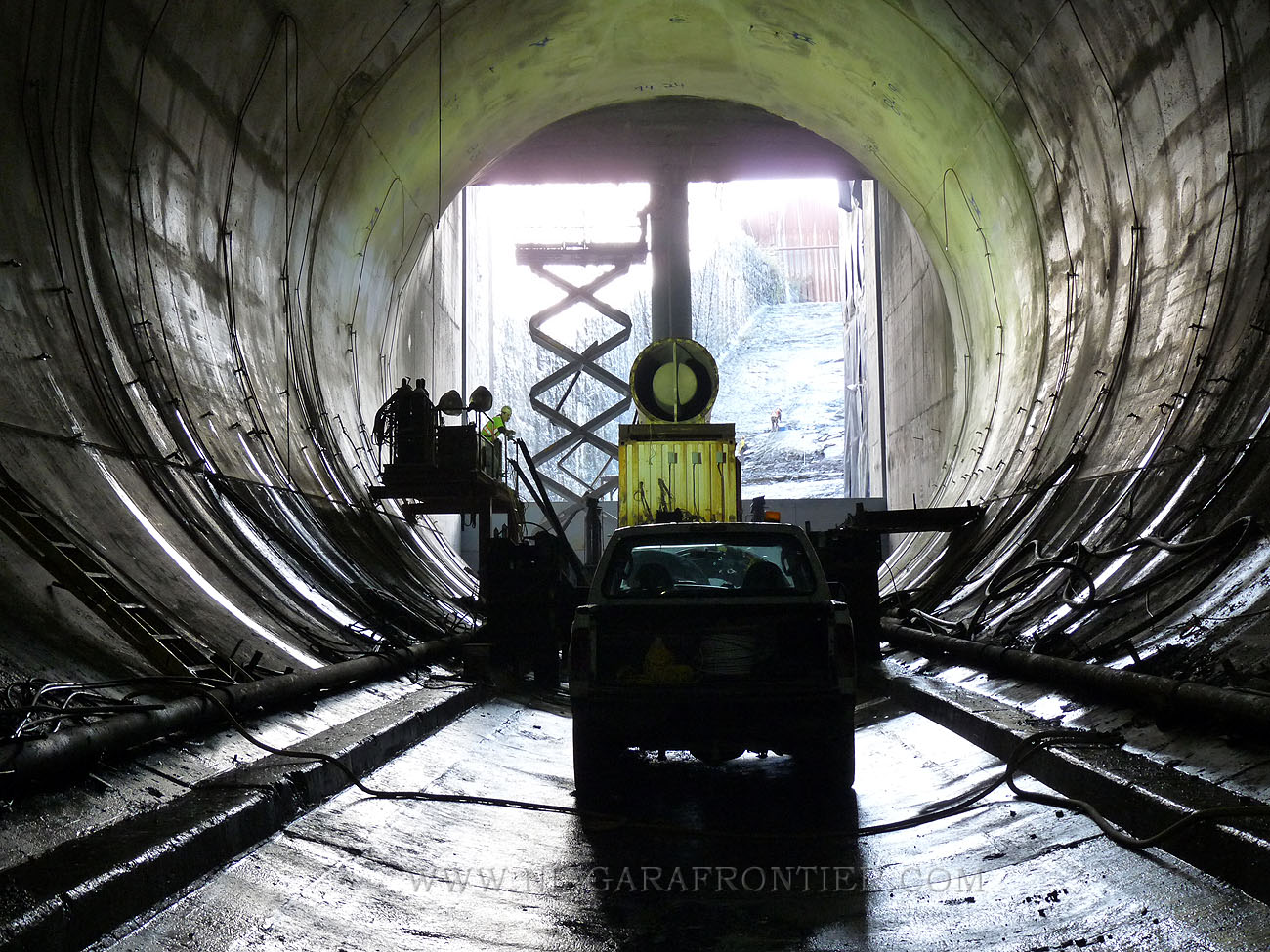
feet) in length. The tunnel ends on the Niagara River at the International Water
Control Dam located one mile upriver from the Horseshoe Falls with an ascent
gradient of +7.28% over the final 1,500 meters (4,921 feet).
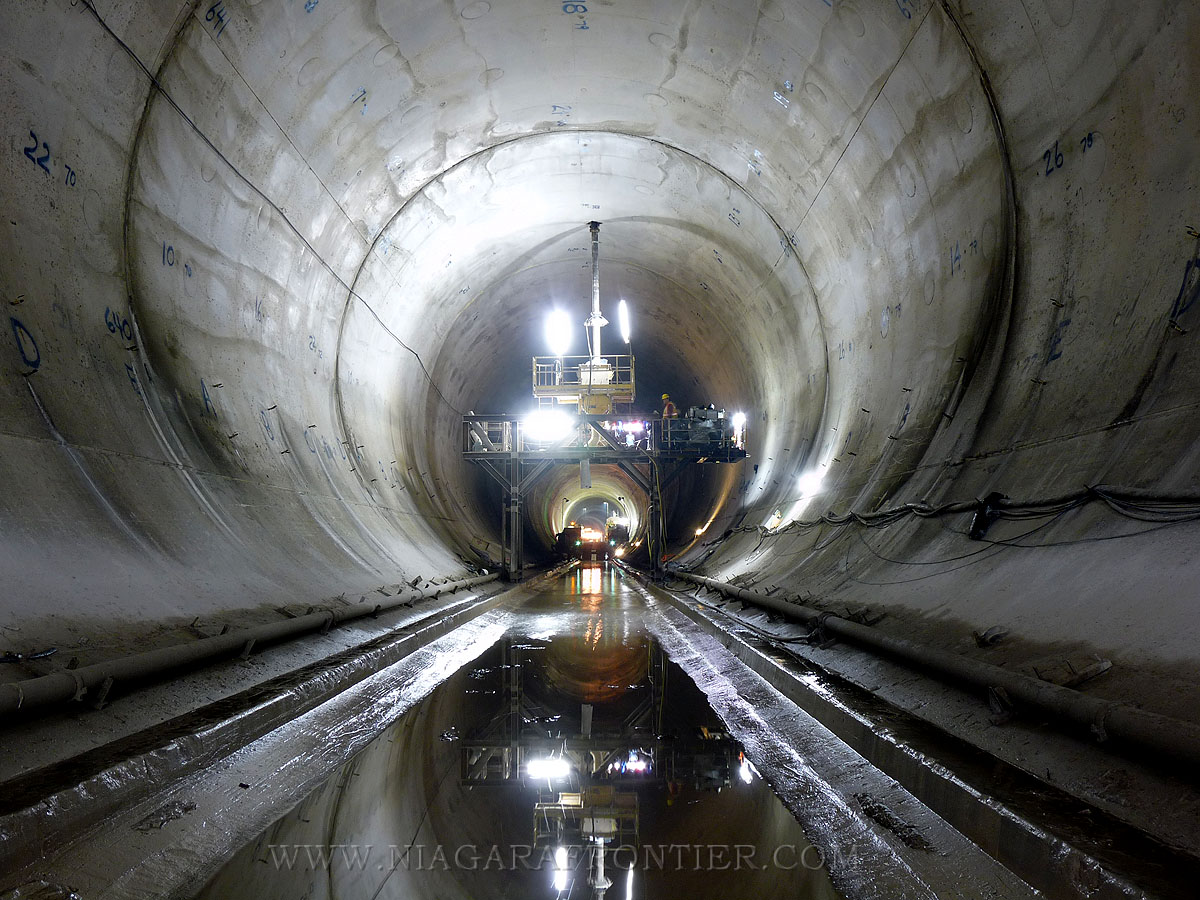
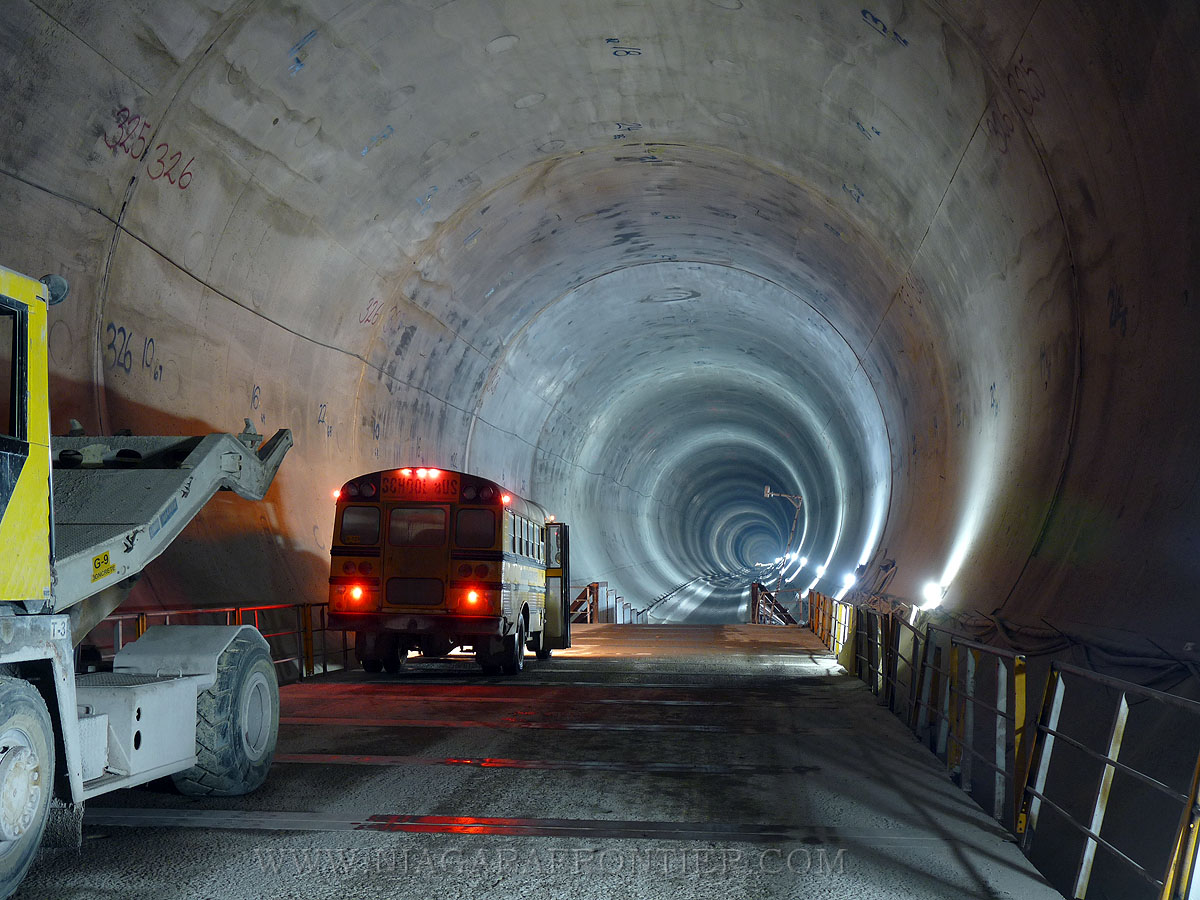
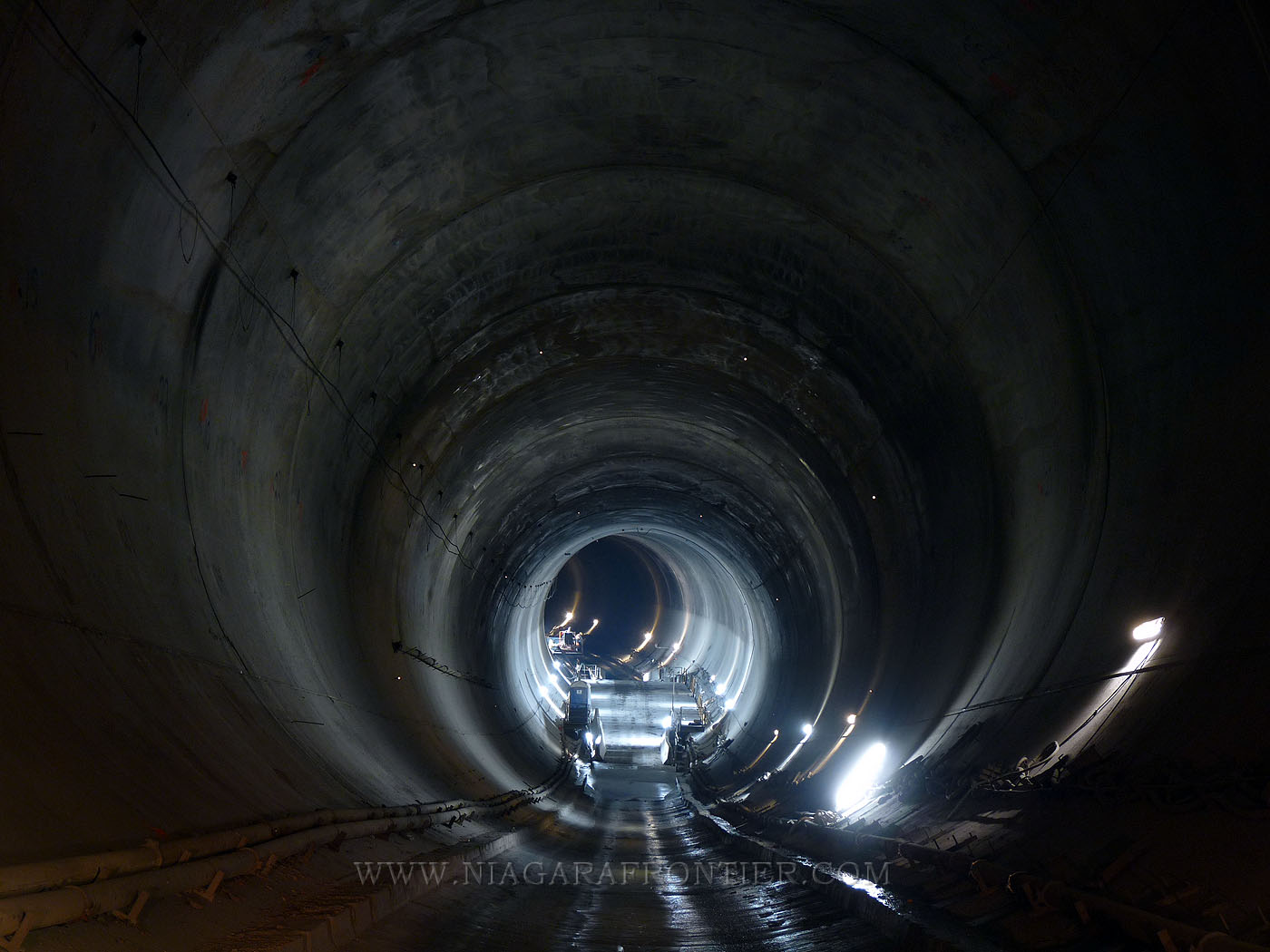
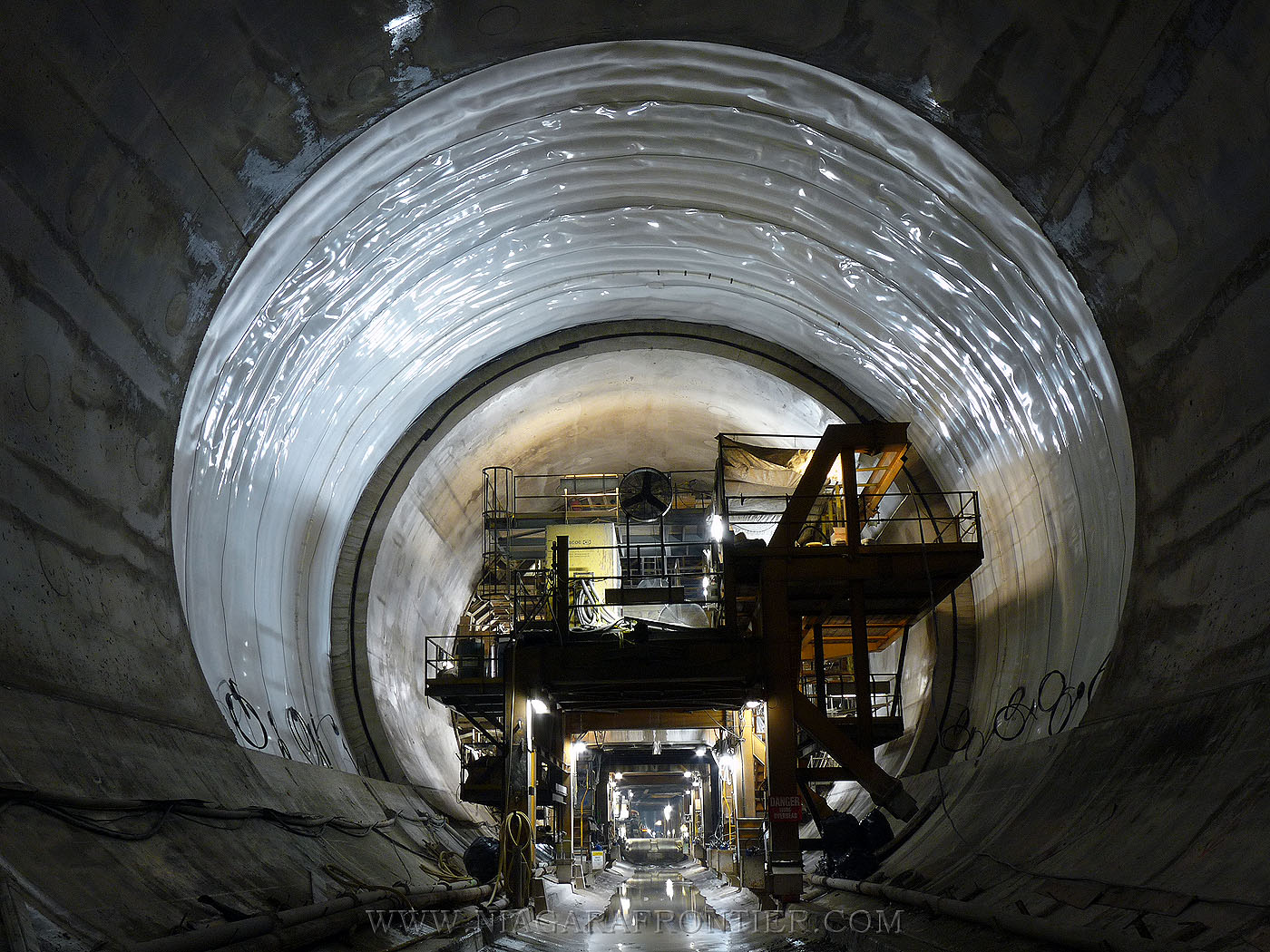
The inside diameter of the finished tunnel will be 12.5
meters (41.1 feet) and will be lined with 50 centimeters (23.62 inches) of un-reinforced concrete with double layer seal and pre-stressed injection
concrete.
The Tunnel Boring Machine will reach its maximum depth of
140 meters (459.3 feet) within the first 1.5 kilometers of operation. The TBM
will operate 24 hours a day - 365 days a year on a 3 shift rotation (8 hours) until completed. The Tunnel Boring
Machine will be operated by two Chief Operators per shift with a crew of
approximately 10 workers onboard. An additional 20-30 men will be employed on
each shift for the required surface support.
May 18th 2006 -
Province of Ontario, Minister of Energy - Donna Cansfield on tour of the
construction site announced the nickname of the Tunnel Boring Machine as "BIG
BECKY". A grade 6 class at Port Weller Elementary School came up with the
winning entry to name the TBM. Under the direction of computer and science
teacher - Kevin Dyck, his class selected the name after much "brainstorming".
They called it BECKY because it is a feminine version that pays tribute to Sir
Adam Beck.
August 8th 2006
-
A ceremony attended by Ontario Premier - Dalton McGuinty and other officials was
held at the starting location of the Niagara Tunnel Project near the Sir Adam
Beck Power Generating Stations. Premier McGuinty threw a switch to turn on the
cutter head of the Tunnel Boring Machine (TBM).
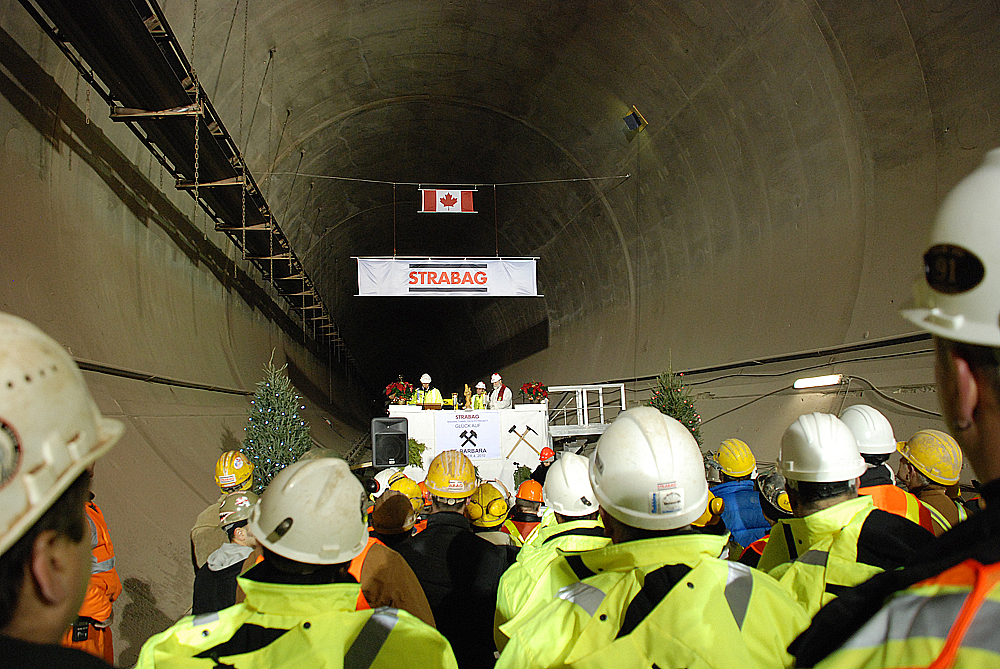
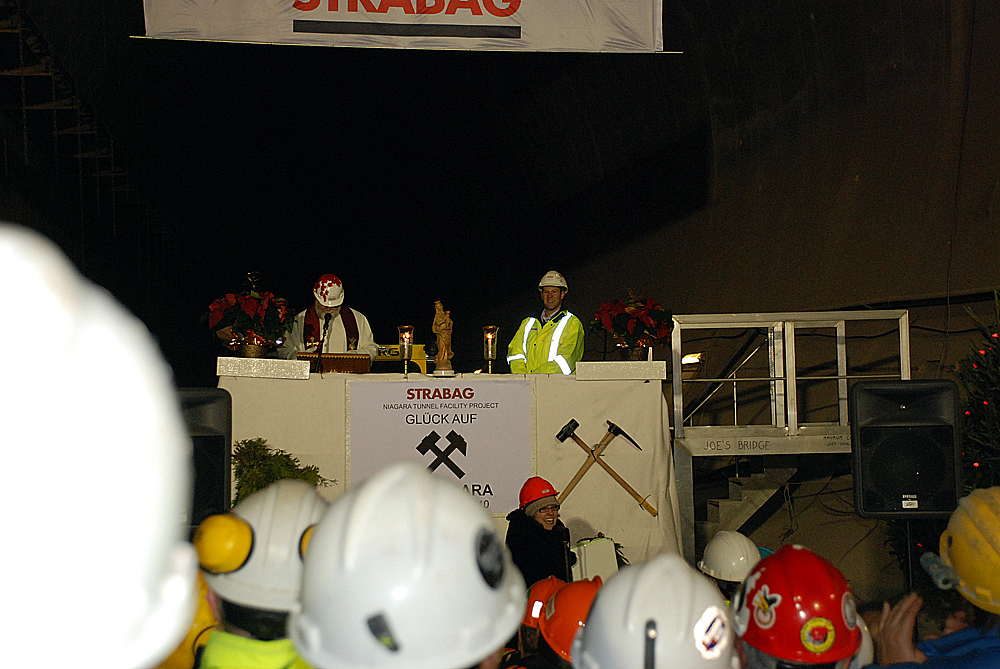
Importing a European tradition, Doctor Robin Williams -
Regional Municipality of Niagara - Medical Officer of Health was named the
patroness of the Niagara Tunnel Project by officials of Strabag AG. Naming a
patroness is based upon a religious tradition of St. Barbara - the patron saint
of miners, construction workers and engineers. Doctor Williams will keep up to
date on the tunnelling project and will be a public ambassador for it. According
to traditions associated with tunnelling, naming a patroness of the tunnel will
keep the workers safe.
LEGEND OF ST. BARBARA
Barbara lived in the 3rd Century AD in Nicromedia, the capital
of the Roman province of Bithnia (Asia Minor). She was the only
child of Dioscuros, a high ranking and wealthy man. Her father
adored her, had her tutored in the best schools of arts and
sciences, and set out to reinforce her faith in the Roman- Greek
Gods.
To protect her from foreign influences, he provided sumptuous
living quarters for her in a tower. But her very loneliness
caused Barbara to think seriously; as a result, she became more
and more convinced that the old gods were but a hollow
imitation.
Without her father’s knowledge, she became familiar with the
teachings of Christ, and had herself baptized. At that time,
Christians were being persecuted nearly everywhere, and
considered as enemies of the state. Adherence to Christianity
was subject to the severest punishment.
Dioscuros planned to marry Barbara to a very prosperous man,
with a view to increasing the family fortunes. At first Barbara
asked for time to reflect. Following his return from a long
journey, Barbara explained to her father that she was a
Christian and did not wish to marry. She had already removed the
different images of Pagan gods from her living room quarters and
had replaced them with crucifixes.
Dioscuros, seeing that his only child had turned to the new
religion and that he himself had been placed at a disadvantage,
was overcome with rage. He handed over his daughter, as a
Christian, to the Roman pro-consul Martianus, a Supreme Court
judge, for the assessment of punishment.
Martianus tried at first by kind persuasion, to make her break
with her faith; but when this failed, he had her thrashed and
cast into jail. Due to the strength of her faith, her wounds
healed immediately. On the following day, she was ordered by
Martianus to pay sacrifice to the pagan gods. When she refused,
she was mutilated in a dreadful way. When she continued to
proclaim her Christian faith, she was sentenced to die by the
sword. Barbara went to her place of execution in cheerful
ecstasy: with her enthusiasm for her true faith. Her last wish
was that God through her experience help all those confronted
with and unprepared for a sudden untimely death.
The Barbarous father was so outraged that he himself severed his
daughter’s head! Immediately following Barbara’s death, a
terrible thunderstorm arose. As punishment for his monstrous
crime, Dioscuros was killed by lightning. This is the story of
Santa Barbara in its oldest form.
Later when Christianity had become firmly established, St.
Barbara was invoked as a protectress against the perils of
lightning. Barbara Day was used as a holiday in the very
earliest festival calendar of the city of Cologne. The belief
became widespread that Barbara could control lightning and other
manifestations of flame and fire. Barbara was adopted as the
patron saint of miners most probably because the mining
profession had to cope with many hazards to life in those days.
Also, the miners formed a large part of those for whom she
prayed in the hours of her own death.
Miners later developed the use of gunpowder for disintegrating
rock, involving manifestations similar to thunder claps and
lightning flashes. This led to their need for special protection
against accidents from the use of explosives, thereby
strengthening the reputation of Saint Barbara as their adopted
patron saint.
Saint Barbara was also a protectress of the plague which
further strengthened her veneration, mothers would pray for
healthy children and miners would mirror that by praying for
plentiful blessings in their mining operations: both seeking a
bountiful production and an enhanced degree of well being.
There are many churches, mines and works of art named after or
produced in remembrance of Saint Barbara. A few examples of
note:
Barbara Cathedral in Kuttenberg (Bohemia) built between 1388 and
1518 in the old silver city. This was thought to be the most
likely source of the Barbara adoration. The cathedral was built
around an already existing Barbara altar in an area with many
Barbara altars present. Kuttenberg has for centuries had on its
coat of arms St. Barbara above the crossed hammer and gad. [Schlaegel
und Eisen-the classical symbol of mining]
Mine names frequently indicated wishes and hopes, in both
Freiberg and Marienberg there was a mine named "St. Barbara
Bonanza". There is also the "St. Barbara Good Hope Vein" in the
Harz Mountains on the German-Austrian border.
August 2006 -
The
Regional Municipality of Niagara and Ontario Power Generation drafted an
agreement that will see approximately 3.5 million tonnes of Queenston Shale
excavated provided to the brick manufacturing industry for free. Queenston Shale
is the sole raw material used for the production of clay bricks in Ontario.
August 2007 -
The
tunnel boring machine (TBM) is nearing the 1,000 meter (3,281 feet) mark.
Progress has been extremely slow because of frequent vertical rock falls as a
result of unforeseen geological rock structures. It is hoped that the unstable
rock sections will soon be behind them as the TBM bores deeper underground . Several
rock falls weighing an estimated 10-20 tons have stopped the boring progress for
lengthy periods. The
maximum depth of 140 meters (459.3 feet) will soon be reached as the TBM reaches
the 1,500 meters mark. In order to reduce the frequency of rock falls,
horizontal support rods are being installed in the rock above the TBM in advance
of the cutter head.
In order to reduce airborne dust pollution at the
debris dump site, a containment building has been erected.
September 22nd 2007-
The tunnel boring machine (TBM) has reached a milestone of the first 1000 meters
(3,281 feet).
January 21st 2008 -
The tunnel boring machine (TBM) is approximately 1,650 meters (5,413 feet) and
is located at it's maximum depth. It's current location is under the
ancient buried St. David's Gorge. Because of very difficult, unpredictable and
unstable rock conditions, the TBM has been progressing at forward rate of
several meters per day. This unfortunate delay in progress
has setback the targeted completion date of this project from 2009 to 2010.
Five - 130 meter deep dewatering shafts from the surface to
the tunnel are being drilled near the Whirlpool Road site approximately 1500
meters from the tunnel outlet. Each of these shafts
will allow the tunnel to be dewatered using massive mobile water pumps if ever
required. Each shaft is approximately 900 millimeters in outside diameter with
the inside diameter of 700 millimeters.
March 1st 2008 -
The tunnel boring machine (TBM) is 1800 meters (5,905 feet) with
continuous roof-line over break.
March 5th 2008 -
Strabag has announced further delays in the Niagara Tunnel Project. The Tunnel Boring machine (TBM) has been making very
slow progress under very unstable rock conditions. Big Becky might have to chart a new course and
revise her schedule to make up for time lost while digging through difficult
rock conditions. Progress on the Niagara Tunnel Project continues to
be slower than both Ontario Power Generation and Strabag AG, the Austrian
company hired to build the 10.4-kilometre tunnel, expected, officials with both
companies say.
"You're dealing with nature. You can't predict the
rock condition for 10 kilometers," said Ernst Gschnitzer, Strabag's project
manager, who oversees the construction of a third hydro tunnel under the city of
Niagara Falls.
What excavators call "over- break" continues to be the problem, the same situation
that slowed progress last year. Once Big Becky, the nickname for the $35-million
tunnel-boring machine, cuts a portion of the tunnel, loose rock from the ceiling
falls in behind the machine.
The cavities will be filled in to make a smooth surface before the tunnel is
finished, he said. But for now, removing the rock and digging through "unstable"
material is hindering progress.
To compensate for the delays, Strabag wants to alter the alignment of the
tunnel, both vertically and horizontally.On the south side of the St. David's Gorge, the tunnel will go higher than first
planned. That will allow the excavation to get out of the difficult conditions
and into more predictable rock, said Gschnitzer.
According to the Niagara Peninsula Conservation Authority, the buried St. David's Gorge is
an abandoned channel that has been filled in with a glacial debris including
gravels, sands, tills, silts and clays. The ancient gorge is thought to have
been 116 meters (380 feet) wide and up to 79.25 meters (260 feet) deep. It has been estimated at approximately 22,000 years old.
A portion of the tunnel will also be shifted a bit to the east - or toward the
Niagara River - from its original alignment, which ran approximately underneath
Stanley Avenue.
Strabag has applied for necessary approvals to make that change. The company
expects to hear a decision in a few months, Gschnitzer said. The August 2010
target for completion also needs to be adjusted.
"We hope it won't change that much. It will go into 2011," said Gschnitzer.
Last fall, Ontario Power Generation's board approved August 2010 as the
completion date for the tunnel. When work began in September 2006, Strabag
expected it could complete the work by fall 2009.
OPG says Ontario taxpayers are protected from cost overruns because it gave
Strabag a design-build contract meaning the company agreed to build the tunnel
for a fixed price, said OPG spokesman John Earl. The tunnel work is pegged at
$600 million.
At the beginning of March 2008, the TBM had excavated 1,800 meters of the
10.4-kilometre tunnel.
By December 31st 2007, the TBM had excavated 1,609 meters of the tunnel.
By September 2007, the TBM had excavated 1,350 meters of the tunnel, less than
half the distance Strabag had hoped for at that point.
Once the TBM excavation reaches 2,300 meters (2.3 kilometers), Strabag will be
in a position to reassess how to make up for lost time in the remaining 8.1
kilometers of the tunnel.
May 10th 2008 -
The TBM - Big Becky has reached the 2,000 meter mark.
May 24th 2008 -
The TBM - Big Becky has passed the 2 kilometer
point in the Niagara Tunnel Project, but is so far behind that Ontario Power
Generation (OPG) and Strabag AG are reviewing the cost of the $630-million
project and its schedule.
"The Niagara tunnel is progressing slower than
planned. The drilling conditions have been challenging," president and chief
executive officer Jim Hankinson said Friday. OPG is officially sticking to its
August 2010 completion target, which had already been revised once from 2009.
But Ernst Gschnitzer, project manager for Strabag, the Austrian company
contracted to design and build the tunnel, predicted it won't be completed until
much later.
"It's going to be 2012. We don't see any possibility to be quicker, at present,"
Gschnitzer said.
After 2 kilometers, the TBM is one-fifth of the way into the 10.4-kilometre
tunnel that will connect the Sir Adam Beck generating stations to the upper
Niagara River, south of Dufferin Islands.
At the end of March, OPG's first fiscal quarter, the tunnel boring machine had
advanced about 1,848 meters. That's 239 meters further than where it was at the
end of 2007, based on OPG figures.
For the first three months of 2008, Big Becky was digging an average of 2.6
meters a day - considerably slower than what had been hoped could be an average
rate of 15 meters a day.
As part of the review, three independent experts are examining how the project
has gone since work began. They're looking for mistakes that might have been
made and ways to improve progress, an OPG official said. Those experts are
expected to consult with both OPG and Strabag in June. OPG expects to have a
better understanding of how the cost and schedule will be affected by July.
"We will provide further details about changes in the schedule and the cost when
they are available," Hankinson said in a conference call to discuss the Crown
corporation's first quarter results for 2008.
Tunnel construction has been slowed by the loose rock conditions under the St.
David's Gorge - the area near the whirlpool - that have dogged the project almost
since it started. As Big Becky - the nickname for the tunnel-boring machine -
advances, loose rock from the tunnel ceiling falls in behind it. That "over-break"
rock has to be removed. The cavities in the rock will be filled in when the
tunnel's concrete lining is poured.
"Once we get beyond the St. David's Gorge, we do expect better performance,"
Hankinson said.
The tunnel-boring machine was 2,077 meters into the tunnel as of Friday,
Gschnitzer said. His company expected to be "much further" along than it is now,
after 20 months. "I can't even tell you - several more kilometers," he
said. Removing the "huge amount of over-break material" is the ongoing
challenge, he added.
It's impossible to know for certain what rock conditions exist before
construction starts, Gschnitzer said. OPG could have spent more than $100
million on a more extensive rock study, he added, but "you would never be able
to anticipate these rock conditions 100 per cent." Strabag has bought more
equipment to remove that rock material faster. That reduces the time the
tunnel-boring machine loses, Gschnitzer said.
"We have worked on a consistent basis to make improvements. The rock conditions
aren't changed," he said.
OPG agrees the pace has picked up. "In the last couple weeks, our progress
has been much better - more like six or seven meters a day," Hankinson said.
OPG's report predicts "considerable uncertainty" about the schedule and cost
until Big Becky reaches the 2,300-metre mark, the point when the loose rock is
expected to turn to harder rock, reducing the over-break concerns. Ontario
Power Generation plans to review the entire $985-million estimate of the Niagara
Tunnel Project. That estimate includes some work OPG is doing not directly
related to the tunnel, including the refurbishing of the Toronto Power station
on the Niagara Parkway.
On May 29th 2008, the TBM had progressed to 2,114
meter. Now slightly south of the St. David's buried gorge, the TBM was averaging
up to 7 meters per day but still experiencing heavy over-break (rock fall from
the roof of tunnel).
May 29th 2008 -
The tunnel boring machine (TBM) is 2114 meters (9,936 feet) with
continuous roof-line over break.
July 11th 2008 -
Big
Becky is behind schedule and potentially over-budget, but the Niagara Tunnel
Project is so "integral" to Ontario's electricity supply the government is
prepared to pass cost overruns onto provincial
electricity customers, Premier Dalton McGuinty says. If
there are additional
costs that fall to us, that is regrettable.
But these
things happen from time to time in large-scale construction projects," McGuinty
said in an interview Thursday, following a funding announcement at Niagara
College. Despite lingering questions about the cost and timetable, McGuinty
remained bullish.
"We're absolutely committed to finishing this project. We need that clean
electricity," McGuinty said. "We're not going to build another coal
plant."
Ontario Power Generation, the publicly-owned electricity producer, and Austrian
contractor Strabag AG are now trying to sort out who will pay for expenses if
the tunnel work goes above its $600-million budget.
Loose rock conditions have plagued construction of a third tunnel that will
divert water from the upper Niagara River to the Sir Adam Beck
generating stations since work began nearly two years ago.
It was a problem for the first 2,300 meters of the tunnel, the portion between
the Beck generating stations and the St. David's Gorge.As
the tunnel-boring machine nicknamed Big Becky inches along, overhead rock falls
in from the tunnel roof and needs to be removed.
OPG and Strabag AG met for two days last month with their "dispute review
panel," a three-member board created before
the project began. The expert panel is expected to make recommendations in
September about how to assess additional costs incurred because of the
rock conditions.
"In general, it's about the different rock conditions and who is going to be
responsible for these rock conditions," said Strabag's project
manager Ernst Gschnitzer.
Strabag says the rock is not what the company expected based on geological
information OPG provided before the company bid on the
contract.
"The rock is
different than anticipated," Gschnitzer said.
OPG says the contract holds Strabag responsible for overruns. Strabag was given
a design-build contract, meaning they agreed to do it
for a fixed price of $600 million.
"The contract has been done in a way that as much of the risk has been
transferred to the contractor as can be done," OPG's chief
operating officer Pierre Charlebois said in an interview.
Before asking for bidders, OPG bored test holes in the rock to give them an idea
of the type of rock they would be excavating.
"Bore holes tell you one thing," Charlebois said, but doing the actually digging
with a 14-metre diameter boring machine is
another.
It could mean an increase in electricity rates if Ontario Power Generation is
deemed to be responsible for some of the
overruns and if they use up the undisclosed contingency fund the
provincially-owned generation company included as part of the Niagara
Tunnel Project.
Under the contract, OPG pays Strabag for progress, meaning payments are made as
the tunnel moves forward. Charlebois
emphasized it's "premature" now to say whether the project will go over-budget.
But if it does happen, OPG will recover its costs through the rates the company
charges for power. The rate-recovery process allows OPG
to spread those costs over a 100-year period, Charlebois said.
While OPG and Strabag await the dispute panel's recommendations, work continues.
Both companies say progress has improved now
that excavation is past the St. David's Gorge. The tunnel boring machine (TBM) is
2,475 meters into the 10.4 kilometer tunnel. The pace has picked up to an
average of eight meters a day from the 2.6 meter average in the first quarter of
2008. But it is still below the 12 meters a day goal set when work began.
July 18th 2008 -
The TBM had
tunnelled 2,528 meters and was progressing at a rate of 8 - 9
meters
daily. The over-break (rock falling from the ceiling) was continuous
August 22nd 2008 -
The tunnel boring machine named "Big
Becky" is taking a short cut. Two years after construction of the Niagara Tunnel
Project began, Ontario Power Generation confirmed both the horizontal and
vertical alignments will be changed to cut costs and make up for lost
construction time.
"The horizontal realignment has been adopted which will reduce the total length
by 200 or 300 meters," Pierre Charlebois, Ontario Power Generation's chief
operating officer, said Friday.
Ontario Power Generation is building a 10.4-kilometre tunnel under the city of
Niagara Falls to bring more water from the upper Niagara River to the Sir Adam
Beck generating stations in the city's north end. But the Niagara Tunnel Project
has been plagued with delays caused by the loose rock in the St. David's Gorge
area. As the tunnel-boring machine, nicknamed Big Becky, moves along, overhead
rock falls in and has to be removed. It has created what OPG regularly calls
"considerable uncertainty" about the $600-million budget and schedule. Plans
originally called for it to be completed in 2010, but the contractor has
suggested 2011 is more realistic. A realignment was suggested by Strabag AG, the
Austrian company hired by OPG to build the tunnel. Original plans called for the
tunnel to run north-south, a bit west of Stanley Avenue.
"We have decided to change the horizontal alignment. "We will enter into a
curve a little bit sooner," said Ernst Gschnitzer, Strabag's project manager.
The new alignment will put the tunnel "more or less under Stanley Avenue," he
said. "There is a slight cost advantage. There is an advantage in flow capacity.
The tunnel can deliver slightly more water, once it's in service."
Recent excavation has occurred at about seven meters a day. At that rate, a
200-metre short-cut would save about 28 construction days. Strabag also plans to
change the vertical alignment of the tunnel - the point at which the tunnel will
begin rising toward the surface from its lowest point. Tunneling is taking
place 140 meters (459 feet) below the surface to get underneath the St. David's
Gorge. The vertical re-alignment has been approved, but not formalized,
Gschnitzer said.
Both OPG and Strabag say they believe the pace will quicken now Big Becky has
advanced past the troublesome rock conditions of the buried gorge.
It was at the 2,812-metre mark as of Friday (August 22nd), Gschnitzer said.
That's a little more than one-quarter of the length of the entire tunnel.
Ontario Power Generation and Strabag have discussed how to improve the pace.
OPG and Strabag are working through a dispute-resolution process to determine
which company will be responsible for additional costs resulting from the delay.
Strabag has said the rock conditions aren't what the company expected based on a
geological report prepared by OPG. A three-member panel held a hearing June 23
and is expected to make a recommendation by the end of September. "The
schedule delay and the issues currently being considered by the dispute review
board could impact the project cost," OPG's report states.
August 27th 2008 -
The tunnel boring machine (TBM) is 2862 meters (9,390 feet) into the 10.4 kilometer tunnel
with continuous roof-line over break of 1.5 meters. Progress is averaging 8
meters per day.
October 2nd 2008 -
The tunnel boring machine (TBM) is 3,131 meters (10,5073 feet) into the 10.4 kilometer tunnel
with continuous roof-line over break of 1.5 to 2.5 meters. Progress is averaging
8 meters per day.
October 20th 2008 -
As a result of an agreement between Strabag and OPG, the tunnel boring machine
has begun altering it's course from the original planned path. The new alignment
will basically follow a north-south route under the existing Stanley Avenue. The
former path followed an alignment underneath the existing twin tunnels west of
Stanley Avenue. This former alignment required the TBM to maintain a greater
depth to create a safe buffer from the tunnels above.
The Queenston shale continues to be a great source of over-break causing lengthy
delays. As the cutting head bores into the rock face, a large amount of
unsupported roof shale is collapsing onto the TBM. This causes the stopping of
the TBM until the fallen rock debris is removed and the roof stabilized. With
the St. David's buried gorge behind them, the rock conditions were hopefully
expected to improve: have not. Strabag and OPG have agreed to change the
trajectory of the TBM in an upward movement until the TBM reaches a more stable
rock strata of Whirlpool Sandstone. Final approval of the change in trajectory
of the TBM by OPG is further slowing progress.
The tunnelling is stopped for a six week maintenance period. The tunnel is 3,200
meters in length.
December 2008 -
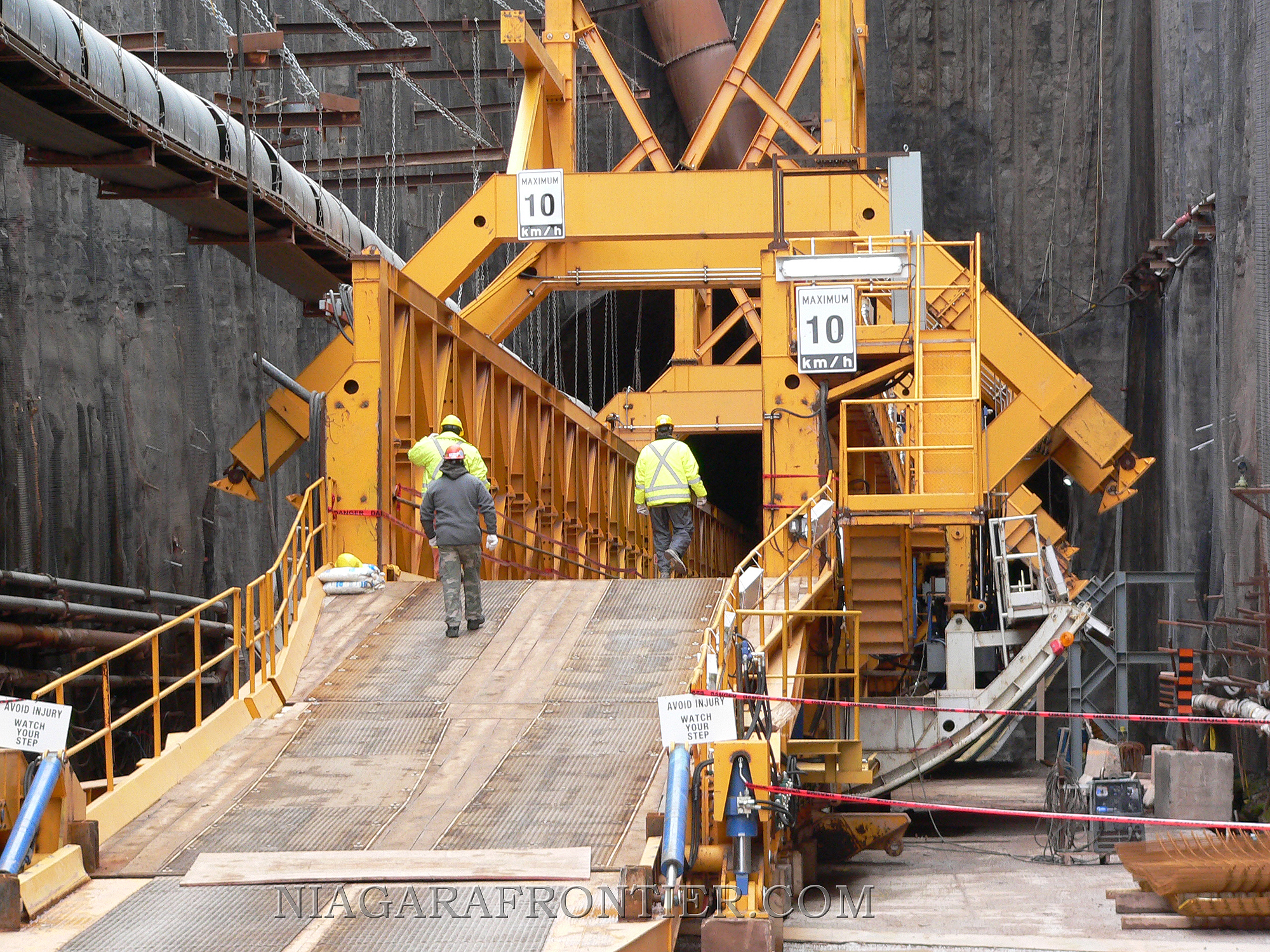
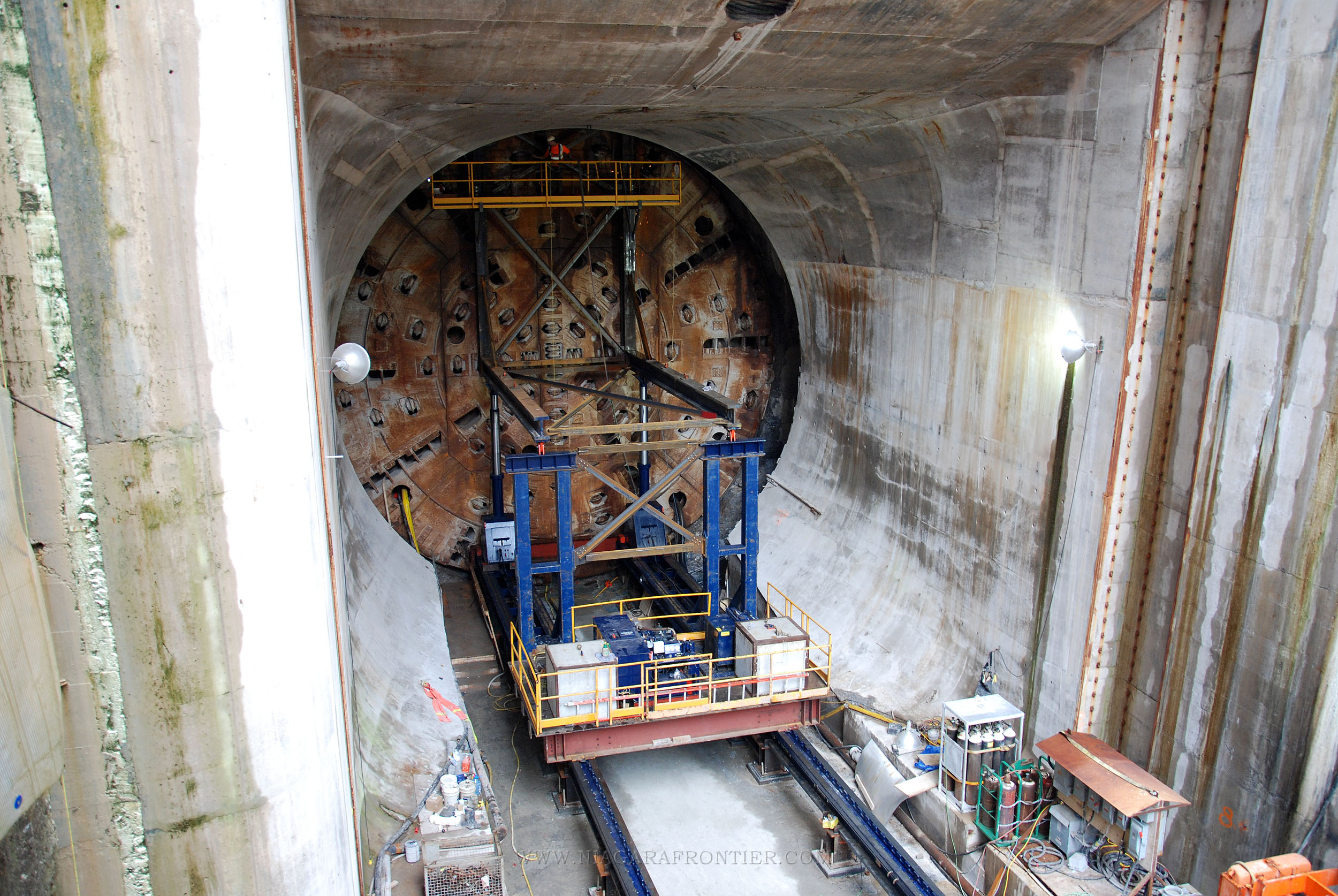
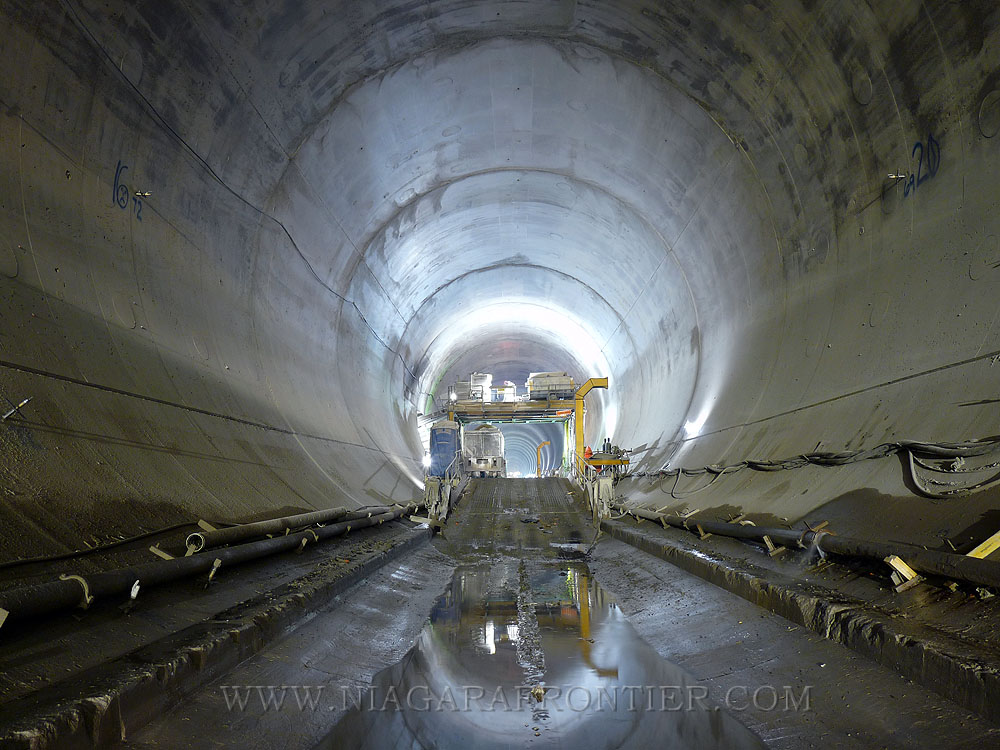
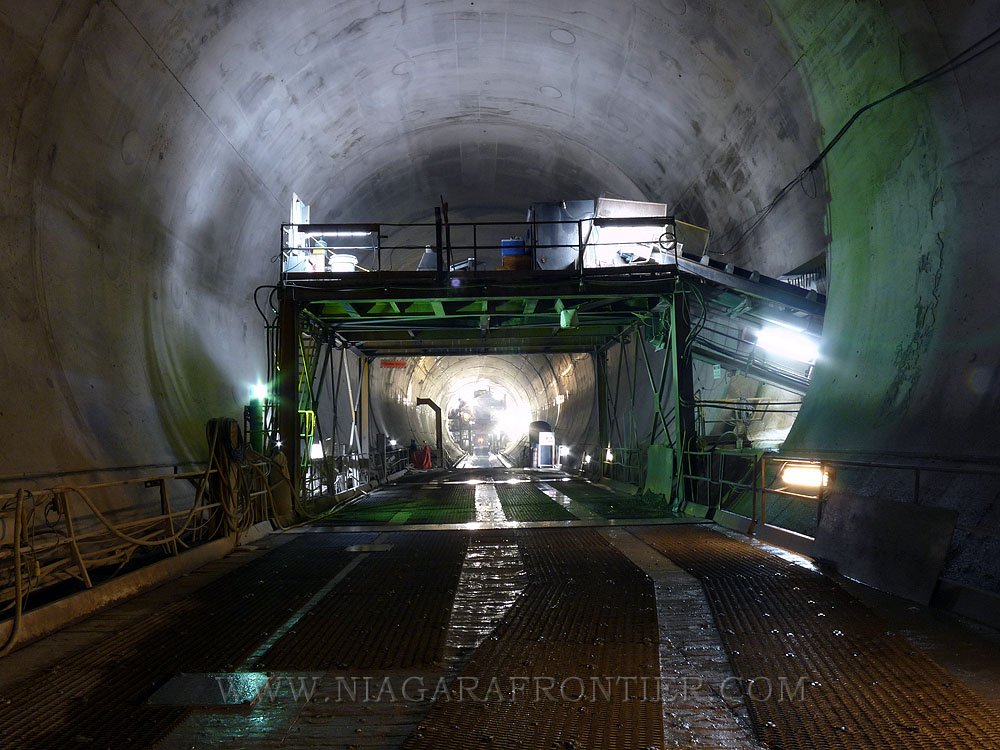
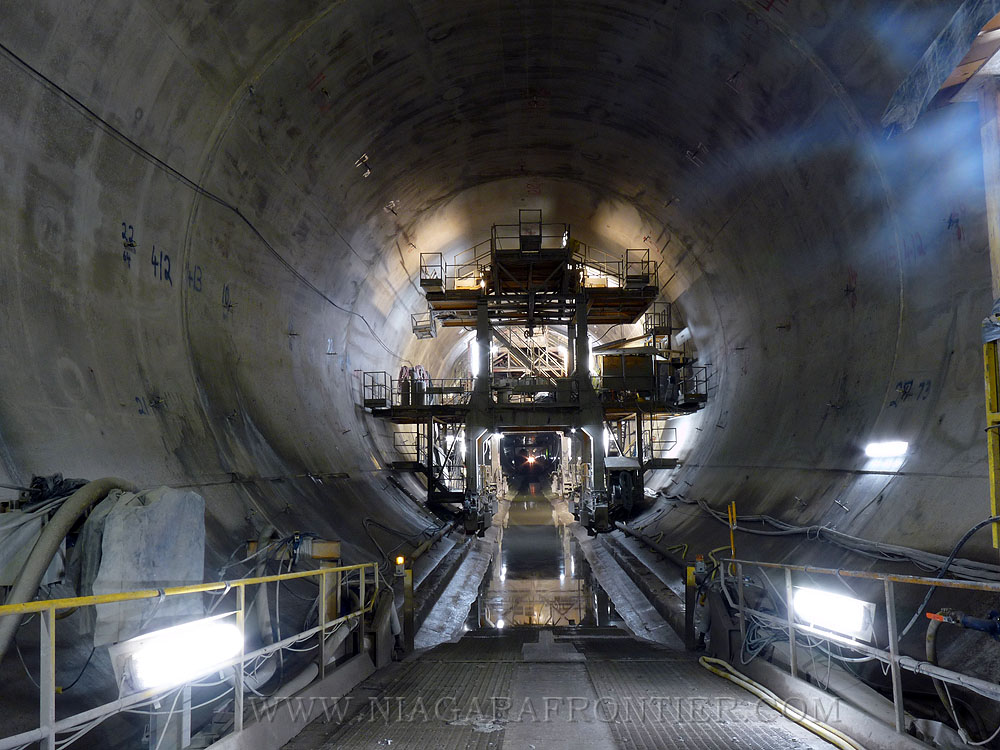
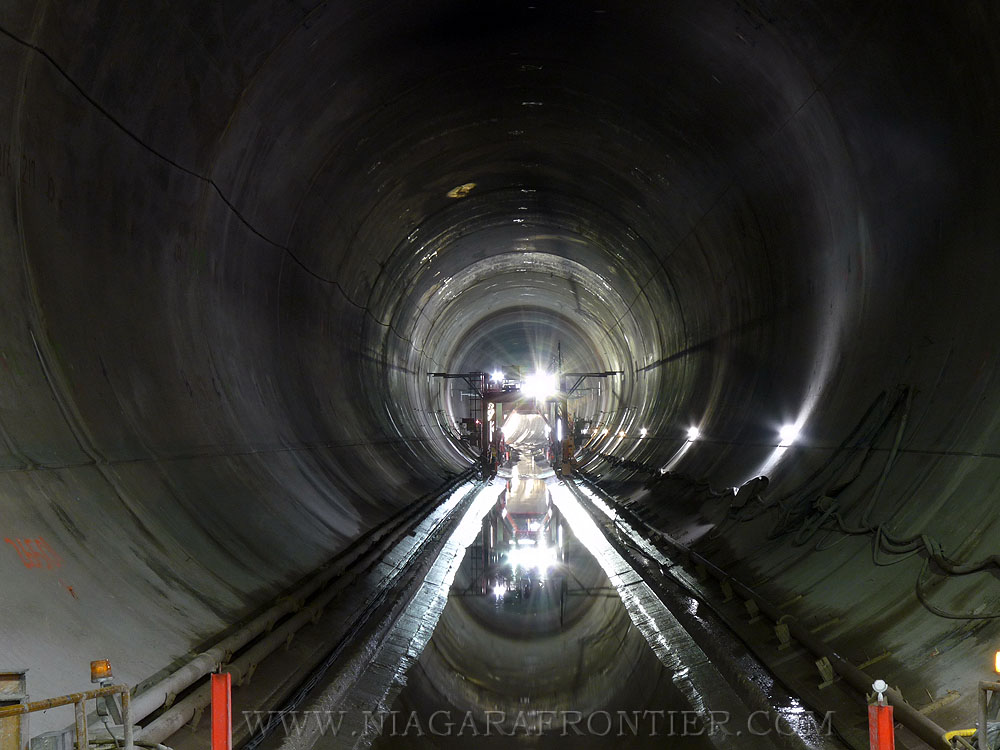
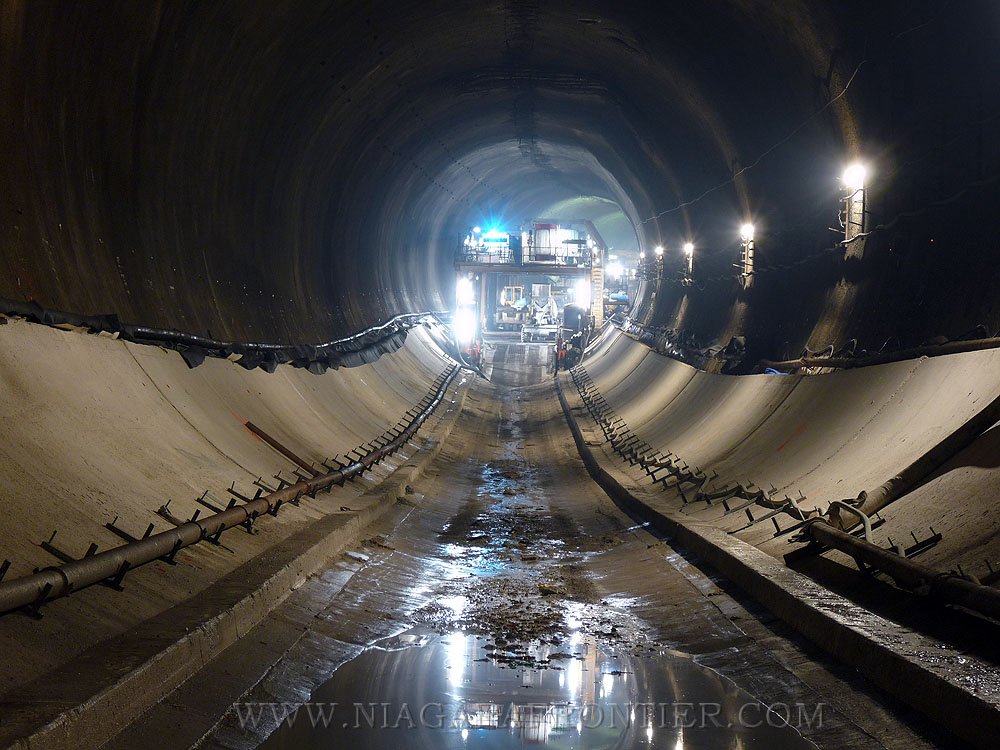
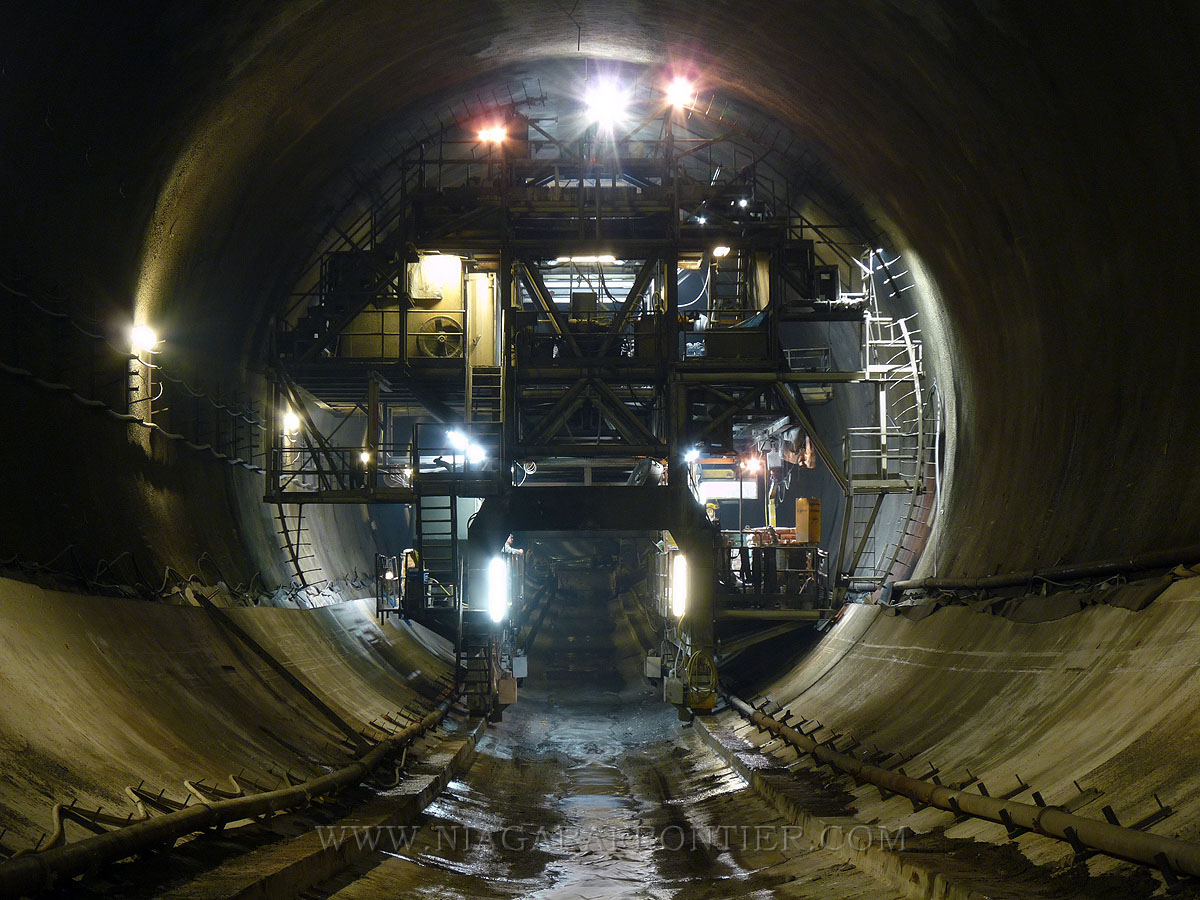
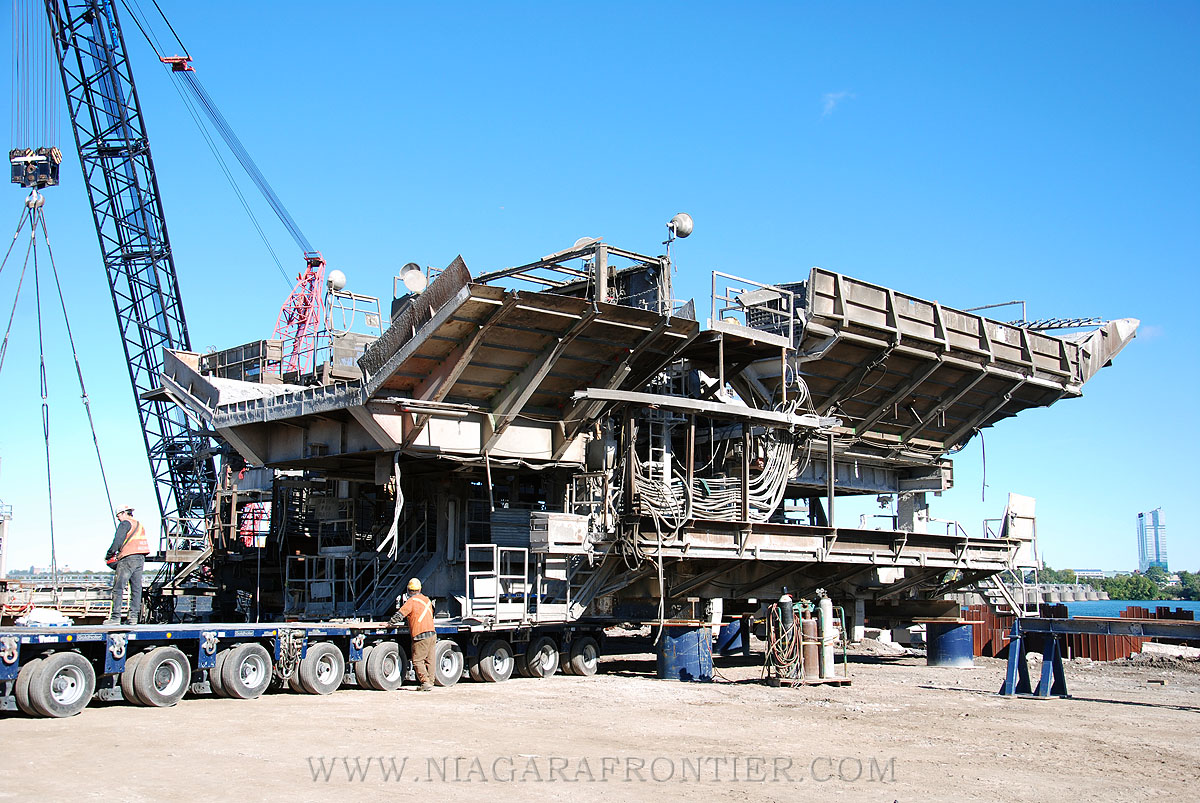
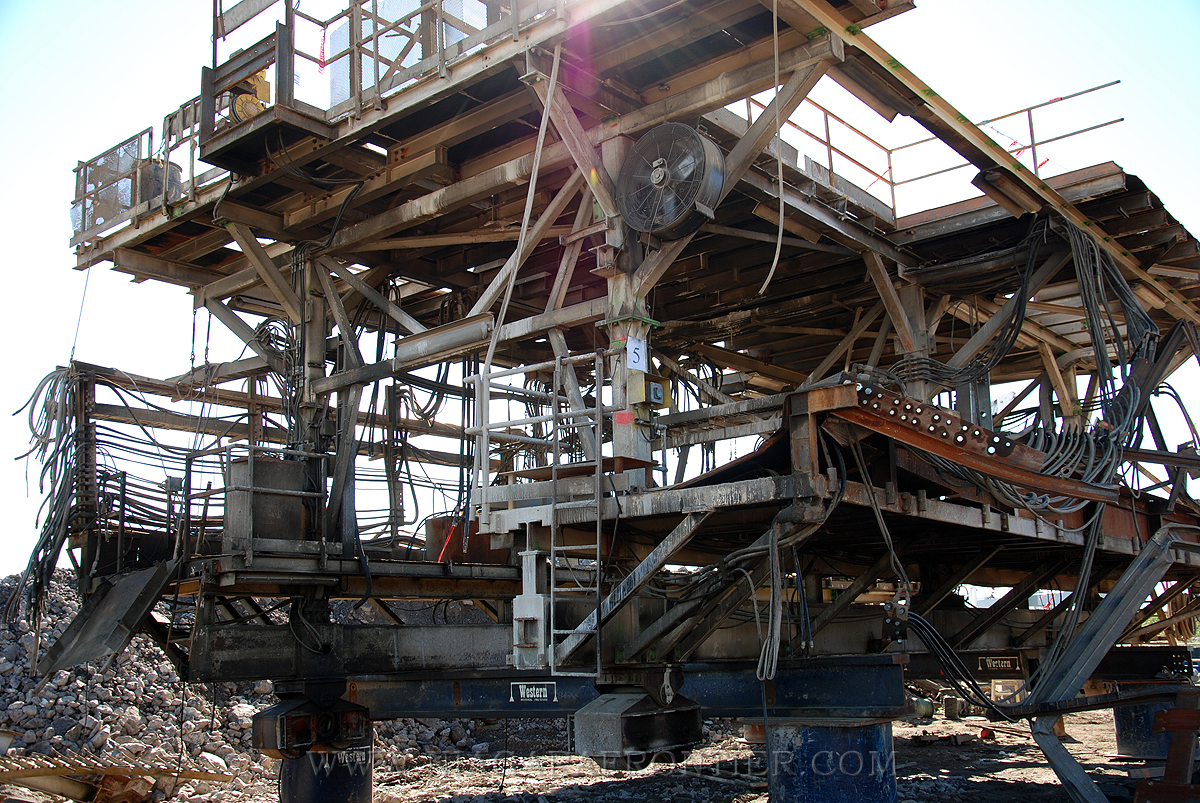
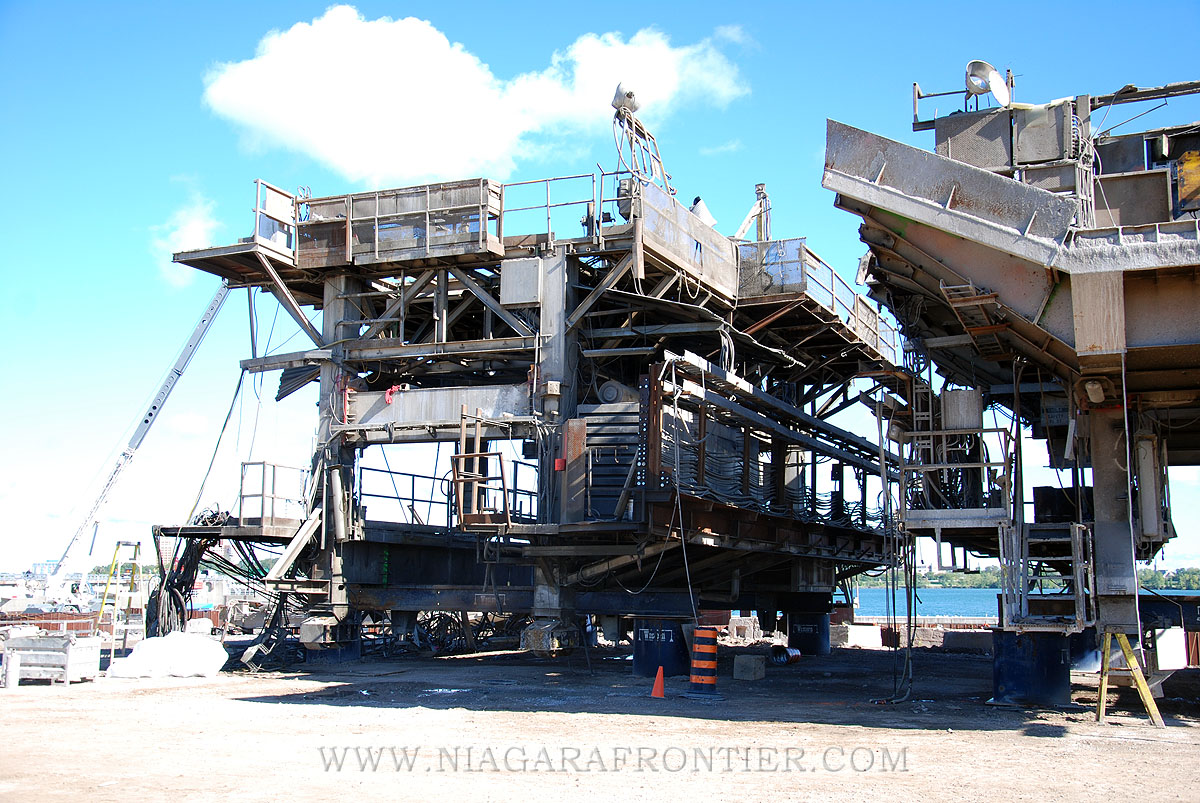
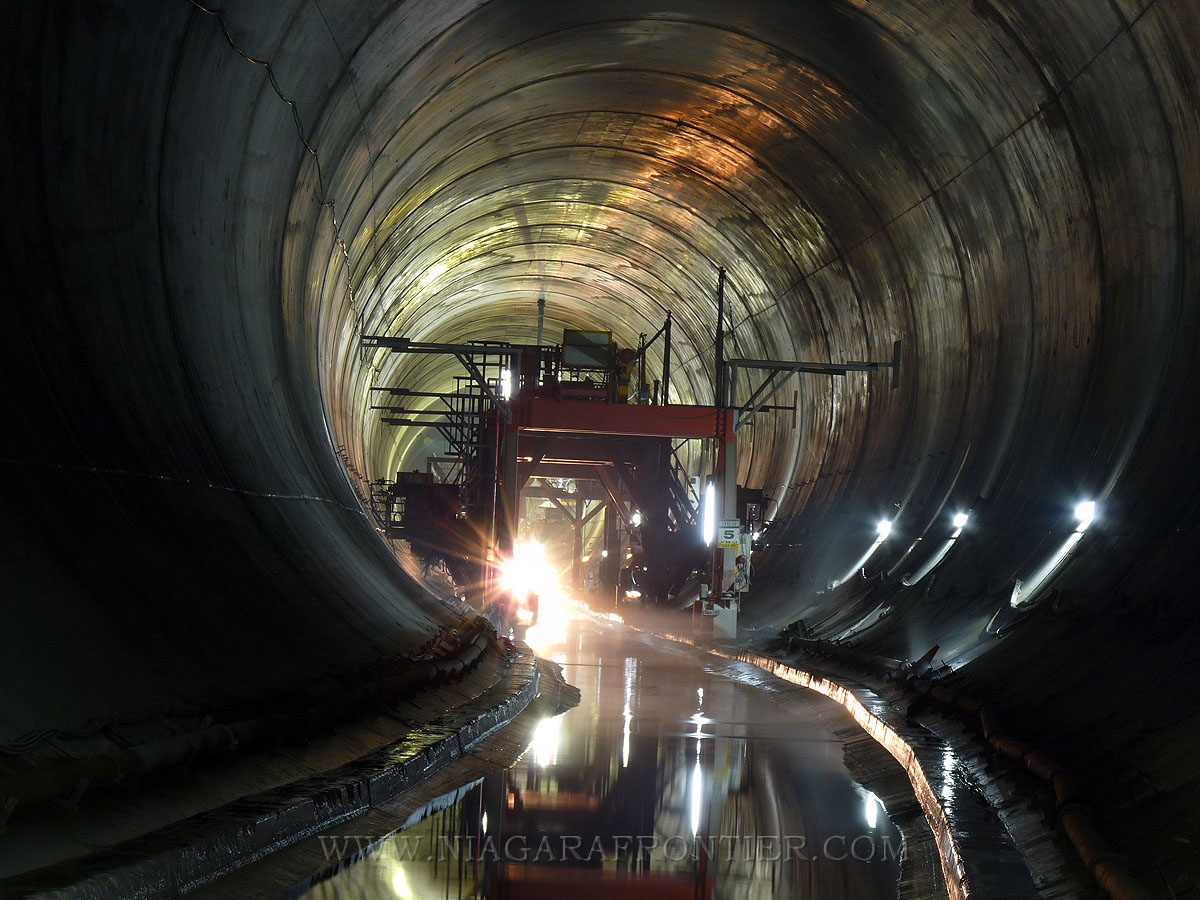
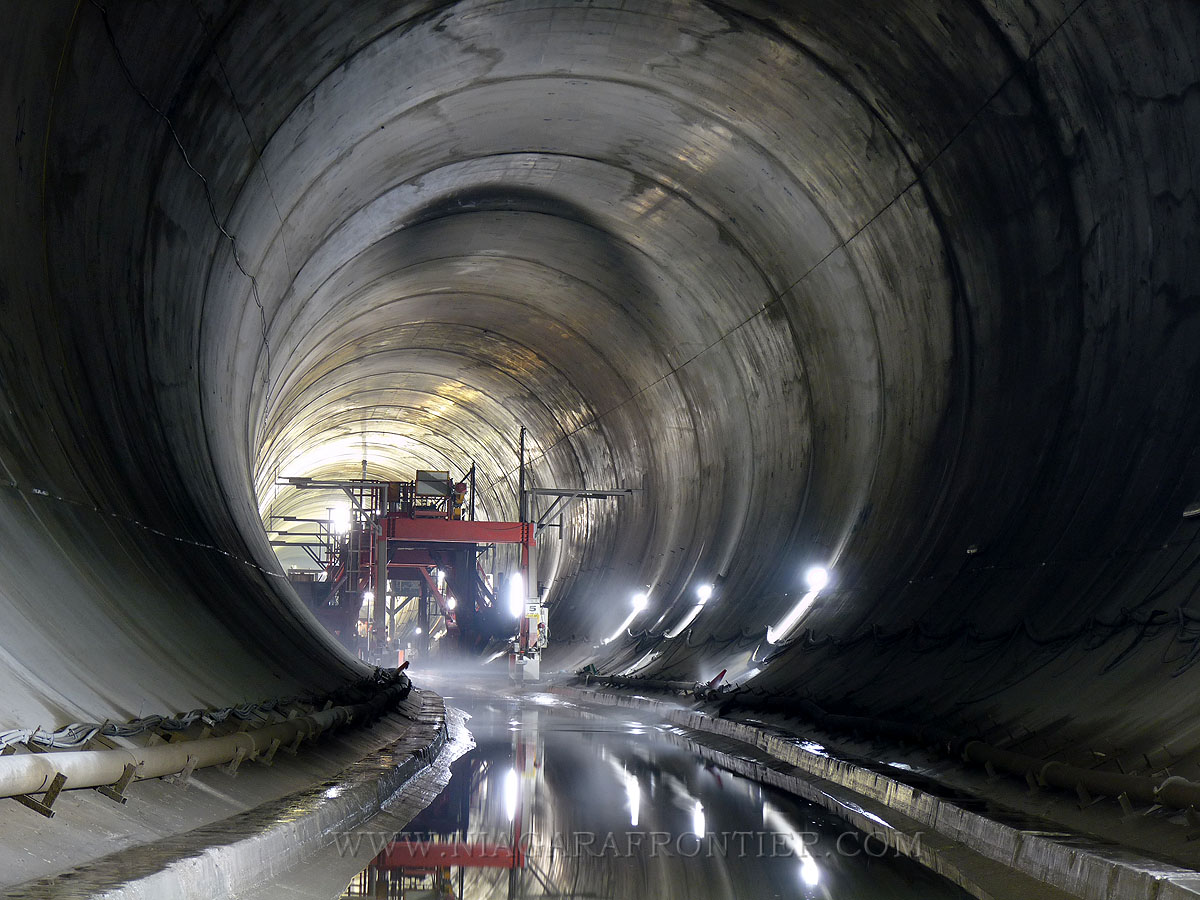
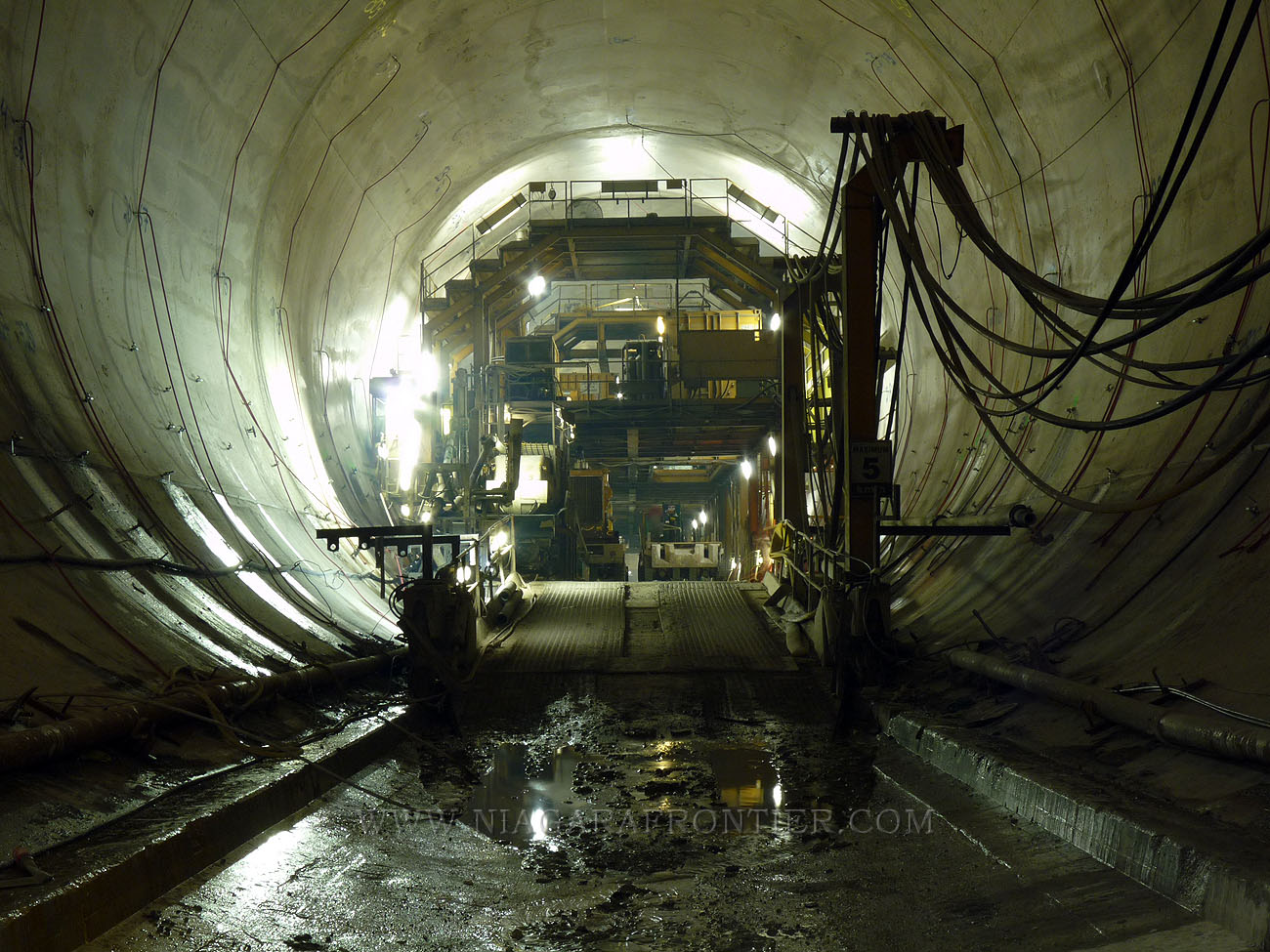
The Invert Concrete Formwork Bridge has been walked into position. The first two
bays have been lined with the waterproofing membrane and the first concrete pour
is scheduled for Friday December 12th 2008.
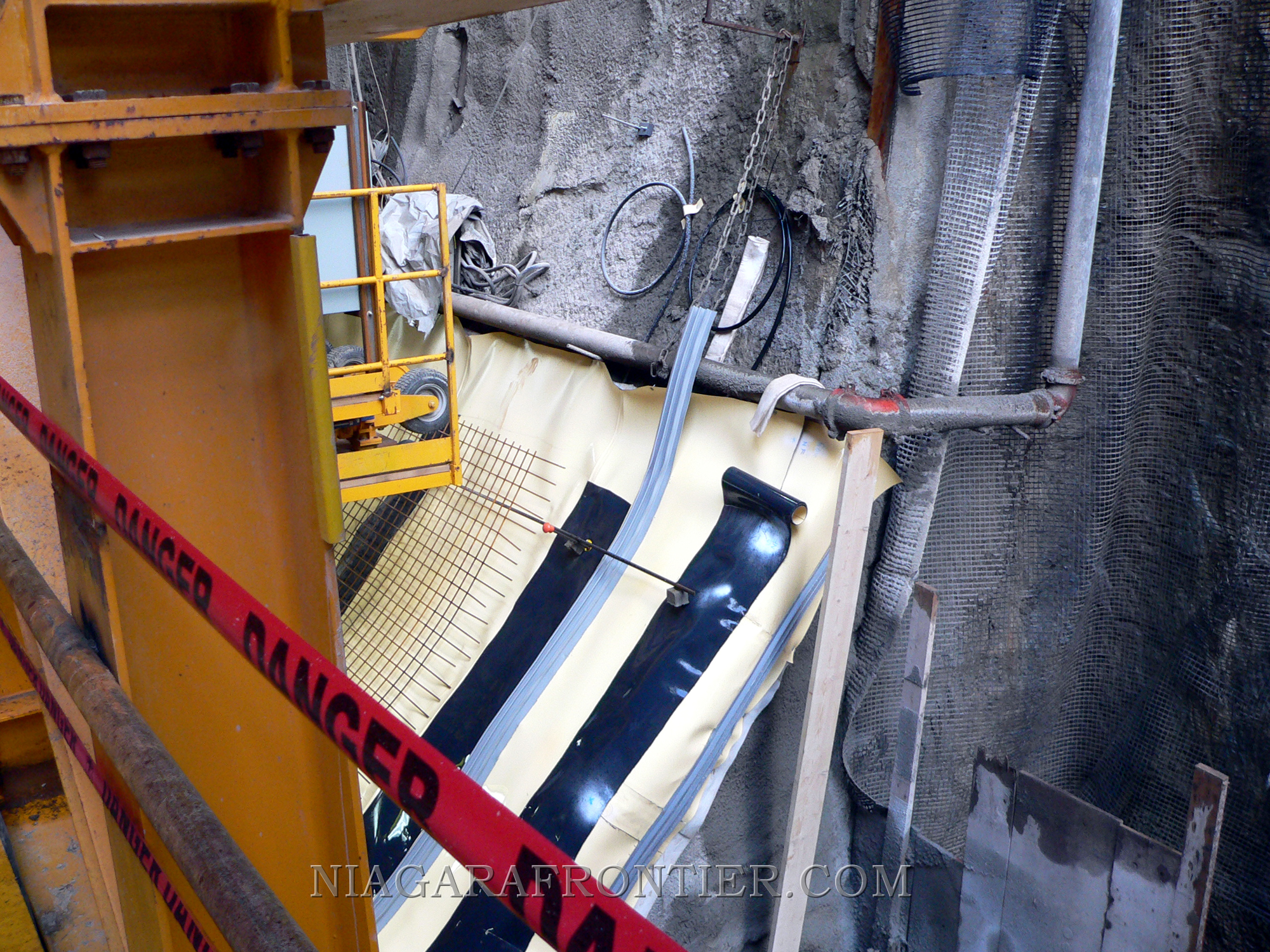
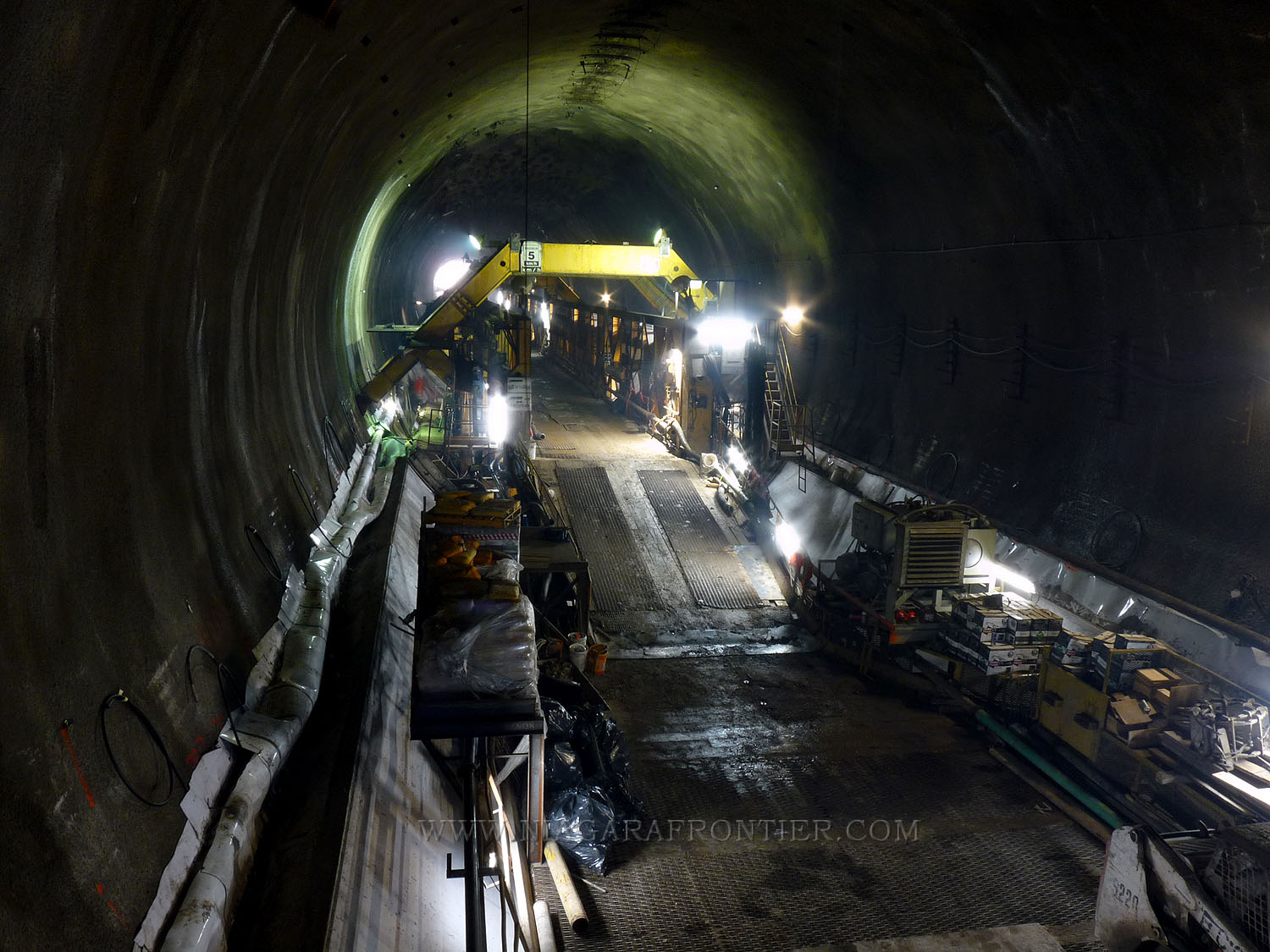
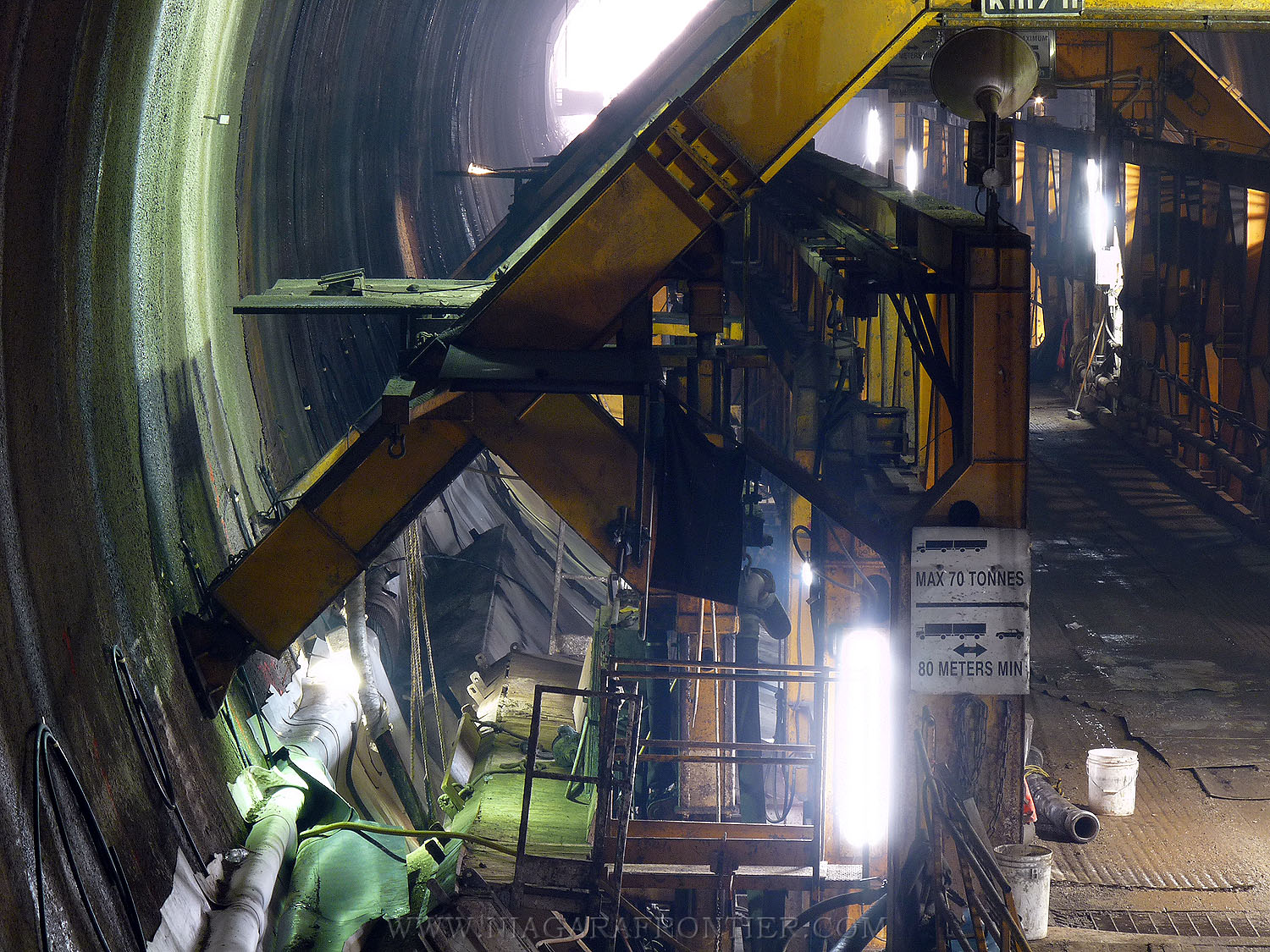
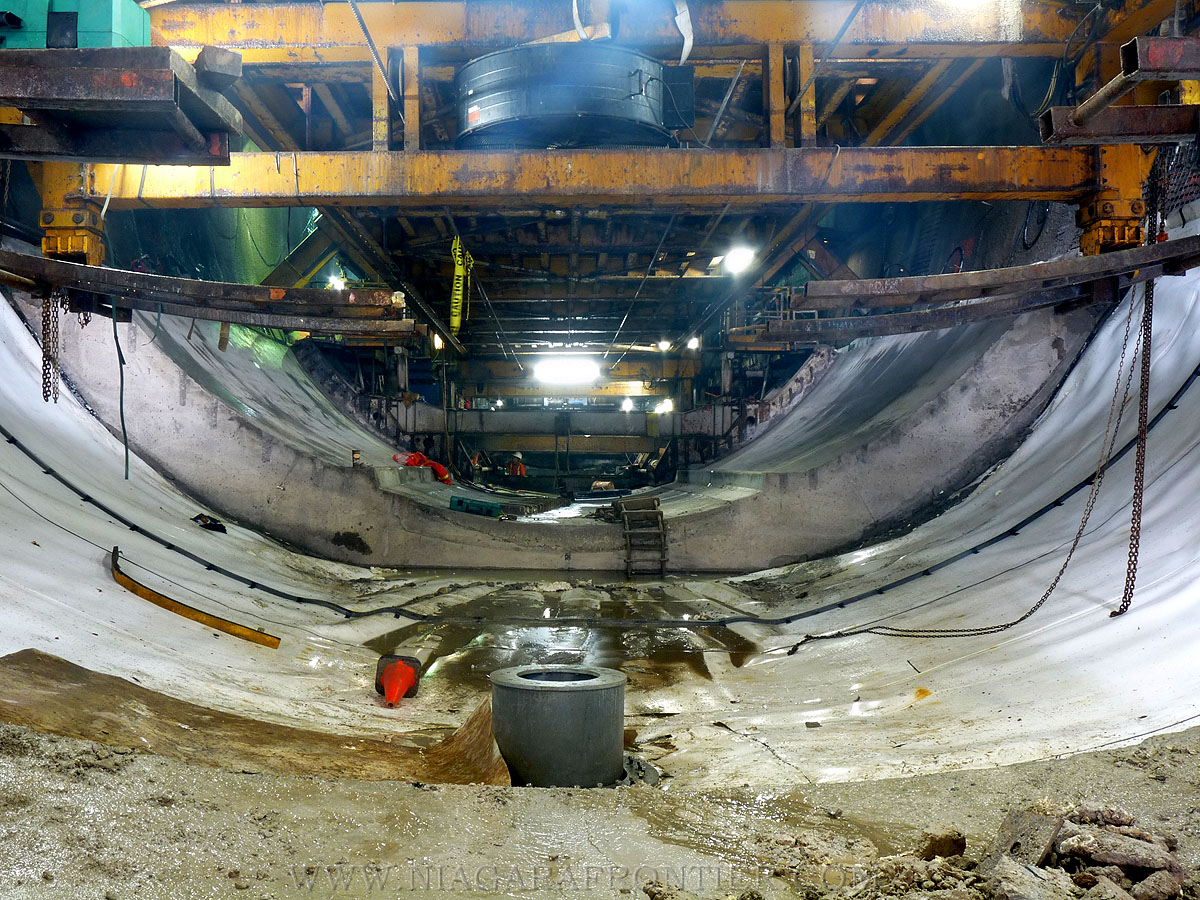
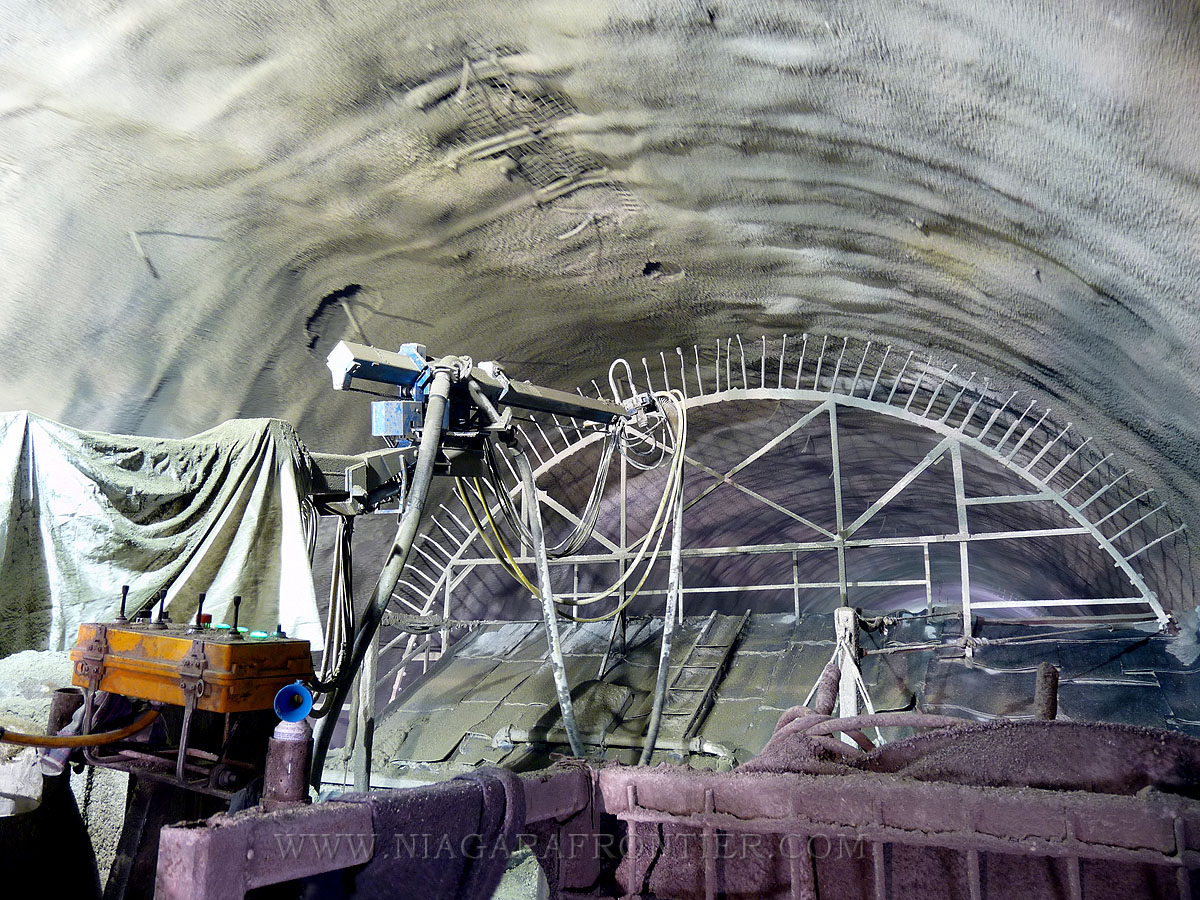
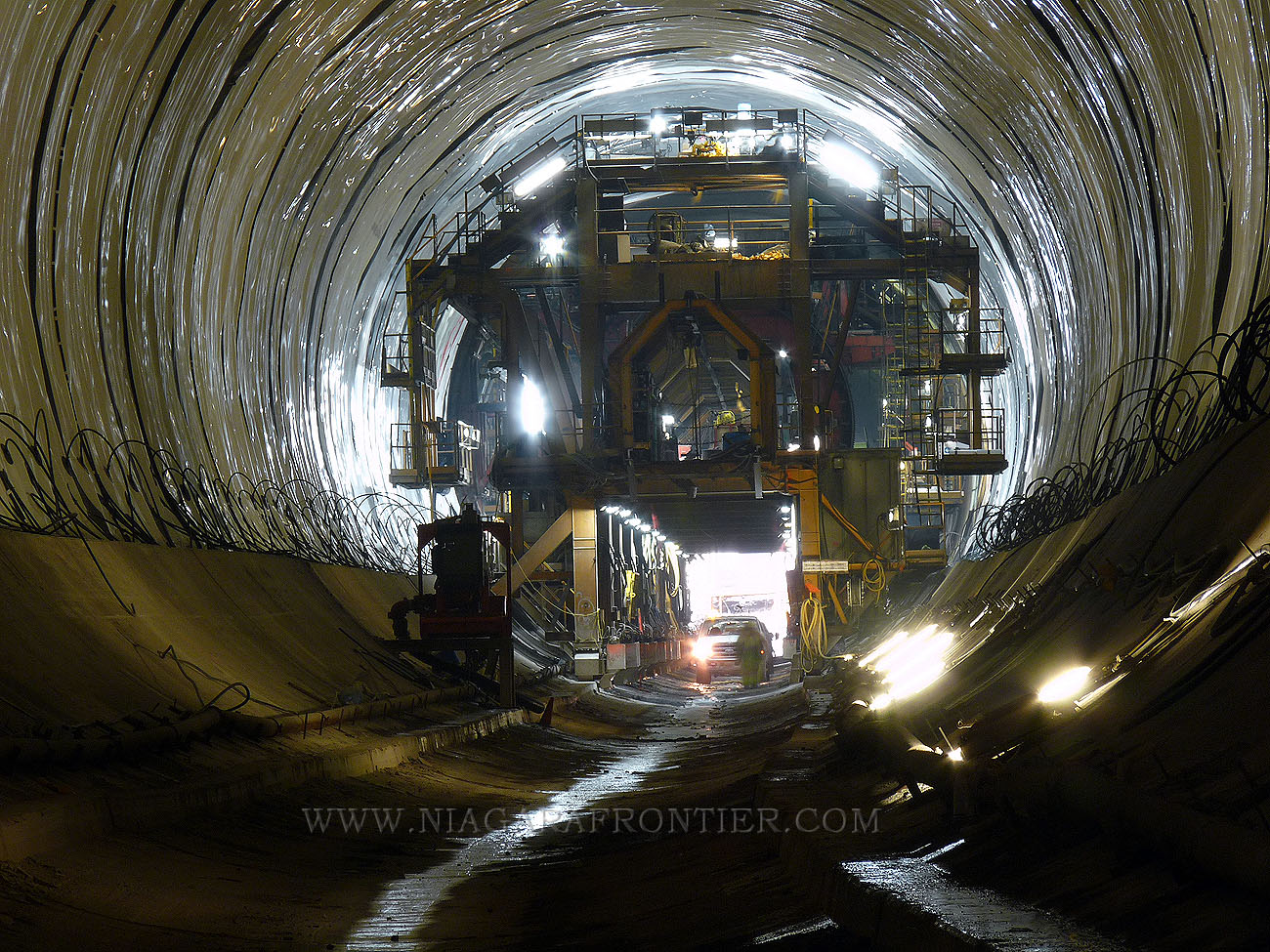
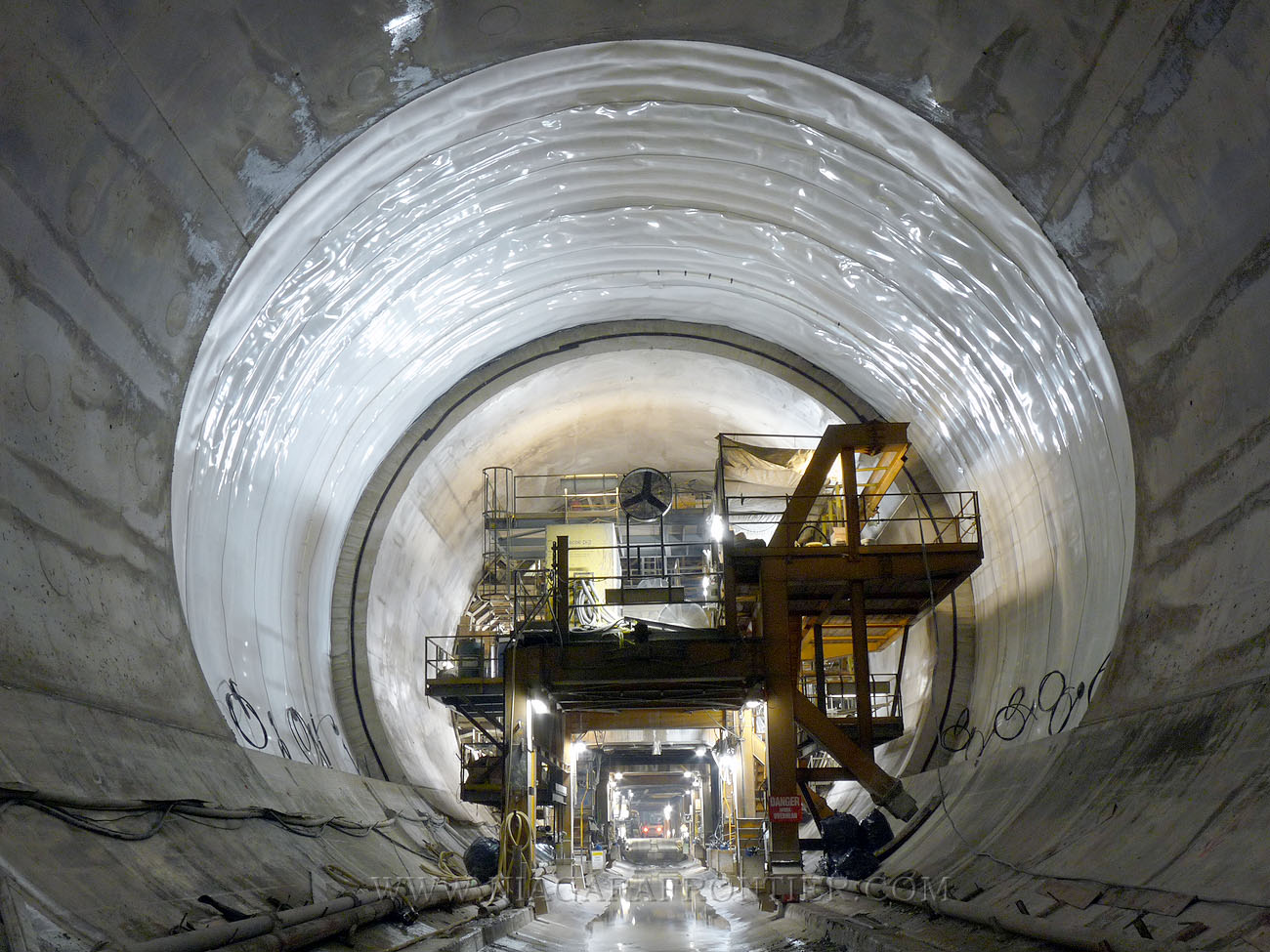
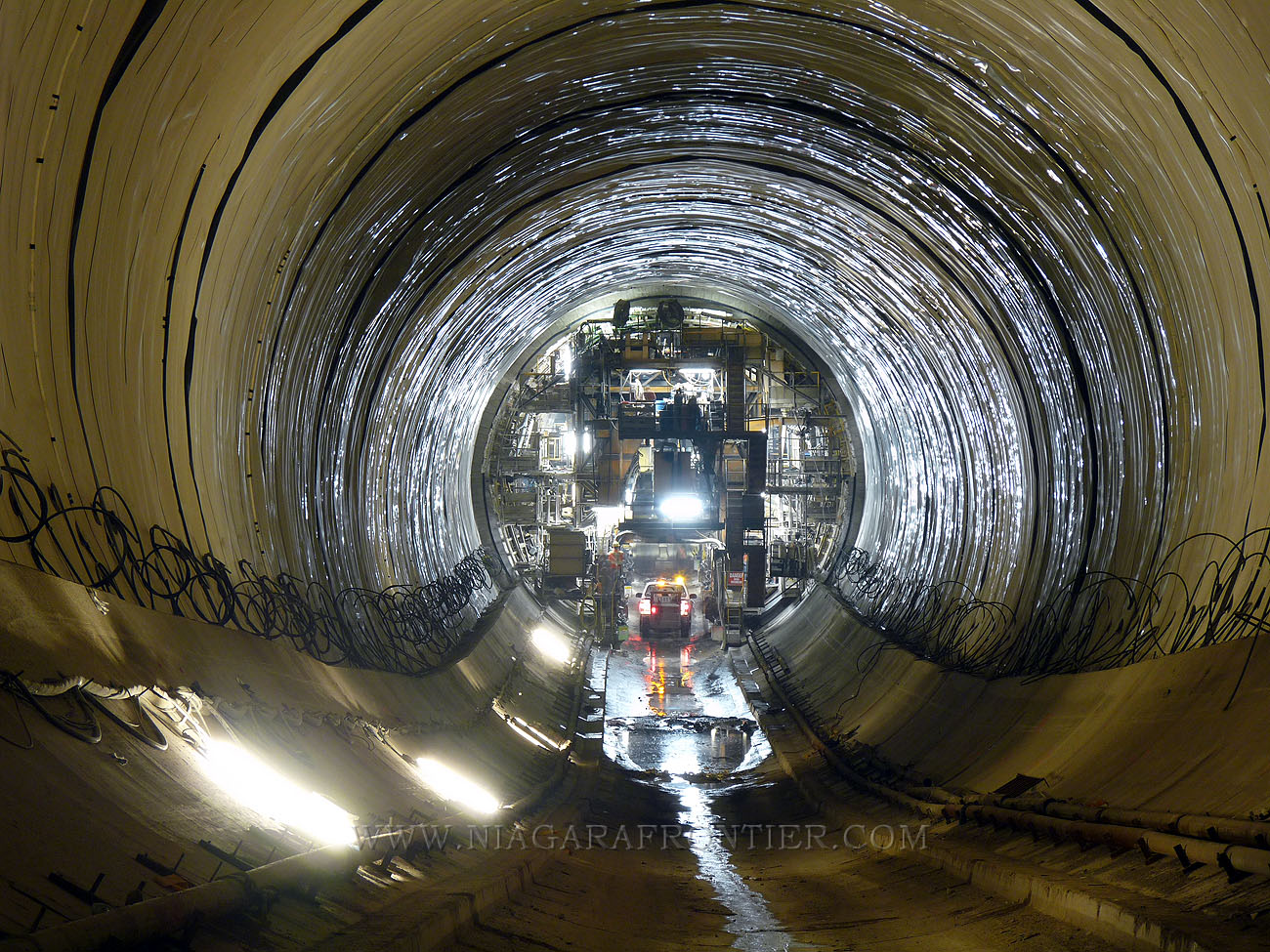
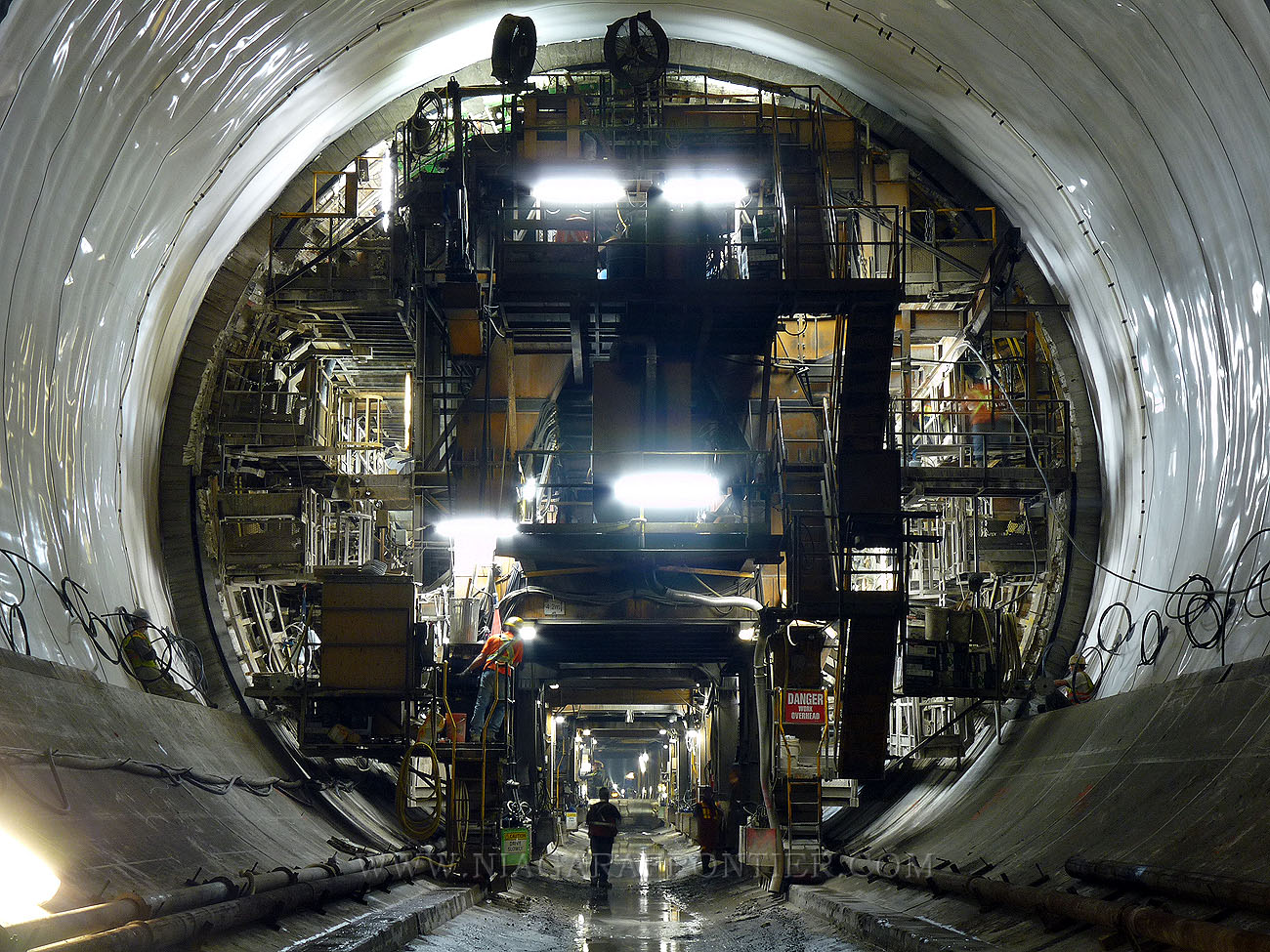
The Invert Concrete Formwork Bridge (right) is used
to apply inner tunnel membranes (left) before concrete is applied
December 4th 2008 -
The annual
St. Barbara Day celebration is held. No significant injuries have been reported
during the past two years of tunnelling.
December 10th 2008 -
The TBM is at 3,222.76 meters (10,573 feet) with a continuous over-break of up
to 3.7 meters (12.14 feet).
December 30th 2008 -
The TBM is at 3,296.6 meters(10,815 feet)with a
continuous over-break of up to 3.7 meters (12.14 feet).The TBM is
gently ascending at a rate of 0.100% (rising one meter for every one kilometer).Rock over-break continues to prevent efficient tunnelling progress.
Currently, the TBM is pushing (moving) forward at a rate of 0.8 meters
(80 centimeters) because of the heavy over-break rather than a usual push of up
to 1.5
meters (150 centimeters). Although the TBM is capable of pushes of 4 meters (400
centimeters) or more, it is restricted in order to allow the mining crews the
time to safely reinforce the roof line to prevent over-breaks and to prevent the
rock conveyor from becoming overloaded. Debris removal from the
roof line over-break causes much of the delay being experienced. The cutting
head of the TBM is 6 meters (19.6 feet) thick
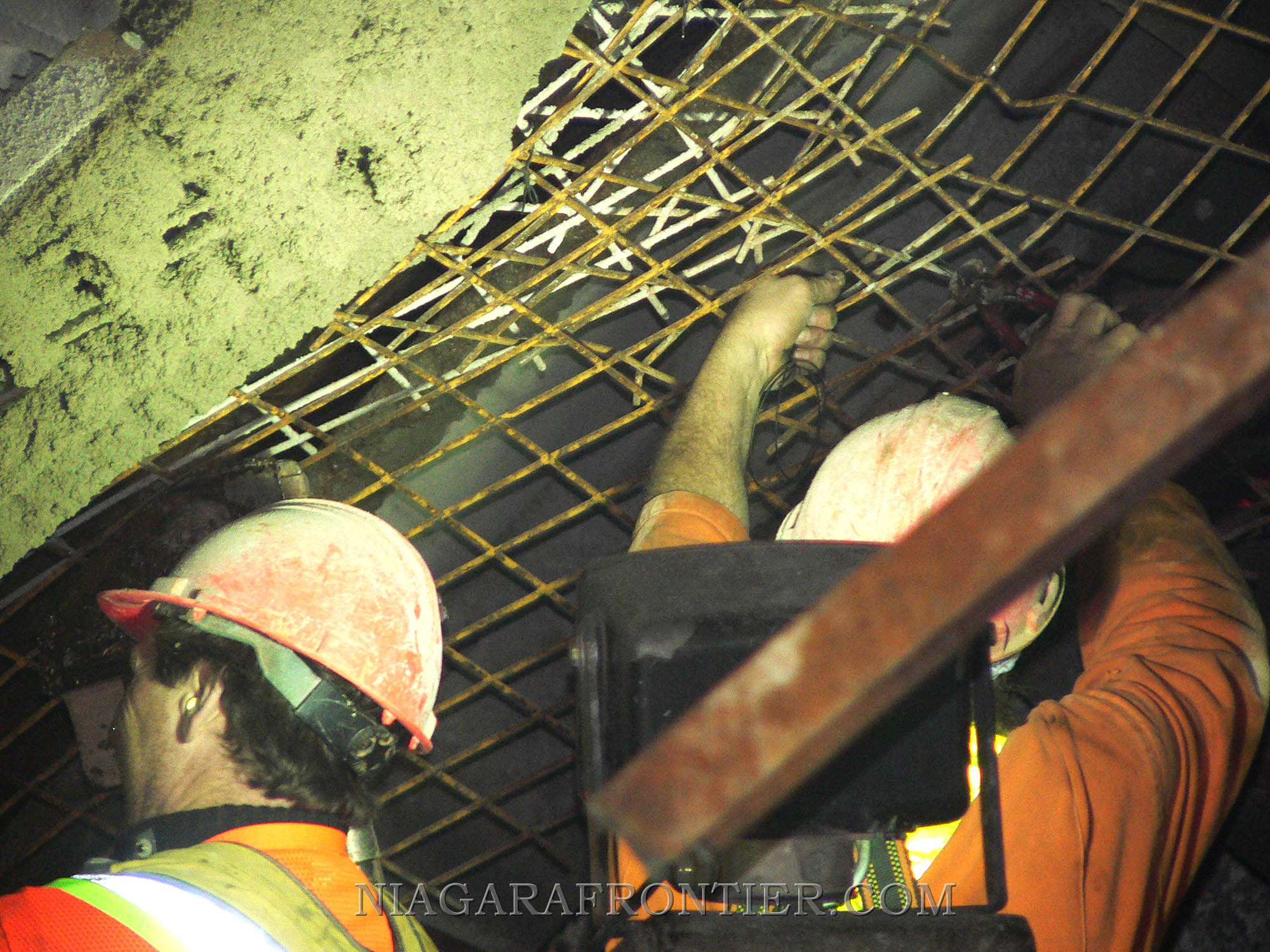
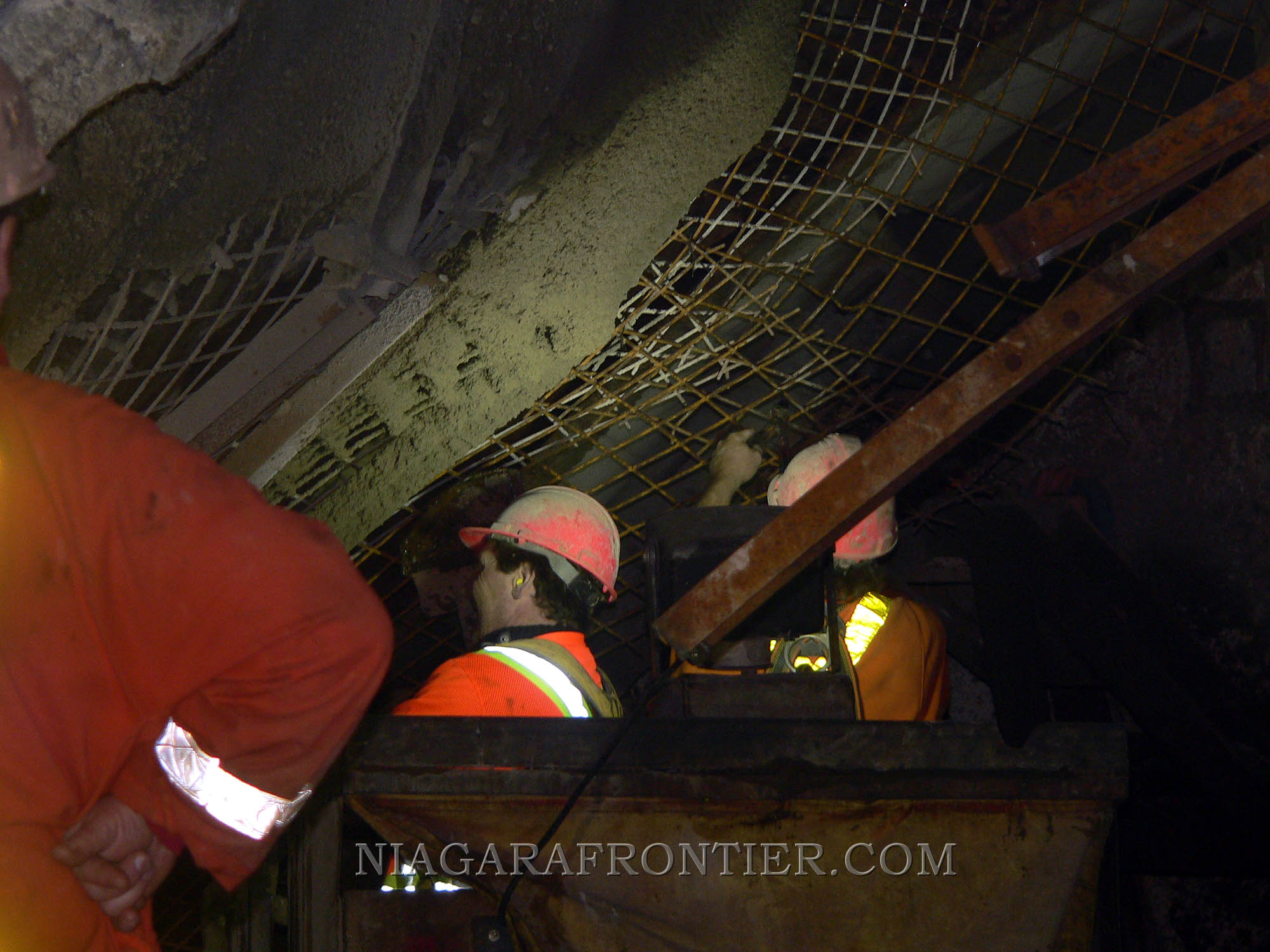
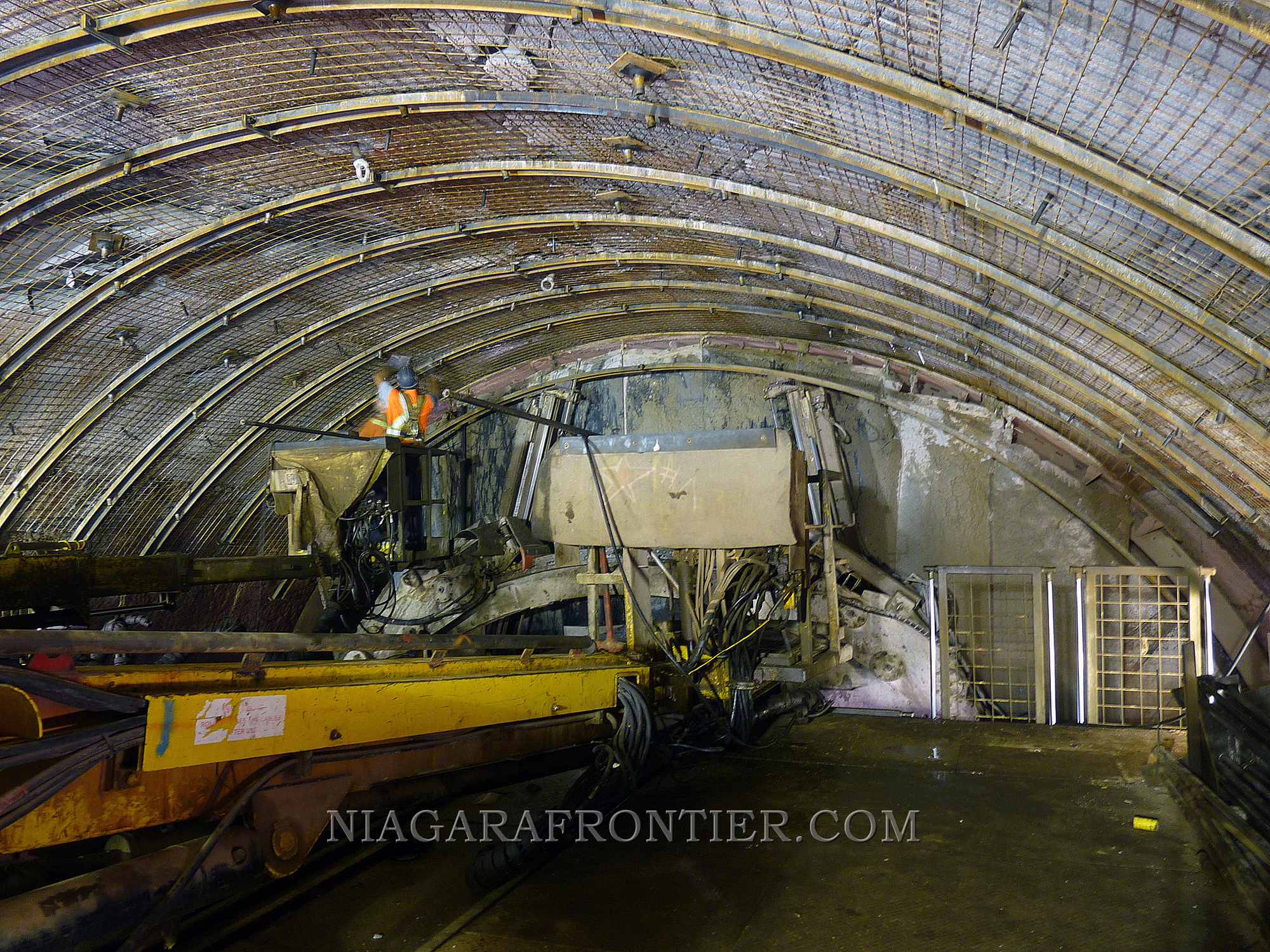
After each push (movement)
forward the TBM is halted to allow mining crews to clear the rock debris from
the roof line over-break, apply reinforcement rebar and steel joists which are bolted
into the ceiling. Ten holes are drilled into the support joist at regular
(80 centimeter) intervals and 4 meter long expansion rock bolts are inserted into each hole and
pressurized causing the bolts to expand in diameter to secure the roof line.
Each bolt is rated at 25 tonnes. The
final process involves spraying Shot Crete (concrete spray) over this entire
ceiling area. This process is repeated with each measured "push" of the TBM.
When the TBM
reaches 3,304 meters (10,840 feet), it will begin to ascend at a 7.15% gradient
(rising 7.15 meters every 100 meters) in
an effort to escape from the Queenston Shale strata to more predictable and
stable rock formation (Whirlpool Sandstone). The TBM will level out after rising
to a depth of 90 meters (295 feet) from the surface. It is hoped that this
manoeuvre will allow much less roof line over-break currently experienced.
At this depth the TBM will be at the same level of the existing twin tunnels
built under the city in the 1950's.
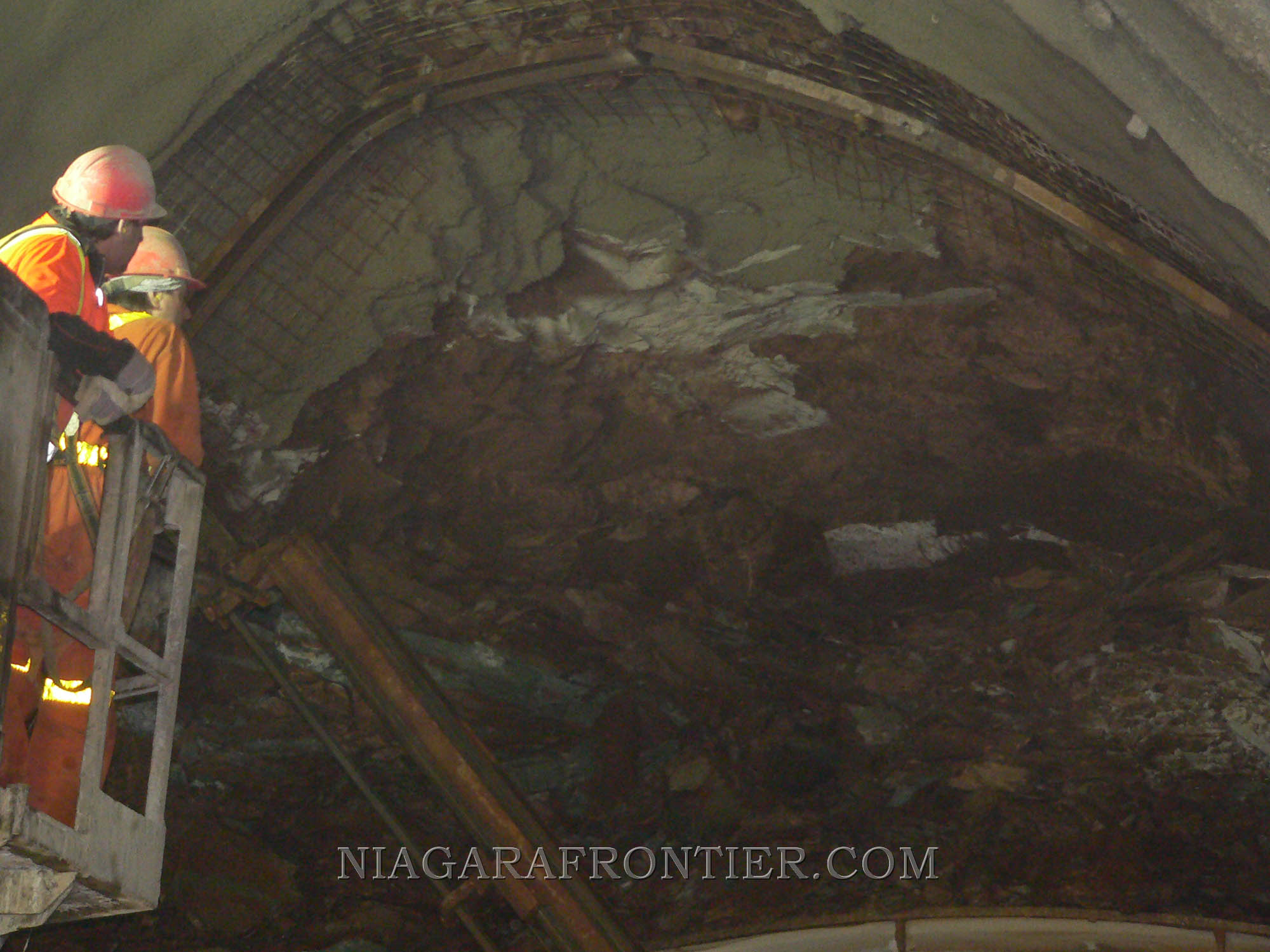
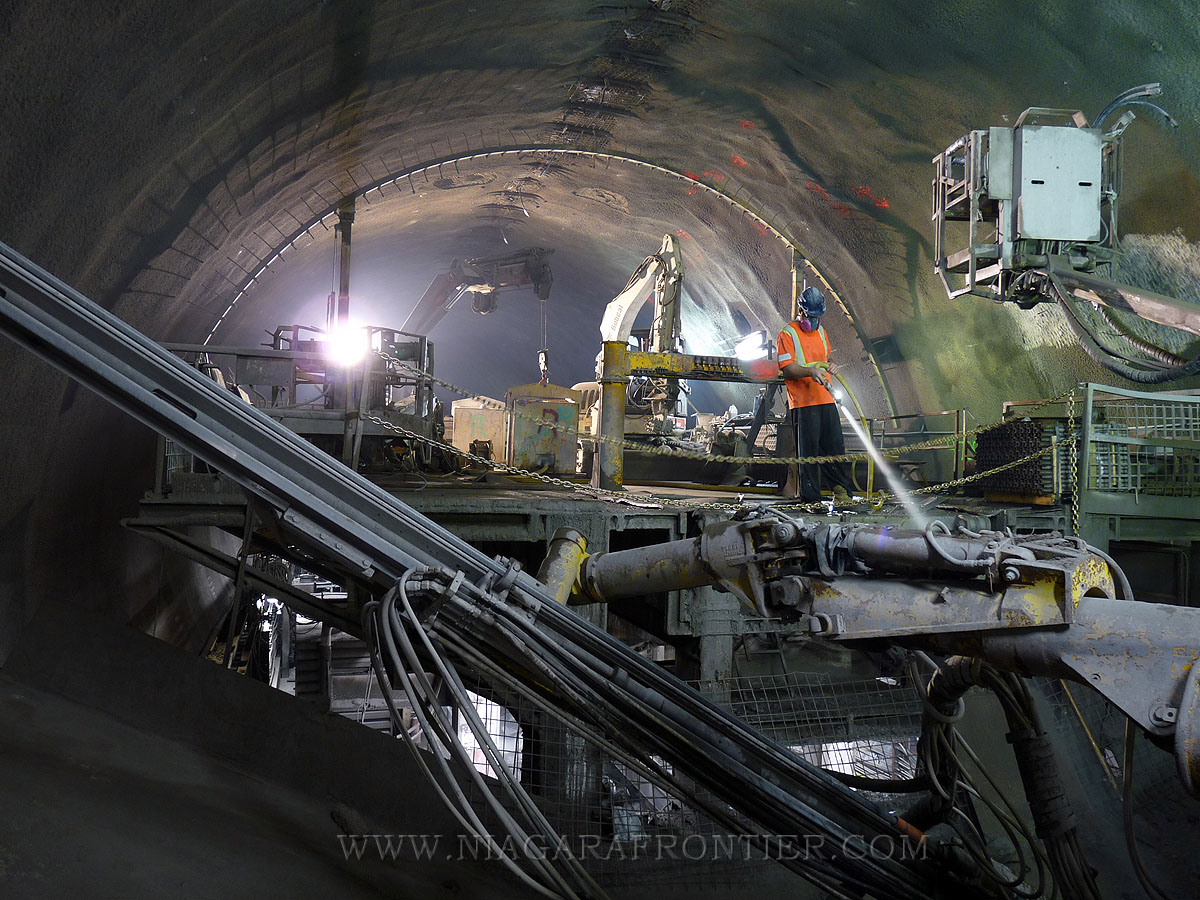
Miners working above the crown of the TBM cutter head
January 23rd 2009 -
The TBM is at 3,417.02 meters(11,210.5 feet)with a
continuous roof line over-break of up to 4 meters (13 feet).
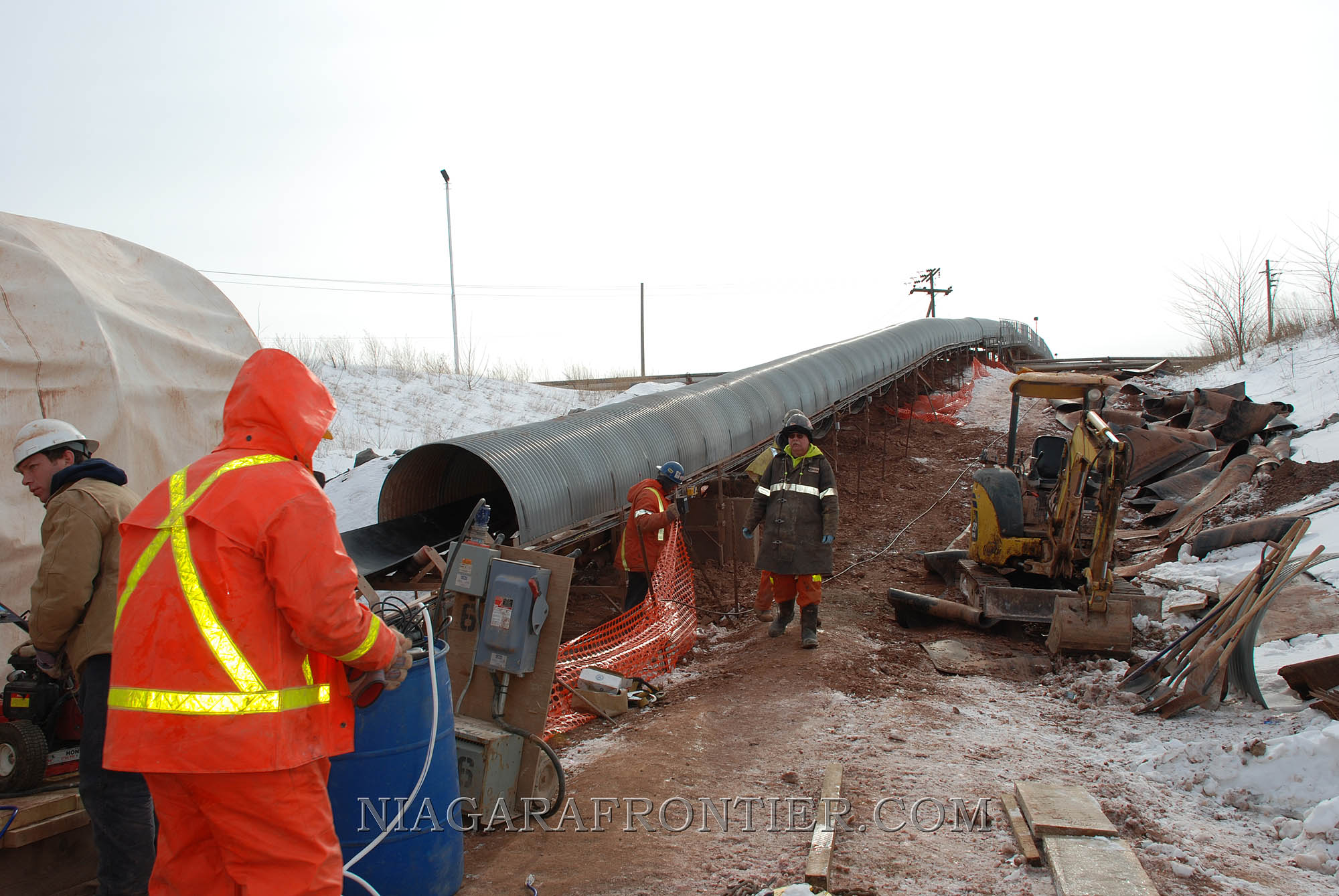
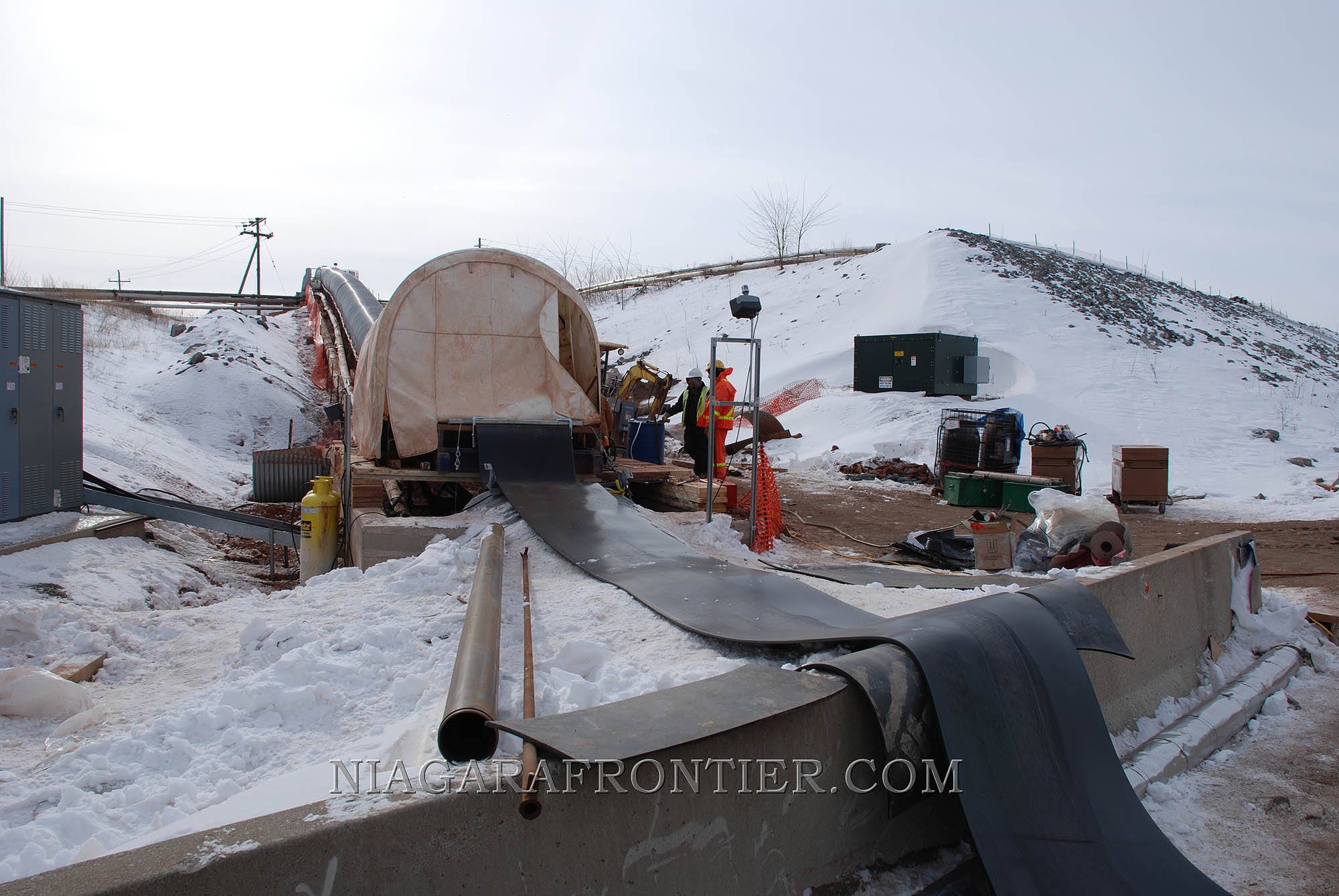
The overland conveyor belt from the tunnel to the rock dump broke down on the
evening of January 22nd causing a temporary shutdown of mining operations until
600 meters of continuous loop conveyor belt is replaced.
Workers replacing the overland conveyor belt
January 26th 2009 -
The overland conveyor belt from the tunnel to the rock dump has been replaced
and mining has resumed.
February 5th 2009 -
The tunnel is 3473 meters long (11,394 feet) with a continuous roof line
over-break of up to 4 metres (13 feet). Progress is averaging 6 metres per day.
February 12th 2009 -
The tunnel is 3503.7 meters long (11,495 feet) with
continuous roof line over-break of up to 3.8 metres. Progress is averaging 6
metres per day. TBM has already begun ascent to the Whirlpool Sandstone rock
strata on a 7.150% gradient (rising 7.15 meters every 100 meters). The TBM will follow a route directly under Stanley
Avenue.
February 13th 2009 -
Progress rate reaches 8.2 meters. Average push is now 90
centimeters up from previous 80 centimeters.
February 23rd 2009 -
The tunnel is 3574.9 meters (11,728.5 feet) long with
continuous over-break of up to 4 meters. The progress rate is averaging 6
meters per day.
March 2nd 2009 -
The tunnel is 3618.6 meters (11,872 feet) long with
continuous over-break of up to 4 meters. The progress rate is averaging 5
meters per day.
March 12th 2009 -
The tunnel is 3693 meters (12,116 feet) long with
continuous over-break of up to 4 meters. The progress rate is averaging 5
meters per day.
March 22nd 2009 -
The Toronto Star Newspaper reported today the according to the OPG, the Niagara
Tunnel Project could be three years behind schedule.
Ontario Power
Generation confirmed today that its Niagara tunnel
project could be three years late in a worst-case
scenario, but the province-owned power producer denied
reports that the cost of the hydroelectric venture is at
risk of more than doubling. The tunnel is being built to
divert more water from Niagara Falls to the Adam Beck
power station, which will be able to generate enough
additional electricity to power 160,000 homes. But Big
Becky, the massive boring machine that's digging the
10-kilometre, 14-metre wide tunnel has run into some
dangerous rock conditions and is behind schedule. OPG
disclosed late last year that the project will be late
and over budget, but the details are still under review.
Global News, citing an interview with John Murphy, OPG's
executive vice-president of hydro, reported on Friday
that the project could cost $1.6 billion and be three
years late under a worst-case scenario. It also reported
the original cost estimate as $600 million. However, OPG
spokesperson Ted Gruetzner told the Star that the
original estimate was $985 million. He doesn't dispute
the $1.6 billion figure, just the suggestion it's more
than doubling the cost of the project. In reality it
would represent a 62 per cent increase.
Gruetzner also said it's unclear how much of that
additional costs, if any, will be borne by electricity
ratepayers. OPG is still negotiating its contract with
Strabag AG, the Austrian company leading the project. A
dispute review board is expected to determine who will
bear the cost or whether it should be shared between the
two parties.
"Once we do get the final timelines we'll announce
that," said Gruetzner, adding that the update could come
next month.
OPG says that even in a worst-case scenario the project
is still economical because the tunnel will deliver
clean electricity for more than 90 years. But critics
say the company should have known about the rock
conditions before committing to such a complex
engineering project.
March 23rd 2009 -
The tunnel is 3762.2 meters (12,342 feet) long with continuous over-break of up to 4 meters.
The progress rate is averaging 5 meters per day.
April 11th 2009 -
The tunnel is 3855.3 meters (12,648 feet) long with continuous over-break of up to
2.85 meters.
The progress rate is averaging 6 meters per day.
April 14th 2009 -
The tunnel is 3873.84 meters (12,709.2 feet) long with continuous over-break of up to
2.85 meters.
The progress rate is averaging 6 meters per day.
April 30th 2009 -
The tunnel is 4007 meters (13,146 feet) long with continuous over-break of up to
2 - 2.5 meters. The progress rate is averaging 7-8 meters per day. The TBM
has stopped ascending (39.778 meters - 130 feet) and has levelled it's trajectory. It was originally hoped
that the crown of the TBM cutter-head would be cutting into the Whirlpool
Sandstone rock strata while the lower portion of the cutter-head would continue
to mine in the Queenston Shale rock strata. It appears at this point that the
TBM remains approximately 2 meters below the Whirlpool Sandstone and for the
time being continues to mine entirely within the Queenston Shale layer. The
over-break has been significantly reduced.
May 3rd 2009 -
The average push of the TBM is now 1 meter (up
from a previous average 80 centimeters). Over-break continues
at 2 to 2.5 meters.
The Invert Concrete Formwork Bridge has
poured approximately 350 meters of finished concrete tunnel lining. It is
progressing at a rate of approximately 62.5 meters per week with an estimated
rate of 100 meters per week in the near future.
To date approximately 700,000
cubic meters of rock debris have been mined from the tunnel.
May 9th 2009 -
The tunnel is 4067.9 meters (13,346 feet) long with continuous over-break of up
to 2.85 meters. The progress rate is averaging 6 meters per day.
The average push of the TBM is now 1-2 meters (up
from a previous average 80 centimeters). Over-break continues
at 2 to 2.8 meters. The TBM had been halted for the past three days to allow for
the expansion of the rock conveyor system.
The TBM has begun to ascend another
1.50 meters (5 feet) over a distance of approximately 150 meters . When it levels out after this brief climb, it will
continue to mine entirely within the Queenston Shale strata however the
over-break will be significantly reduced. The TBM will be approximately 80 centimeters below the Whirlpool Sandstone strata.
The Invert Concrete Formwork Bridge has
poured approximately another 100 meters of finished concrete tunnel lining
during the past week.
May 19th 2009 -
The tunnel is 4148.0 meters (13,609 feet) long with continuous over-break of up
to 2 to 2.5 meters. The progress rate is averaging 7-8 meters per day.
The average push of the TBM is now 1-2 meters (up
from a previous average 80 centimeters).
May 22nd 2009 -
Ontario Power Generation has released information in its first quarter financial
report of 2009 that the cost of the Niagara Tunnel project has risen from
the original project cost estimated at $985 million with a
scheduled completion of June 2010 to the revised project cost estimated at $1.6
billion and the revised scheduled completion by December 2013.
May 23rd 2009 -
The TBM is now pushing forward at a rate of 1.2 to 1.6 meters and is averaging
6-7 meters per day. The over-break above the crown of the TBM cutter-head is
approximately 2 - 2.5 meters. The crown of the tunnel has become much flatter in
appearance as the TBM nears the bottom layers of the Whirlpool Sandstone. The
TBM has levelled out after an ascent of 10 meters (33 feet). On the current
trajectory, the TBM will climb at a grade of 0.010% (10 centimeters for every 1
kilometer).
The Invert Concrete Formwork Bridge
advancing at a rate of 100 meters per week as it lines the bottom portion of
tunnel with finished concrete.
May 27 2009 -
The tunnel is 4230.9 meters (13,881 feet) long with continuous over-break of up
to 2 to 2.5 meters. The TBM is now pushing forward at a rate of 1.2 to 1.6 meters
and is averaging 6-7 meters per day.
June
1st 2009 -
The tunnel is 4245 meters (13,927 feet) long with continuous over-break of 1.4 meters
but decreasing. The TBM is now pushing forward at a rate of 1.2 to 1.6 meters
and is averaging 10 meters per day.
June
11th 2009 -
The tunnel is 4348.9 meters (14,268 feet) long with continuous over-break of 1.4 meters
but decreasing. The TBM is now pushing forward at a rate of 1.2 to 1.6 meters
and is averaging 10 meters per day.
June
13th 2009 -
The TBM is halfway into a one meter (3.28 feet) ascent. Roofline over-break above the
crown of the TBM cutter-head is 60 centimeters and lessening as the climb to a
higher elevation towards the Whirlpool Sandstone strata continues. The TBM is
now progressing at a rate of 13 meters per day with each push forward averaging
1.1 meters.
Since beginning it's journey the TBM
has been in operation more than twenty-two thousand (22,000) hours.
The Invert Concrete Formwork Bridge has
poured approximately 750 meters of finished concrete tunnel lining to the bottom
portion of the tunnel.
June
21st 2009 -
The tunnel is 4459.6 meters (14,631 feet) long with continuous over-break of 60
centimeters and decreasing. The TBM is now pushing forward at a rate of 1.1 to 1.2 meters
and is averaging 13 meters per day. The TBM has levelled it's trajectory and is
moving forward at near maximum capacity. The crown of the TBM cutter-head
will soon begin mining into the much more stable Whirlpool Sandstone above.
The Whirlpool Sandstone rock strata is
quite narrow averaging 4 to 7 meters in thickness and the entire rock strata
drops in elevation the farther south the TBM progresses.
The Invert Tunnel Concrete Lining is
1050 meters long and is
averaging 100 meters per week.
June
30th 2009 -
The Tunnel Boring Machine (TBM) has
mined a record best of 323 meters (1,060 feet) during the month of June.
July 1st 2009 -
The tunnel is 4568 meters (14,986 feet) long with no roof line over-break. The TBM is
mining forward at near maximum capacity. The crown of the TBM cutter-head is mining in the much more stable Whirlpool Sandstone
rock strata.
July 5th 2009 -
The TBM sets a single day mining record of
21.1 meters (69.2 feet) and a single shift mining record of 14 meters (46
feet). There is no roof line over-break.
July 6th 2009 -
The tunnel is 4656 meters (15,275 feet) long with
no roof line over-break. The TBM is
mining forward at near maximum capacity. The crown of the TBM cutter-head is mining into the much more stable Whirlpool Sandstone rock strata.
The current elevation is approximately 97.5 meters (319.8 feet) below the
surface.
The TBM pushes approximately a meter at a time before
being required to stop to re-grip as the TBM moves forward. With no over-break,
the process of reinforcing of the roof with rebar, steel joists and expansion
bolts are done virtually simultaneous as the TBM cutter-head is engaged. The
only limitation is the amount of debris the rock conveyor can handle and the
speed of the mucking operations under the TBM behind the cutter-head.
The cutter-head of the TBM crown is now clearly mining
into the Whirlpool Sandstone. The sandstone rock occasionally cracks with sounds
similar to that of thunder as it is mined. The vibration aboard the
TBM is much more intense.
The Invert Tunnel Concrete Lining is
approximately 1400 meters long and is
averaging 100 meters per week.
Fresh air into the tunnel is now being channelled through
the five existing dewatering shafts from the surface to the tunnel. The
dewatering shafts are
located near the 1400 meter mark and at the deepest portion of the tunnel (140
meters/459 feet) .
Previously the fresh air had been channelled from the tunnel entrance.
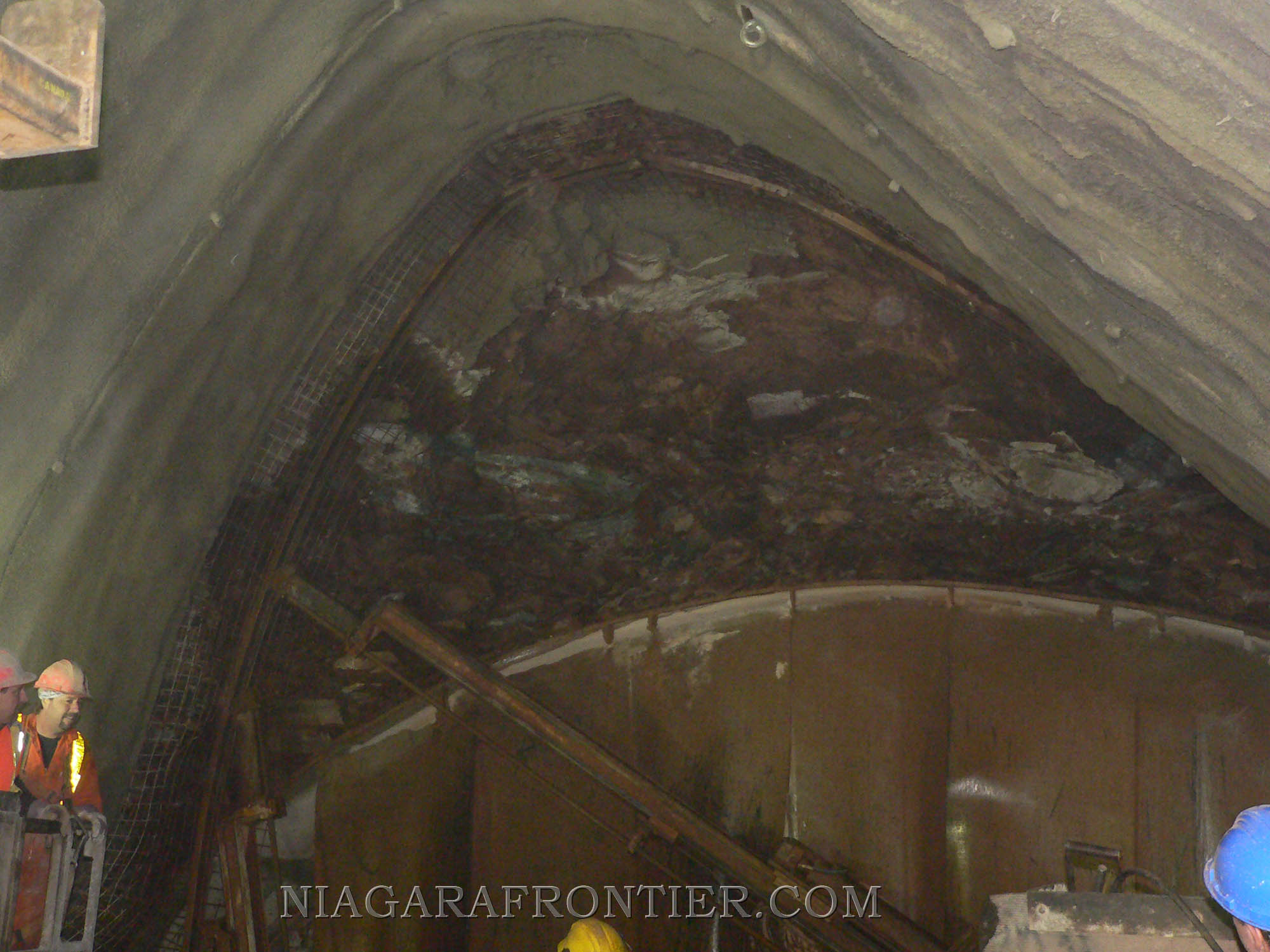
The crown of the TBM Cutter head - July 7th 2009
the crown is mining into the Whirlpool Sandstone with no roof line
over-break
July
14th 2009 -
The tunnel is 4795.3 meters (15,732 feet) long with
zero to .80 centimeter roof line over-break. The TBM is
averaging 15 meters per day. The Invert Concrete poured to date is 1,375 meters
(4,511 feet).
July
18th 2009 -
The TBM had been inoperative for the previous several
days for maintenance updates. It began operations again and completed 20 meters
by the end of the day. Over-break is minimal. The TBM is partially mining
through the much more abrasive Whirlpool Sandstone. The replacement of cutter
discs has become daily with one or two being replaced regularly. Previously
while mining the Queenston Shale, the replacement of a cutter discs once or
twice a month was typical.
July
20th 2009 -
The tunnel is 4862.1 (15,952 feet) long with zero to
.80 centimeter roof line over-break. The TBM is averaging 20 meters per day.
July
27th 2009 -
The tunnel is 4961.3 meters (16,227 feet) long with zero to
.80 centimeter roof line over-break. The TBM is averaging 20 meters per day.
The Invert Concrete is 1,450 meters (4,757 feet).
July
29th 2009 -
The TBM (Tunnel Boring Machine) reached the 5000
meter (16,404 feet) milestone at 2:08 p.m.
August 4th 2009 -
The TBM reached the 5,079 meter official halfway milestone of the Niagara
Tunnel Project at 02:30 hours (2:30 a.m.).
August 6th 2009 -
The tunnel is 5115 meters (16,781 feet) long with zero to
.80 centimeter roof line over-break. The TBM is averaging 19 meters per day.
The Invert Concrete is 1,500 meters (4,921 feet).
August
15th 2009 -
The tunnel is 5199.50 meters (17,058 feet) long. The TBM is
averaging 11 meters per day. The crown of the
TBM cutter-head has begun mining the bottom of the Power Glen rock strata within
the last 30 meters (100 feet) or so and it's coasting just above the centre of
the shield. The roofline is horizontal on the left side with over-break down to
the end of the shield. The Whirlpool Sandstone/Queenston Shale contact is
currently about a meter above the spring-line, so thickness of Whirlpool
Sandstone is about 6.2 - 6.3 metres (20.3-20.6 feet) in thickness. Elevation is
89.633 meters (294 feet).
August
18th 2009 -
The tunnel is 5239.0 meters (17,188 feet) long. The TBM is
averaging 20 meters per day.
August
22nd 2009 -
The tunnel is 5289.48 meters (17,354 feet) long at an
elevation below the surface of 89.775 meters (294.5 meters). The TBM is
averaging 12.63 meters per day. The over-break has returned. It is approximately
1.7 meters (5.6 feet) in that top left corner of the flat ceiling and about 1
meter (3.2 feet) above the centreline. Apparently the same type of rock
over-break was similar as the TBM descended at the beginning of the tunnel
boring process at a chainage of about 0+650 (2,132.5 feet). The over-break is in
the bottom of the Power Glen Rock Strata Formation. The Power Glen Formation
grades upward from shale to a sandstone, so the over-break should lessen as the
TBM ascends up through this strata and into the Grimsby Formation.
August
31st 2009 -
Contrary to the projection, the tunnel over-break has increased to 3 meters (10 feet) and
as a result the TBM is progressing at a daily rate of 5-6 meters per day.
September 3rd 2009 -
The tunnel is 5370 meters (17,621 feet) long at an elevation
below the surface of 89 meters (292 feet). The tunnel over-break has increased to
2.5 meters (8.2 feet) and
as a result the TBM is progressing at a daily rate of 5-7 meters per day.
The Invert Concrete Bridge is 1,925 meters
(6,315.5 feet).
September 9th 2009 -
The tunnel is 5404.2 meters (17,730 feet) long at an elevation
below the surface of 89 meters (292 feet). The tunnel over-break has increased to
3.5 meters (9.8 feet) and
as a result the TBM is progressing at a daily rate of 5-7 meters per day.
The Invert Concrete Bridge is 2,000 meters
(6,561.6 feet).
September 11th 2009 -
The tunnel is 5418 meters (17,775 feet) long at an elevation
below the surface of 89 meters (292.5 feet). The tunnel over-break is
3.5 meters (9.8 feet) and
as a result the TBM is progressing at a daily rate of 5-7 meters per day. Mining
has been halted following a fall of ground at 3,600 meters. The clearing of
debris and repairs to the effected area as well as a scheduled six week shut
down for maintenance of the TBM will precede continuation of mining.
Niagara Falls Review:
Work on the Niagara Tunnel Project has
resumed after a small portion of the temporary lining and Queenston shale fell
at the construction site Friday morning. The material that fell was enough to
fill a few dump trucks, said Ernst Gschnitzer of Strabag, the contractor on the
Niagara Tunnel Project.
No one was injured, as on-site workers escaped from the tunnel safely using what
a company press release described as well-rehearsed procedures.
"When this type of event does occur in tunnel and mining projects, safety is our
top priority so we'll make every effort to find out what happened and make sure
it doesn't happen again," said Gschnitzer.
The incident happened about two kilometres behind the current location of the
tunnel-boring machine nicknamed Big Becky, in an area that experienced some of
the most severe "overbreak" during the digging. A realignment of the tunnel route moved Big Becky to more stable rock conditions
and the project has been making progress, having recently moved past the halfway
mark of the 10.2-kilometre tunnel.
Gschnitzer said work is continuing on the first 3.5 kilometres of the tunnel and
intake structure, and that a six-week maintenance outage that was scheduled to
start at the end of the month was moved up and started Friday.
Strabag engineers are working with staff from the Ontario Ministry of Labour to
determine the cause of the event and how best to move forward.
September 12th 2009 -
Niagara Falls Review:
Work on the Niagara Tunnel Project has
resumed after a small portion of the temporary lining and Queenston shale fell
at the construction site Friday morning.
The material that fell was enough to fill a few dump trucks, said Ernst
Gschnitzer of Strabag, the contractor on the Niagara Tunnel Project. No one was injured, as onsite workers escaped from the tunnel safely using what
a company press release described as well-rehearsed procedures.
"When this type of event does occur in tunnel and mining projects, safety is our
top priority so we'll make every effort to find out what happened and make sure
it doesn't happen again," said Gschnitzer.
The incident happened about two kilometres behind the current location of the
tunnel-boring machine nicknamed Big Becky, in an area that experienced some of
the most severe "overbreak" during the digging.
Gschnitzer said work is continuing on the first 3.5 kilometres of the tunnel and
intake structure, and that a six-week maintenance outage that was scheduled to
start at the end of the month was moved up and started Friday.
Strabag engineers are working with staff from the Ontario Ministry of Labour to
determine the cause of the event and how best to move forward.
Strabag is building the Niagara tunnel for Ontario Power Generation.
October 7th 2009 -
Niagara This Week: reporter Bill Robinson
There will be no more tunnelling under
the city’s streets until the contractor makes repairs to a portion of the Big
Becky tunnel that collapsed early last month.
The Ontario Ministry of Labour issued a stop work order to Strabag, the
German-based company contracted for the Niagara Tunnel Project, after a collapse
occurred on September 11th 2009. Bruce Skeaff, spokesman for the Ministry of
Labour, said no work can be done beyond the 3,500-metre mark of the tunnel,
where the collapse occurred, until deemed safe by the ministry.
“We have stop work orders in place, so no more tunnelling can go on while the
employer continues to repair the tunnel,” Skeaff said. “Drilling is halted until
the repairs are done and quality assessments have been completed. We’ve got
engineers working with the employer to make sure that everything is done
properly and up to our standards.”
Strabag issued a statement after the collapse, saying “a small portion of the
temporary tunnel lining and Queenston shale fell.” No workers were injured
during the collapse.
Project manager Ernst Gschnitzer said this type of collapse is not uncommon, and
occurred about two kilometres behind the present location of “Big Becky,” the
tunnel boring machine.
“While this type of event does occur in tunnel and mining projects, safety is
our top priority so we’ll make every effort to find out what happened and make
sure it doesn’t happen again,” Gschnitzer said, adding the amount of material
that fell “would fill a few dump trucks.”
The collapse caused Strabag to prematurely begin a six-week maintenance
operation that had originally been scheduled to take place the end of September.
As a result, the company laid off about 100 workers, Gschnitzer said.
“Obviously, we have some temporary layoffs,” he said. “We’re working behind
schedule but we hope to be up and running in about a month.”
Gschnitzer said while drilling has halted, work and repairs are still being done
inside the tunnel, which is now 5,418 metres long, and that Big Becky is
currently under Stanley Avenue, near Valley Way, undergoing maintenance.
Completion of the 10-kilometre tunnel, which will add enough electricity to
power a city twice the size of Niagara Falls by allowing more water to the Sir
Adam Beck generating stations in Queenston, was pushed back to some time in 2010
instead of late 2009 as originally planned.
Strabag ran into problems drilling through Queenston Shale. The cost of creating
the tunnel has more than doubled from an estimated $985 million to $1.6 billion.
In a previous interview with Niagara This Week, John Earl, a spokesperson for
Ontario Power Generation, said there are stipulations built into the contract
that will protect the province, and taxpayers, from any cost overruns as well as
incentives for Strabag to complete the project on schedule.
November 1st 2009 -
Scheduled maintenance of TBM is in progress. The Invert
Concrete Bridge is 2,640 meters (8,661 feet).
November 13th 2009 -
Niagara Falls Review: reporter Corey Laroque
Tunnel work back on track after September cave-in causes
delay, OPG says
Mining to resume after planned outage ends in December
Work resumed this week on the Niagara Tunnel Project after it
was stopped in Sept following the collapse of rock from the ceiling of the
tunnel, Ontario Power Generation announced in an update on the project. It means
about 368 workers are back on the job and a full complement of 398 will be
working again some time in December when full-scale excavation resumes, said OPG
spokesman Ted Gruetzner.
"They're expected to be back up and running again in December," Gruetzner said.
Work had been disrupted since Sept. 11 when there was a collapse of rock from a
25-metre section of the tunnel's ceiling. It occurred about two kilometres into
the tunnel, more than three kilometres behind the spot where the tunnel-boring
machine, nicknamed Big Becky, is cutting into the rock face.
Big Becky was about 5.4 kilometres into the tunnel when the collapse occurred.
No one was injured as workers followed what Strabag's project manager Ernst
Gschnitzer called a "well-rehearsed" evacuation. Ontario's Ministry of Labour
ordered a halt to the digging until the debris rock could be removed and the
tunnel ceiling reinforced for worker safety.
The delay is not expected to affect the tunnel's 2013 target for completion.
The Niagara Tunnel Project is OPG's $1.6-billion construction of a third tunnel
to bring more water to the Sir Adam Beck hydroelectric generators. Over-break
had been an ongoing problem for the first three years of the digging because
loose Queenston shale in the St. David's gorge area fell in.
Strabag AG, the Austrian mining company hired by OPG to dig a 10-kilometre
tunnel under the city of Niagara Falls, had scheduled a planned outage on its
tunnel-boring machine for October. They moved the start of that outage up to
coincide with the cave-in. Planned outages are scheduled periodically to do
maintenance work on the tunnel-boring machine and on other equipment used in the
excavation process.
When the rock fell in on Sept. 11th, no one could get past the debris and Big
Becky was left unattended. That debris has been removed and wire mesh is being
installed on the roof and Shotcrete, a rough form of concrete is sprayed over
top to give the tunnel a rough shape.
Both OPG and Strabag say they're committed to worker safety. There have been no
significant injuries since work began in 2006.
November 19th 2009 -
Tunnel Talk Magazine: reporter Paula Wallis
Repairs are complete following a 25m3 rock fall
in the tunnel but planned maintenance keeps the mega TBM idle on Niagara's water
diversion tunnel some two months after the partial collapse. Meanwhile, in an
interview with Tunnel Talk yesterday (November19), the contractor says the root
cause of the collapse stems from early geotechnical investigations. Section of
high over-break in crown of tunnel - "The crown fall happened in a area
surrounding a 20-year old bore hole," said Ernst Gschnitzer, Project Manager
for Strabag. "The hole had a long time to deteriorate and eventually the
ground gave way."
Gschnitzer said it took some time to make the repairs in part because the
contractor had to build up a ramp to reach the crown and the over-break. "We
used standard means and methods employed throughout excavation to repair the
crown, including 6m (20 ft) rock-bolts and 6m (20 ft) IBO bolts plus wire
reinforced Shotcrete," said Gschnitzer. "We will also increase rock supports
in areas of known previously drilled bore holes and we have also grouted all
these old bore holes." Gschnitzer said the bore hole in question hadn't grouted
at the time it was encountered, but has been subsequently.
The partial collapse came just as the TBM was moving into more competent ground
and achieving higher progress rates. About 25m3 (100 tonnes) of
temporary lining and Queenston Shale fell from the crown on September 11th 2009.
According to the owner, Ontario Power Generation, no one was injured in the
collapse and all of the workers left the tunnel safely, following established
emergency procedures. The fall occurred about 2 km (1.2 miles) behind the TBM,
and some 3,600 meters (2.2 miles) into the 10 kilometer (6.2 mile) long ,14.4
meter (47ft) diameter tunnel, in an area that experienced some of the most
severe over-break to date.
It happened on the new alignment in 80 meters (262 ft) of overburden and beyond
the immensely challenging section under the St David's Gorge that cancelled out
the original completion schedule and cost estimate of the contract. The revised
schedule agreed to as part of the realignment. The original project cost was
estimated at $985 million with a scheduled completion of June 2010. The revised
project cost estimate is $1.6 billion and the revised schedule completion date
is December 2013. The contract includes revised incentives and penalties tied to
the new target cost and schedule.
A six-week maintenance outage planned for the end of September on the Robbins
TBM was moved forward and combined with the crown repairs. "After 5.4km (3.4
miles), partially in very abrasive rock, the bucket lift scrapers were worn out,
so we have some major refurbishment on the cutter-head and we are also making
repairs to the conveyor system, trucks and trailers and other equipment,"
said Gschnitzer.
Meanwhile installation of the concrete lining is
progressing ahead of the revised schedule. Before the stoppage, ground
conditions had improved markedly following a change in the vertical alignment
that was initiated late last year. Progress rates jumped to a high of 468m
(1,535ft) for the month of July. "That was excellent, and confirmed that
changing the alignment was the right decision," said Gschnitzer. "Since
then rates have deteriorated a little to about 8m-10m/day (26ft-32ft), but not
to the extent of what we experienced in the Queenston Shale, and we expect
decent progress rates once we resume excavations in about two weeks."
Repairs to the crown were completed at the end of October and Gschnitzer says
the TBM repairs will be completed shortly, with excavation resuming in early
December.
December 4th 2009 -
The annual
St. Barbara Day celebration is held. No significant injuries have been reported
during the past three years of tunnelling.
December 8th 2009 -
TBM mining has resumed.
December 20th 2009 -
The tunnel is 5454.9 meters (17,897 feet) long at an elevation
below the surface of 89 meters (292 feet). The tunnel over-break is 3 meters (9.8 feet).
The Invert Concrete Bridge is at 3,300 meters
(10,827 feet).
The Shotcrete Over-break Carrier is at
500 meters.
December 31st 2009 -
At the end of 2009, the tunnel is 5480.7 meters (17,981
feet) long at an elevation below the surface of 88 meters (289 feet).
The tunnel over-break is 3.4 meters (11.15 feet).
January 10th 2010 -
The tunnel is 5541.2 meters (18,179.5 feet) long at an
elevation below the surface of 89 meters (292 feet).
The tunnel over-break is 3.4 meters (11.15 feet).
The Invert Concrete Bridge is at 3,475 meters (11,401 feet).
The Shotcrete Over-break Carrier is at 551 meters (1,808 feet).
A 300 meter section of the conveyor belt was torn causing
a shut down of TBM production. The conveyor section was damaged as a result of a
rock piercing the belt as it dropped onto the conveyor from the TBM. The damaged
conveyor belt section caused the TBM to remain idle until it was replaced.
January 13th 2010 -
The TBM resumes mining following a three day delay while a
section of conveyor belt was replaced.
January 27th 2010 -
The tunnel is 5,711 meters (18,737 feet) long at an elevation
below the surface of 89 meters (292 feet). The crown of the TBM cutter-head is
mining into the silt/sandy Power Glen rock strata.
There is no tunnel over-break. The TBM is currently averaging 18.5 meters per
day. The Invert Concrete Bridge is at 3,725 meters (12,221 feet).
The Overbreak Restoration Carrier is at 900 meters (2,953 feet).
Due to an electrical short in the main power feeder to the
TBM, mining was suspended for a period of 5 days until the problem was isolated
and repaired.
February 4th 2010 -
The tunnel is 5,757.2 meters long at an elevation below the
surface of 89 meters. There is an over-break along the left flank of the crown
of 1-1.5 meters. The TBM averaging 10
meters per day.
The Concrete Invert Bridge is at 3,850 meters.
The Restoration Carrier: Grinding is at 1,040 meters/ Shotcrete is at 800 meters
February 7th 2010 -
Work has begun at the 4500 meters mark of the tunnel to sink
a new ventilation shaft from the surface to the tunnel. Once constructed, it
will replace the existing dewatering shafts currently utilized for providing
ventilation into the tunnel.
February 19th 2010 -
The tunnel is 5,958.3 meters long at an elevation below the
surface of 89 meters. There is 1-1.5 meters over-break. TBM averaging up to 14.3
meters per day. The Concrete Invert Bridge is at 4,100 meters and the
Restoration Carrier is at 1,100 meters.
February 21st 2010 -
The tunnel is 17.7 meters from reaching the 6,000 meters
mark. There is 1-2 meter over-break to the left side of the TBM cutter-head
crown. The daily mining average is 9 meters. Since January 1st 2010 the
TBM has mined 501.6 meters.
A new air shaft is currently under construction at the 5,318 meter mark of the
tunnel. An 8 meter long adit (shaft) will be mined perpendicular into the eastern side of the
existing tunnel at the springline before a pilot hole is drilled from the surface. Once the pilot
hole reaches the access shaft, a 3 meter diameter hole will be constructed to
the surface. This shaft will supply fresh air to the tunnel.
February 21st 2010 -
On Monday February 22nd at 4:38 p.m.
(16:38 hrs) the Tunnel Boring Machine nicknamed 'Big Becky' passed the 6'000
meter mark. The TBM is underneath Stanley Avenue
in front of
the LaPenna Co. Liquidation Store.
March 4th 2010 -
The TBM is at 6,097.5 meters.
There is 1-2 meter over-break to the left side of the TBM cutter-head crown. The
daily mining average is 9 meters. The Invert Concrete Carrier is at 4,225
meters. The Overbreak/Restoration Carrier is at 1,250 meters.
March 7th 2010 - The TBM is at 6,152.6 meters. There is less than 30 cm over-break. The daily mining average is
10.4 meters. Elevation is 92 meters below the surface.
The TBM has mined 672 meters since January 1st 2010. During the past week,
mining had been suspended for three days to allow for routine maintenance and
upgrades. The adit for the new air shaft is now 6 meters of a total of 8 meters.
During the past week, mining was suspended for three days to allow for routine
maintenance.
March 12th 2010 -
The TBM is at 6,233.1 meters. There is
less than 30 cm over-break. The daily mining average is 16.1 meters. Elevation
is 92 meters below the surface.
The Invert Concrete Carrier is
at 4,325 meters.
The Overbreak/Restoration
Carrier is at 1,250 meters. This operation will be between 590 meters and
1'250 meters for a period of time as the carrier has to go back and forth
several times.
March 24th 2010 -
The TBM mined a near daily record best of 21.2
meters (69.55 feet).
March 25th 2010 -
The TBM is at 6,379 meters. There is
less than 30 cm over-break. Elevation
is 92 meters below the surface.
March 31st 2010 -
The TBM is at 6,469.5 meters.
There is up to 1 meter over-break. Elevation
is 91 meters below the surface. Daily mining average is 15 meters.
The Invert Concrete Carrier is
at 4,525 meters.
The Overbreak/Restoration Carrier is at 800 meters. This operation will be
between 800 meters and 1,400 meters for a period of time as the carrier has to
go back and forth several times.
April 7th 2010 -
The TBM is at 6,552.5 meters.
There is up to 1 meter over-break. Elevation
is 91 meters below the surface. Daily mining average is 15 meters.
The Invert Concrete Carrier is
at 4,575 meters.
The Overbreak/Restoration Carrier is at 800 meters. This operation will be
between 800 meters and 1,400 meters for a period of time as the carrier has to
go back and forth several times.
April 2010 -
Construction has begun on the
building of a new primary air shaft to provide fresh air into the Niagara
Tunnel. The site is located on hydro property along the east side of Stanley
Avenue just north of Valleyway. A 15 meter long steel pipe - 3 meters in
diameter has been sunken into the ground to the bedrock below. The surface soils
have been removed to expose the bedrock from within the pipe. A pilot shaft
is going to be drilled to the existing tunnel below. Once the location is confirmed as
accurate, a small cutterhead (approximately 2.5 meters in diameter) similar to
that of the TBM cutterhead will begin cutting a bore hole from the surface to
the tunnel below. This new air shaft is expected to be ready for service in
June.
April 24th 2010 -
A 600 mm pilot shaft has been drilled to the
existing tunnel adit below. Once the location is confirmed as accurate, a small cutterhead (approximately 2.5 meters in diameter) similar to
that of the TBM cutter head will begin cutting a bore hole from the surface to
the tunnel below. This new air shaft is expected to be ready for service in
June.
April 25th 2010 -
The TBM is at 6,745 meters.
There is up to 1 meter over-break. Elevation
is 91 meters below the surface. Daily mining average is 12 meters.
The Invert Concrete Carrier is
at 4,775 meters.
April 27th 2010 -
Four Strabag workers were taken to hospital
as a precaution Tuesday after an early morning fire inside the Niagara Tunnel
Project forced about 30 workers to take shelter in rescue containers and put in
practice the emergency procedures they practice every six months.
A diesel compressor used for pumping water caught fire about 5:30 a.m., said
Ernst Gschnitzer, the project manager for Strabag, the Austrian company hired to
build the 10.2-km tunnel that will divert more Niagara River water to the Sir
Adam Beck hydroelectric generating stations.
Strabag officials had not determined what caused the compressor to catch fire.
The fire took place at about the 5,300-metre mark in the tunnel, a section of
the tunnel underneath the intersection of Stanley Ave. and Valley Way. "The
workers established our emergency procedure. A few of the workers began
extinguishing the fire," Gschnitzer said. "There was a huge pile of smoke."
Tuesday's fire was the first time the containers had been used in a real
situation, though they have been used as part of the emergency drills Strabag
conducts every six months.
There are two rescue containers attached to Big Becky, the tunnel-boring
machine. Each one is big enough to accommodate 25 people and provide enough
oxygen for 24 hours. The purpose of the containers is to give workers a safe
place to stay during an emergency while rescuers get to them.
"The guys did all the right things. It worked like it did on previous training
exercises," Gschnitzer said. Stranded workers were able to leave the tunnel at
about 10 a.m. Four were sent to hospital for treatment as a precaution for smoke
inhalation. All the men were subsequently released.
Work was expected to resume at the tunnel at 3 p.m., Gschnitzer said. The city's
fire department was not called to the tunnel construction site, whose entry
point is off Stanley Avenue, south of Thorold Stone Road. Firefighters are not
trained in going into a tunnel, so Strabag counts on its own staff to be trained
to fight fires, Gschnitzer said.
April 28th 2010 -
The TBM has accomplished a
single day BEST mining distance of 22.4 meters (73.49 feet). The previous single
day BEST occurred on July 11th 2009 for mining with a distance of 22.3 meters
(73 feet).
April 29th 2010 -
The TBM is at 6,799 meters.
There is up to 1 meter over-break. Elevation
is 91 meters below the surface. Daily mining average is 13.5 meters. The Best Weekly Record was eclipsed during the week of April
26th-April 29th 2010 for mining a distance of 136.3 meters
(447 feet).
May 1st 2010 -
The TBM has accomplished a
single day BEST mining distance of 25.4 meters (83.3 feet). The previous single
day BEST occurred on on April 28th 2010 for mining with a distance of 22.4
meters (73.49 feet).
May 2nd 2010 -
The TBM is at 6,882 meters
(22,578.4 feet).
The TBM has been shutdown for scheduled maintenance and to allow for the launch
of the arch forms into the tunnel. On May 11th, the widening of the new air vent
shaft will begin. The ventilation shaft is 2.6 meters internal diameter and 2.7
meters bore diameter.
May 29th 2010 -
The TBM is still undergoing
scheduled maintenance and is not expected to begin mining until June 20th. The
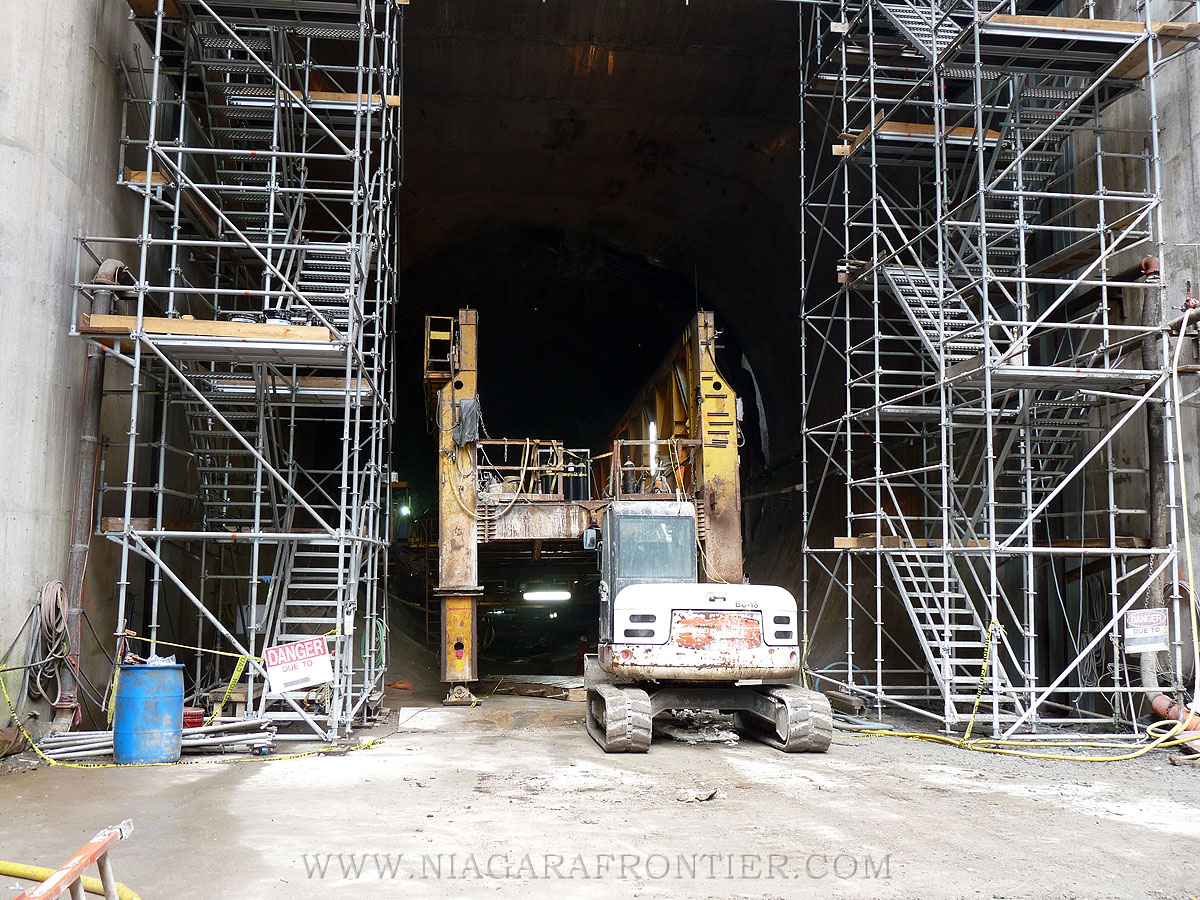
first of two arch forms has been moved into position just inside the tunnel
entrance.
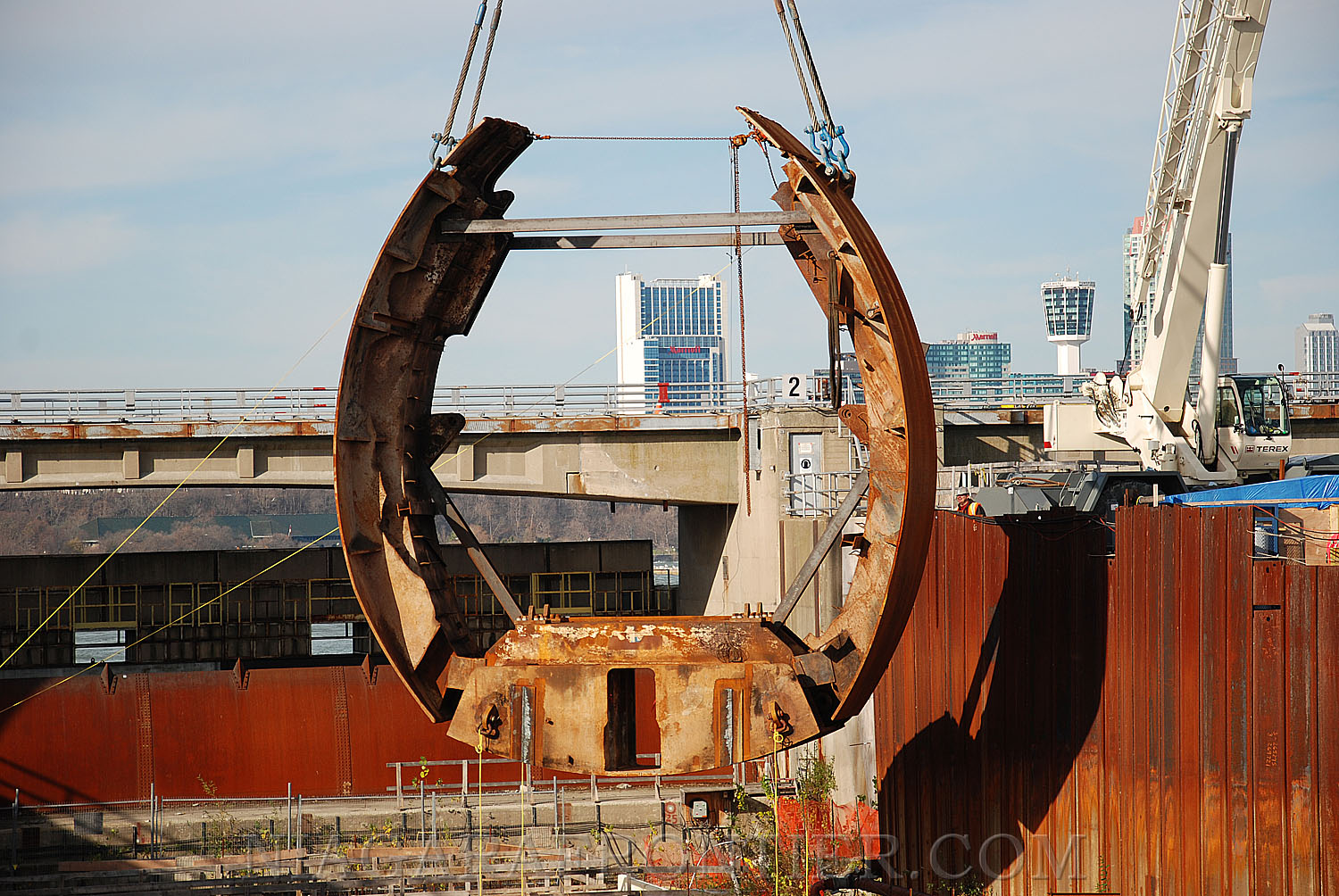
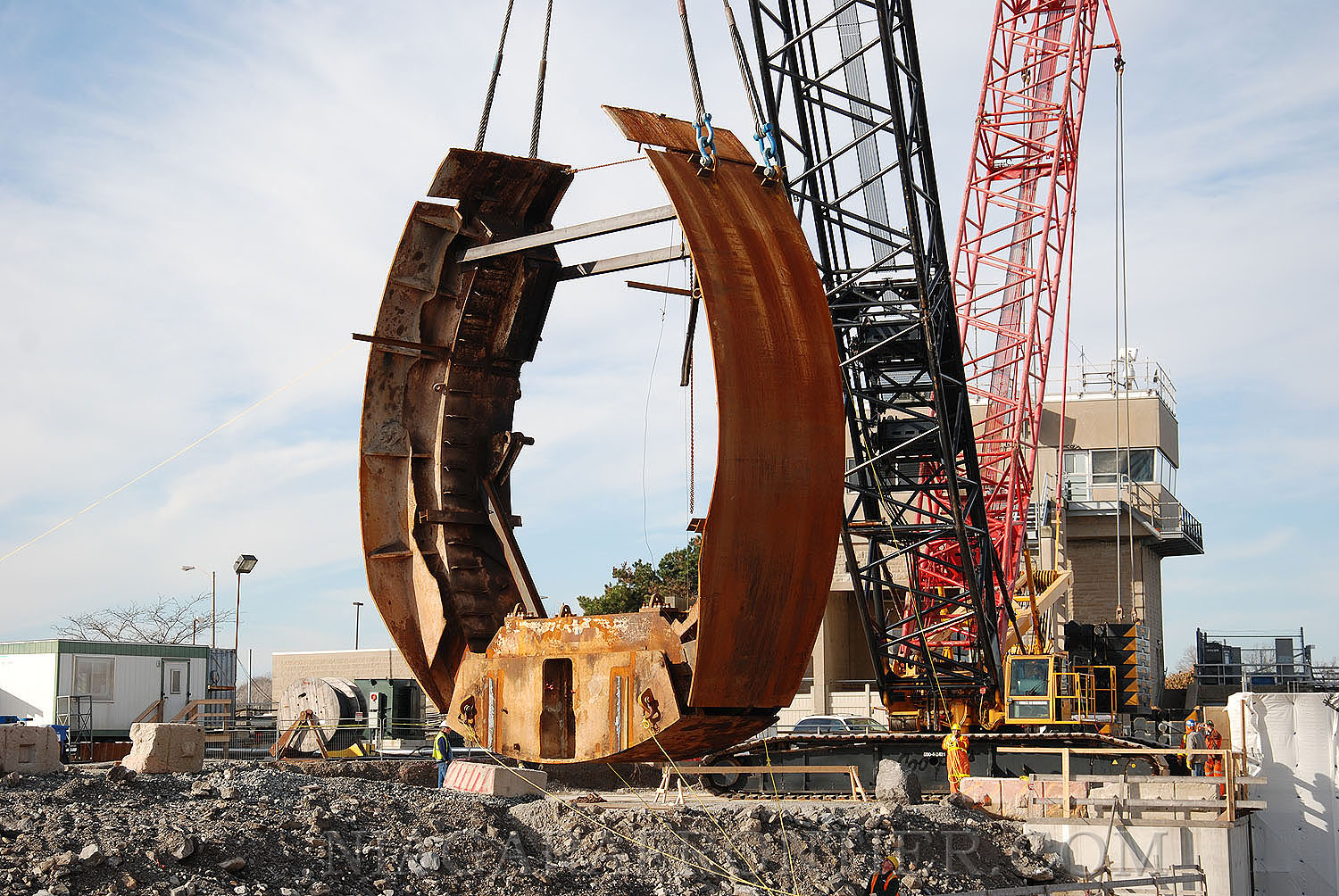
On Thursday May 27th, the first concrete pouring on the arch form bay (12.5
meters) took place. The two arch forms are designed to take turns pouring every
other section in succession. The arch forms when fully functioning will attain
an average rate of 21 meters per day.
Work continues on the new air vent shaft. The maximum outer diameter of the
shaft is currently being drilled. Before this vent shaft becomes fully
functional it will need to be lined and grouted. In addition, the Invert Carrier
will have to pour concrete beyond the location of the adit.
Work on the Invert Carrier resumed this past week.
Work on the Restoration Carrier continues reinforcing and reshaping the crown of
the tunnel. Shotcrete spraying continues in multiple 400 millimeter layers to
reshape the crown damaged from previous overbreak.
June 19th 2010 -
The TBM has resumed mining.
June 28th 2010 -
At the beginning of the day
shift, the TBM is at 6,993.5 meters
(22,944 feet). The Invert Carrier is at 5,075 meters (16,650 feet) and the
Restoration Carrier is at 1,865 meters (6,119 feet). At 6 p.m. (18:00 hrs), the TBM reached
the 7,000 meter milestone.
Both Arch Carriers have been moved into the tunnel.
July 1st 2010 -
At the beginning of the day
shift, the TBM is at 7,050 meters (23,130 feet). There is no appreciable
overbreak.
July 7th 2010 -
Rock boring (2.7 meters
diameter) for the air vent shaft located on Stanley Avenue has been completed.
July 8th 2010 -
At the beginning of the day
shift, the TBM is at 7,152 meters (23,464 feet). The TBM is averaging 15 meters
daily There is no appreciable overbreak. The Invert Concrete Carrier is at
5,075 meters (16,651 feet). The Arch Concrete Carrier is at 112 meters (367
feet).
July 16th 2010 -
At the beginning of the day
shift, the TBM is at 7,315 meters (23,999 feet). The TBM is averaging 20.3 meters
daily. There is no appreciable overbreak. The Arch Concrete Carrier is at 150 meters (492
feet).
July 22nd 2010 -
The TBM mining has stopped
pending a conveyor belt extension.
July 23rd 2010 -
The TBM is at 7,447.6 meters
(24,434 feet) at a depth of 91 meters (301 feet). The TBM is averaging 19 meters daily. There is no
appreciable overbreak. The Arch Concrete Carrier is at 200 meters (656
feet). The Restoration Carrier is at 2,050 meters (6,726 feet). The Air Shaft:
drilling is done, the liner pipe has been installed and by the end of next week
the grouting of the annular gap will be completed. The Invert Concrete Carrier
is awaiting completion of the air shaft before progressing forward.
July 30th 2010 -
The TBM is scheduled to resume
mining in this afternoon following a one week shutdown for maintenance .
The Invert Carrier is at 5,300 meters. The Invert Concrete Carrier is
scheduled to resume work during the middle of next week (August 3-5). The Invert
Concrete Carrier is awaiting completion of the air shaft before progressing
forward beyond the adit.
August 6th 2010-
At the beginning of the
dayshift, the TBM is at 7,559.6 meters
(24,801.5 feet) at a depth of 91 meters (301 feet). The TBM is averaging 19 meters daily. There is no
appreciable overbreak. The Arch Concrete Carrier is at 275 meters (902
feet). The Restoration Carrier is at 2,140 meters (6,726 feet). The Invert
Concrete Carrier is at 5,300 meters (17,388 feet) and is awaiting completion of
the air shaft before progressing forward beyond the adit.
August 7th 2010 -
At the beginning of the
dayshift, the TBM is at
7576.6 meters
(24,857.6 feet) at a depth of 90 meters (295 feet). The TBM is averaging 19 meters daily. There is no
overbreak. The TBM has begun a 1,000 meter long arching curve (south-east)
since reaching the 7,393.9 meter mark. The tunnel is beginning to veer away from
following the Stanley Avenue route.
There are approximately 300
workers currently employed on the Niagara Tunnel project.
August 14th 2010 -
At the beginning of the
dayshift, the TBM is at 7,694.997 meters
(25,245 feet) at a depth of 91 meters (298 feet). The TBM is averaging
23.6 meters daily. There is no overbreak. The TBM has begun a 1,000 meter long arching curve (south-east)
since reaching the 7,393.9 meter mark.
The Invert Carrier is at 5,150
meters. The Restoration Carrier is at 2,230 meters and the Arch Form is at 262.5
meters.
August 15th 2010 -
Since the beginning of 2010,
the TBM has progressed 2 kilometers and in the past year it has mined 2,514.4
meters.
The TBM is at 7,717.37 meters (25,319 feet) at a depth of 91.889 meters
(301.47 feet)*.
August 20th 2010 -
Ontario Power Generation
releases 2nd Quarter Financial Report.
Read more
August 23rd 2010 -
The TBM is at 7,786.98 meters
(25,245 feet) at a depth (elevation) of 91.879 meters (301.4 feet)*.
August 27th 2010 -
The TBM is at 7,857 meters
(25,777 feet) at an elevation (depth) of 91.879 meters (301.4 feet)*. The Invert Concrete at 5,320 meters. The
Overbreak Restoration at 2350 meters and the Arch Forms are at 362.5 meters.
September 4th 2010 -
The TBM is at 7,969.59 meters
(26,146.63 feet) at a depth (elevation) of 91.900 meters (301.5 feet)*. The TBM
is mining a daily average of 14 meters (46 feet).
September 7th 2010 -
The TBM is at 8,043.50 meters
(26,389 feet) at a depth (elevation) of 91.979 meters (301.76 feet)*. The TBM
is mining a daily average of 18.4 meters (60.37 feet).
September 15th 2010 -
The TBM is at 8,131.40 meters
(26,677.5 feet) at a depth (elevation) of 91.944 meters (301.65 feet)*. The TBM
is mining a daily average of 18 meters (59.5 feet).
September 16th 2010 -
The TBM is at 8,148.5 meters
(26,733.6 feet) at a depth (elevation) of 91.944 meters (301.65 feet)*. The TBM
is mining a daily average of 18 meters (59.5 feet).
September 17th 2010 -
At the beginning of their day shift, the TBM is at 8,166 meters
(26,791 feet) at a depth (elevation) of 91.944 meters (301.65 feet)*. The TBM
is mining a daily average of 18 meters (59.5 feet). The Invert Concrete is at
5,500 meters. The Restoration carrier is at 2,500 meters and the Arch Concrete
is at 450 meters.
September 21st 2010 -
At the beginning of their day shift, the TBM is at 8,207.3 meters
(26,926.5 feet) at a depth (elevation) of 91.944 meters (301.65 feet)*. The TBM
is mining a daily average of 10.38 meters (34 feet). The Invert Concrete is at
5,575 meters. The Restoration carrier is at 2,556 meters and the Arch Concrete
is at 450 meters.
September 26th 2010 -
At the beginning of their day shift, the TBM is at 8,296.6 meters
(27,219.4 feet) at a depth (elevation) of 91.944 meters (301.65 feet)*. The TBM
is mining a daily average of 18 meters (59 feet). The Invert Concrete is at
5,661 meters. The Restoration carrier is at 2,605 meters and the Arch Concrete
is at 474 meters.
September 28th 2010 -
The TBM is at 8,314.82 meters
(27,279.2 feet) at an elevation of 92.012 meters (301.87 feet)*.
October 11th 2010 -
At the beginning of their day shift, the TBM is at 8,456 meters
(27,742 feet) at a depth (elevation) of 91.944 meters (301.65 feet)*. The TBM
is mining a daily average of 12 meters (39 feet). Overbreak is minimal. The Invert Concrete is at
5,900 meters. The Restoration carrier is at 2,720 meters and the Arch Concrete
is at 575 meters.
October 12th 2010 -
At 5:15 pm, the TBM is at 8,468.10 meters
(27,742 feet) at a depth (elevation) of 91.98 meters (301.65 feet)*.
October 18th 2010 -
At the beginning of their day shift, the TBM is at 8,548 meters
(28,044 feet) at a depth (elevation) of 91.944 meters (301.65 feet)*. The TBM
is mining a daily average of 13.14 meters (43 feet). Over break is minimal. The Invert Concrete is at
5,975 meters. The Restoration carrier is at 2,800 meters and the Arch Concrete
is at 625 meters.
October 22nd 2010 -
At 6 pm, the TBM is at 8,605.79 meters
(28,233.8 feet) at a depth (elevation) of 91.97 meters (301.74 feet)*.
October 28th 2010 -
At the beginning of their day shift,
the TBM is at 8,640 meters (28,346 feet) at a depth (elevation) of 91.922 meters
(301.65 feet)*. The TBM has been undergoing maintenance since October 24th.
Mining has resumed.
November 3rd 2010 -
At the beginning of their day shift,
the TBM is at 8,716 meters (28,595 feet) at a depth (elevation) of 91.922 meters
(301.65 feet)*. The TBM is mining a daily average of 15 meters (50 feet).
Overbreak is minimal. The Invert Concrete is at 6,050 meters. The Restoration
carrier is at 2,940 meters and the Arch Concrete is at 775 meters.
November 4th 2010 -
At 6 p.m. the TBM is at 8,729.15 meters (28,638 feet) at a depth (elevation) of 92.151 meters
(302.3 feet)*.
November 11th 2010 -
At 6 p.m. the TBM is at 8,847.39 meters (29,026.5 feet) at a depth (elevation) of 92.239 meters
(302.6 feet)*.
November 16th 2010 -
At 6 p.m. the TBM is at 8,913.32 meters (29,242.8 feet) at a depth (elevation) of 92.068 meters
(302.06 feet)*.
November 23rd 2010 -
At 7 a.m. the TBM is at 8,984.43 meters (29,476.2 feet) at a depth (elevation) of 92.062 meters
(302.04 feet)*.
November 27th 2010 -
At 7 a.m. the TBM is at 9,009 meters (29,557 feet) at a depth (elevation) of 91.933 meters
(301.61 feet)*.
December 1st 2010 -
At 7 a.m. the TBM is at 9,076.92 meters (29,779.5 feet) at a depth (elevation) of 92.160 meters
(302.36 feet)*.
December 3rd 2010 -
Mining has been stopped for an
undisclosed period of time pending repairs to the TBM that has sustained
structural damage.
The TBM is at 9,107 meters (29,878
feet).
December 4th 2010 -
The 4th Annual St. Barbara ceremony
took place just inside the tunnel outlet at 10 a.m. It is the only day of
the year that work inside the tunnel is suspended. Safety was the key to a
banner year of mining with no major injuries reported. Strabag has surpassed a
safety record of 1 million man working hours without a lost day injury.
December 6th 2010 -
A 5.1 cm (2 inch) crack appeared at the
top of the main beam (center spine support) of the TBM resulting in the
immediate stoppage of mining. The main beam supports the TBM cutterhead,
grippers and major hydraulics. In order to repair this crack, four 200 ton jacks
have been utilized to lift the sections at the front of the crack and the rear
of the crack in order to align the beam before it can be welded.
Ernst Gschnitzer, Project Manager has
said "she (the TBM ) has a crack in the Main Beam that we need to repair. After
9,107 meters of mainly difficult ground and more than 6,000 hours, we think she
is just getting older and suffering from some correlated disease. We would have
had to do some last repair anyway prior to the last reach of tunnel. Including
these maintenance and repair works, we expect her back in service by December
27."
The crack created a break seperation in the
main beam of 10.2 centimeters (4 inches).
December 29th 2010 -
The TBM has resumed mining.
January 3rd 2011 -
The TBM has reached 9,177.31 meters
(30,108.9 feet) at an elevation of 91.915 meters. The TBM is approximately 68
meters (223 feet) below the surface.
January 5th 2011 -
The TBM has reached 9,192 meters
(30,157 feet) at an elevation of 91.915 meters. The TBM is approximately 68
meters (223 feet) below the surface.
The Arch Concrete Form is at 1,275m (4,183 feet).
January 7th 2011 -
The TBM has reached 9,215 meters
(30,232 feet) at an elevation of 92 meters. The TBM is approximately 68
meters (223 feet) below the surface of the Niagara River. The TBM is mining an
average of 12 meters daily.
At 9,458 meters, the TBM will begin to
ascend towards the surface at an angle of 7.150%. At 9,846 meters, the TBM
will breakthrough into the existing grout tunnel.
January 9th 2011 -
At the beginning of the shift, the TBM
has reached 9,223 meters (30,258 feet) at an elevation of 92 meters.
January 14th 2011 -
At the beginning of the shift, the TBM
has reached 9,271.51 meters (30,418 feet) at an elevation of 91.911 meters
(301.54 feet). The TBM is approximately 68 meters (223 feet) below the surface
of the Niagara River. The TBM is mining an average of 9.7 meters daily.
At 9,458 meters, the TBM will begin to
ascend towards the surface at an angle of 7.150%. At 9,846 meters, the TBM
will breakthrough into the existing grout tunnel.
January 17th 2011 -
At the beginning of the shift, the TBM
has reached 9,309.59 meters (30,543 feet) at an elevation of 92.050 meters
(302 feet). The TBM is approximately 68 meters (223 feet) below the surface
of the Niagara River. The TBM is mining an average of 12.6 meters daily.
January 22nd 2011 -
At the beginning of the shift, the TBM
has reached 9,382 meters (30,780 feet) at an elevation of 92.050 meters
(302 feet). The TBM is approximately 68 meters (223 feet) below the surface
of the Niagara River. The TBM is mining an average of 14.4 meters daily. The Invert Concrete is at 6,623 meters
The Arch Concrete is at 1,425 meters
January 31st 2011 -
At the beginning of the shift, the TBM
has reached 9,456 meters (31,023 feet) at an elevation of 92.050 meters
(302 feet). The TBM is approximately 68 meters (223 feet) below the surface
of the Niagara River. The TBM is mining an average of 10 meters daily.
The Invert Concrete is at 6,712 meters
The Arch Concrete is at 1,525 meters
February 4th 2011 -
At the beginning of the shift, the TBM
has reached 9,527.22 meters (31,257 feet) at an elevation of 93.97 meters
(308 feet). The TBM is mining an average of 17 meters daily.
February 13th 2011 -
At the beginning of the shift, the TBM
has reached 9,640.40 meters (31,628 feet) at an elevation of 93.97 meters
(308 feet). The TBM has begun to ascend. The TBM is mining an average of
7-8 meters daily.
The Invert Concrete is at 6,750 meters
The Arch Concrete is at 1,675 meters
February 17th 2011 -
At the beginning of the shift, the TBM
has reached 9,673 meters (31,735 feet) at an elevation of 102 meters. The TBM is mining an average of
7-8 meters daily.
February 21st 2011 -
At the beginning of the shift, the TBM
has reached 9,717.78 meters (31,882 feet) at an elevation of 107.661 meters. The TBM is mining an average of
11 meters daily.
February 24th 2011 -
At the beginning of the shift, the TBM
has reached 9,758.95 meters (32,017 feet) at an elevation of 110.451 meters. The
TBM is mining an average of 13.7 meters daily.The TBM is currently 55.54 meters
(182.25 feet) below the surface of the Niagara River.
February 26th 2011 -
At the beginning of the shift, the TBM
has reached 9,790.04 meters (32,120 feet) at an elevation of 112 meters. On
February 25th the TBM mined 17 meters. The
TBM is mining an average of 15.6 meters daily. The TBM is currently 56 meters
(183 feet) below the surface of the Niagara River.
At the current pace, the TBM will breakthrough into the existing Grout Tunnel on or about March 1st or
2nd. ** The TBM is 70 meters away from this intersection and is 353 meters from
the the completion of the TBM mining.
March 1st 2011 -
At 1:15 p.m., the TBM
intersected the grout tunnel at 9,845 meters (32,302 feet) at an elevation of
116.667 meters. The TBM is 52 meters (170 feet) below the surface of the Niagara
River. At 9,458 meters, the TBM will begin to
ascend towards the surface at an angle of 7.150%. At 9,846 meters, the TBM
will breakthrough into the existing grout tunnel.
March 11th 2011 -
At the beginning of the shift, the TBM
is at 9951 meters (32,647 feet).
March 13th 2011 -
At the beginning of the shift, the TBM
is at 9986.44 meters (32,736 feet) at an elevation of 126.768 meters.
The TBM will mark the 10,000 meters
milestone during this daily shift. The TBM is 40 meters (131 feet) below
the surface of the Niagara River. The TBM is 157 meters away from completion of
the mining phase.
March 14th 2011 -
At the beginning of the shift, the TBM
is at 10,009 meters (32,837.5 feet) at an elevation of 127 meters. The TBM
is 134.4 meters away from completion of the mining phase.
March 15th 2011 -
The TBM
is at 10,029.48 meters (32,905 feet) at an elevation of 130.008 meters. The TBM
is 36 meters (118 feet) below the surface of the Niagara River and is 128 meters away from completion of the mining phase.
March 20th 2011 -
The TBM
is at 10,088.54 meters (33,098 feet) at an elevation of 134.22 meters. The TBM
is 33.78 meters (110.83 feet) below the surface of the Niagara River and is 70 meters away from completion of the mining phase.
March 24th 2011 -
The TBM
is at 10,136 meters (33,254 feet) at an elevation of 137 meters. The TBM
has stopped mining until the official Breakthrough Ceremony in April. The TBM
is 31 meters (102 feet) below the surface of the Niagara River and is 1.5 meters away from completion of the mining phase.
The Invert Concrete is at 6,900 meters.
The Restoration is at 3,450 meters.
The Arch Form is at 2,000 meters.
March 25th 2011 -
Two Strabag workers involved on the
Niagara Tunnel Project were taken to hospital Friday, following an incident with
a pressurized pipe that carries concrete into the tunnel, project manager Ernst
Gschnitzer says. "Two workers are hurt… They are conscious. They can talk. They
are, so far, OK," Gschnitzer said. The injuries weren't life-threatening and the
two workers were reported to have talked to paramedics and they walked to an
ambulance that attended the site, he added. Both workers are from the
Niagara area, Gschnitzer said, though he couldn't release their names. Their
families had been notified of the incident. The incident took place before noon
on what's known as the arch form – some equipment that's used to install a
concrete lining on the top third of the tunnel. Two Strabag workers involved in
the Niagara Tunnel Project were taken to hospital Friday, following an incident
with a pressurized pipe that carries concrete into the tunnel, project manager
Ernst Gschnitzer says. They were released from the hospital later in the
afternoon and were expected to be back at work for their next shift, he said.
The incident took place before noon on what's known as the arch form -the
equipment used to install a concrete lining on the top third of the tunnel. It
occurred during the cleaning of that pipe. Compressed air is blown through the
pipe to clear it of concrete. "The concrete pipe was opened while it was
still under pressure," Gschnitzer said. The workers were hit with
compressed air and flying chunks of wet concrete. The sudden blast of air
explained why the call was first reported to emergency crews as an explosion, he
added.
Ministry of Labour investigators were called, but left the site in the
afternoon. They ordered Strabag to prepare a written report on how to prevent a
similar occurrence.
That work is being done a little
more than two kilometres into the tunnel, whose entrance is outside the Sir Adam
Beck generating stations. The two-kilometre mark would under the ground, a
little bit north of Thorold Stone Road. Big Becky, the tunnel-boring machine
that excavates the tunnel, has been the high-profile part of the project. It has
dug its way almost to the International Control Structure. But other work is
still taking place at various points throughout the tunnel.
Strabag, the Austrian company hired by Ontario Power Generation to build the
tunnel, has boasted of its safety record since the project began in 2006.
Friday's injuries are a setback to that record, but not a major blemish on it,
Gschnitzer said. "It sets us back a little bit, but it does not have a big
impact on our good safety record so far," Gschnitzer said.
Two men have been sent to hospital
following an accident in the Niagara Tunnel project on Friday. The accident
occurred shortly before lunch time. The two men have been transported to
hospital with non-life threatening injuries.
A cement-carrying pipe at the Niagara Falls "Big Becky" tunnel construction
site crashed on Friday, resulting in two workers being sent to the hospital.
Project manager Ernst Gschnitzer, of Strabag Inc., said the incident
occurred shortly before lunch when the arch concrete machine which he
described as a big piece of equipment spanning two kilometres in the tunnel
had pressure built up in one of its pipes, causing it to collapse. Two men
working below were injured in the accident and sent to hospital.
Gschnitzer said the men were conscious and talking while waiting for the
ambulance. He noted that the injuries were not life-threatening. After a
quick check-up, the workers returned to work with no broken bones or
work-impeding injuries.
"It's good news," said Gschnitzer, who added that this incident will not
affect the project's safety record. The project, which began in 2006, has a
loss-time rate of 0.6 which is well below the provincial average of 1.9,
Gschnitzer said. General work on the tunnel was never interrupted, but the
area where the accident occurred was isolated and shut down while an
investigation took place.
OPG hired the Austrian company to build a 10-kilometre tunnel about 140
metres below the city of Niagara Falls to connect the upper Niagara River to
the Beck hydro generators. The $1.6-billion project is scheduled to be
completed in 2013. The 14.4-metre diameter tunnel is expected to bring
enough water to generate enough additional electricity to supply 160,000
homes. - Corey Larocque Niagara Falls Review
April 3rd 2011 -
The TBM is at 10,136
meters (33,254 feet) at an elevation of 137 meters. The TBM has stopped mining
until the official Breakthrough Ceremony. Work in the tunnel continues. A
ventilation bulkhead is being constructed in the tunnel behind the TBM. This is
to prevent the loss of air pressure inside the tunnel following the
breakthrough. Parts of the TBM that are unnecessary for the final breakthrough
continue to be dismantled and removed.
April 7th 2011 -
OPG has stated in a media release
issued today that the date of the final break-out of the 14.4 meter diameter TBM
named "Big Becky" will occur on Friday May 13th 2011. The TBM remains at
10,136 meters (33,254 feet) at an elevation of 137 meters. This finale will
bring to an official end the mining phase of the Niagara Tunnel Project
construction. The breakout will occur at 10,143.026 meters. The final push will
be 1.5 meters
The tunnel ends at Station 10143 meters
at the Intake Structure, a few meters have been excavated by drill and blast.
Difference between 10143 meters and 10158 meters is due to the alignment change.
Final push is about 1.5 meters.
May 2nd 2011 -
The Official Breakthrough Ceremony of
the TBM will take place on Friday May 13th 2011 beginning at 11 a.m. Work
continues within the tunnel unabated. The Arch Form has poured 12.5 meters every
single day for the past 40 days (advancing 500 meters). Work continues tearing down
unnecessary parts of the TBM, conveyor system and support bridges.
Although much focus is currently on the TBM ceremony marking the completion of the mining
phase of the Niagara Tunnel Project, much major and no less important work
continues on a 24/7 basis of many other processes of the tunnel construction
including the Invert Concrete, Restoration, Arch Form and Grouting.
May 9th 2011 -
MEDIA ADVISORY - NIAGARA TUNNEL EVENT - BIG BECKY
BREAKTHROUGH - issued by Ontario Power Generation
TORONTO, May 9 /CNW/ - The Niagara Tunnel Project will hit an important
milestone May 13, 2011 when Big Becky, the world's largest hard rock tunnel
boring machine "breaks through" to daylight after a 10.2 Km journey beneath
Niagara Falls, Ontario.
When completed in 2013 the Niagara Tunnel will increase the output at Ontario
Power Generation's Sir Adam Beck Generating Station and provide clean, renewable
energy for an additional 160,000 Ontario homes.
The tunnel mining is a major component of the project and tunnel mining
tradition calls for a celebration when the mining is completed.
EVENT DETAILS
WHAT: Big Becky Breakthrough at Niagara Tunnel Project.
WHEN: May 13 - media should arrive at 10:00 a.m. Event starts at 11:00 am-
Breakthrough estimated for 11:30 am.
WHERE: Media Parking: 200 m east of intersection of Upper Rapids Blvd. and
Niagara Parkway, Niagara Falls, Ontario
NOTE: Accredited media must pre-register with OPG Media Relations - MEDIA@OPG.COM
Because of safety regulations media cannot enter the area of the breakthrough.
Images will be available on a live satellite feed. Still photos will be
available shortly after the event. Contact OPG for B-roll and stock images.
The TBM affectionately known as "BIG
BECKY" officially completed the mining phase of the Niagara Tunnel Project at
approximately 12:34 p.m. when the ceremonial breaking through the outer portal of the Grout Tunnel
before a large number of government politicians, company executives, workers,
media and other invited guests. The breakout occurred at 10,143.026 meters.
The Moment of Breakthrough and the Celebration of the Workers
TBM Final Breakout
Niagara Tunnel Project
May 13th 2011 (courtesy of OPG)
May 26th 2011 -
The Concrete Arch lining has reached
2800 meters. Disassembly of the TBM cutterhead is scheduled to begin in
approximately 10 days.
May 29th 2011 -
Workers are in the process of
loosening the bolts of the TBM cutterhead. When ready, (July 2011) a large
hydraulic platform will be assembled in the intake channel cut. This
platform will be used to receive each the six segments (one at a time) that
make up the cutterhead. The platform will then move into an open area where
the segment will be lifted to the surface by a crane. It is expected that
the disassembled segments of the cutterhead will remain on site until a
decision is made as to whether or not it will be reassembled in an area yet
to be determined as a monument to the Niagara Tunnel Project legacy.
June 7th 2011 -
The Invert Concrete is in excess of
7,000 meters. The Arch Concrete continues pouring one bay (12.5 meters) per day.
June 26th 2011 -
Construction within the tunnel has
continued unabated. Crews continue to dismantle parts of the TBM train that are
now redundant. The parts are being placed onto flatbed trailers and moved to a
location within the tunnel pending shipment out the tunnel's outlet portal. The
cutterhead continues to be prepared for disassembly in the near future.
The TBM Cutter-head awaiting disassembly - June 26th 2011
The TBM - May 29th 2011
July 2nd 2011 -
A "Fall of Ground" occurred
within the Niagara Tunnel on Saturday July 2nd 2011 between 10 a.m. and 11 a.m.
Forty to fifty cubic metres of rock fell from the roof of the Niagara Tunnel.
Project manager Ernst Gschnitzer said it happened in a "problematic area" about
six kilometres into the 10.2-kilometre tunnel. Nobody was injured.
"The area is secured and we are in the process of restoring, or gearing up for
restoring, the area," said Gschnitzer, of Strabag AG, the Austrian company hired
by Ontario Power Generation to build the tunnel. "It happened already a while
ago in another zone of the tunnel. It is an area that we have already
monitored."
- Niagara Falls Review
The TBM mined the area of the tunnel at 6,000 Meters at an
elevation of 91.729 meters in February of 2010.
This is the second such occurrence that
has occurred.
The first "Fall of Ground" fell from the crown of the tunnel on September 11th
2009. The partial collapse came just as the TBM was moving into more
competent ground and achieving higher progress rates. About 25m3 (100 tonnes) of
temporary lining and Queenston Shale fell from the crown. According to the
owner, Ontario Power Generation, no one was injured in the collapse and all of
the workers left the tunnel safely, following established emergency procedures.
The fall occurred about 2 km (1.2 miles) behind the TBM, and some 3,600 meters
(2.2 miles) into the 10 kilometer (6.2 mile) long ,14.4 meter (47ft) diameter
tunnel, in an area that experienced some of the most severe over-break to date.
July 5th 2011 -
Arch Form is at 3,362.5 meters.
Restoration Carrier is at 4,474 meters.
Invert Concrete is at 7,625 meters.
All activities from the outlet to
5,500 meters are continuing normally.
The TBM - May 29th 2011
July 17th 2011 -
Arch Form is at 3,375 meters. Two bays per day are now being poured (25m).
Overbreak Restoration Carrier is at 4,558 meters. The Grouting Carrier that
is part of the overbreak restoration process is at 3,900 meters.
The TBM dismantling has begun and the cutter-head is expected to begin being
dismantled during the next week. The outlet structure is being
prepared for concrete pouring in August. The Pre-stress Contact Grouting Carrier and associated platforms have been
moved into the tunnel.
July 25th 2011 -
Work at the intake continues. Crews
have cut the outside welds of the cutterhead in preparation for disassembly.
They are currently erecting a rail system that will be utilized to begin the
cutterhead removal in the near future.
Arch Form is at 3,437.5 meters.
Pouring one bay per day.
Restoration Carrier is at 4,730 meters.
Invert Concrete is at 7,625 meters (stopped pending "fall of ground" repair)
Laying track at the Intake - July 24th 2011
August 2nd 2011 -
Arch Form is at 3,500.0 meters.
Restoration Carrier is at 4,930.0 meters.
Invert Concrete is at 7,625 meters.
August 7th 2011 -
The carrier to be utilized to remove
the cutterhead has been erected at the intake and is being welded in place
against the first section to be removed. Once ready the bolts holding that
section of the cutterhead will be cut and the carrier will bear the full weight
of the section. The carrier will lower the section and move it to an open area
where it will be hoisted to the surface by crane.
Intake - August 7th 2011
August 14th 2011 -
Arch Form is at 3,662.5 meters.
Restoration Carrier is at 5,095.0 meters.
Invert Concrete is at 7,625 meters.
Grouting Operation - Pre-stress grouting bay 67-64
August 16th 2011 -
The first section of the cutterhead
weighing approximately 75 tonnes was removed from the TBM on Monday August 15th and is resting on the carrier that will allow it to be
lifted to the surface in several days using a 300 ton crane. The section was
separated from the remaining cutterhead and lowered by the carriage to clear the
roofline of the intake structure before being rolled backward into an area where
it can be lifted to the surface. The process takes approximately 3 hours.
Cutterhead Section Resting on Carriage
Intake Channel - August 18th 2011
August 18th 2011 -
The first section of the cutterhead
weighing approximately 75 tonnes is expected to be hoisted to the surface on
Monday August 22nd by two surface cranes working in tandem. The primary crane
has a lift capacity of 300 tons and the second crane will have the lift capacity
of 200 tons.
August 21st 2011 -
Arch Form is at 3,775.0 meters. One bay
per day.
Restoration Carrier is at 5,165.0 meters.
Invert Concrete is at 7,625 meters.
Grouting Operation - Pre-stress grouting bay 66-64
What Goes Down - Must Come Up
Lift of first section of Cutterhead
Intake Channel - August 23rd 2011
August 23rd 2011 -
The first section of the cutterhead
weighing approximately 75 metric tonnes was hoisted to the surface from the base
of the Intake channel. The 6 hour process went flawlessly. Both cranes were
utilized to lower the cutterhead to the base of the intake channel before being
shifted closer to the primary 300 ton crane. Once this was undertaken the 300
ton crane performed the solo lift of the section to the surface. The consulting
engineer for the lift was Joseph Ha of St. Catharines, Ontario.
Arch Form is at 3,775.0 meters. One bay
per day.
Restoration Carrier is at 5,165.0 meters.
Invert Concrete is at 7,625 meters.
Grouting Operation - Pre-stress grouting bay 66-64
August 28th 2011 -
Arch Form is at 3,825.0 meters. One bay
per day.
Restoration Carrier is at 5,190.0 meters.
Invert Concrete is at 7,625 meters.
Grouting Operation - Pre-stress grouting completed to bay 54
August 29th 2011 -
The second section of the cutterhead
weighing 75 metric tonnes was hoisted to the surface from the base
of the Intake channel.
Lift of third section of Cutterhead
Intake Channel - September 6th 2011
September 6th 2011 -
The third section of the cutterhead
weighing 75 metric tons was hoisted to the surface from the base
of the Intake channel.
The fourth section of Cutterhead being prepared to be lifted to the surface
Intake Channel - September 17th 2011
September 17th 2011 -
The fourth section of the cutterhead was hoisted to the surface from the base
of the Intake channel.
September 25th 2011 -
Arch Form is at 4,100.0 meters.
Restoration Carrier is at 5,190.0 meters.
Invert Concrete is at 7,625 meters.
Grouting Operation - Pre-stressed grouting up to bay #50. Filling phase
completed up to bay #31
A 550 ton crane will be utilized at the
intake channel in November for the lifting the the main beam of the TBM.
October 23rd 2011 -
The cutterhead "shoe" weighing
approximately 330 tons (pictured below) has been moved into the open area at the
bottom of the intake channel awaiting the arrival of a 600 ton crane that will
lift it and the TBM main beam to the surface.
Intake Channel and Tunnel - October 23rd
2011
October 30th 2011 - Arch Form is at 4,473.5 meters.
Restoration Carrier is at 5,190.0 meters.
Invert Concrete is at 7,625 meters.
Grouting Operation - Pre-stressed grouting up to bay #13. Filling phase
completed up to bay #06
November 6th 2011 - The 550 ton crane is onsite at the outlet location and is being erected in order
to lift the remainder of the conveyor bridge crossing the existing hydro canal.
When finished it will be moved to the intake location.
Workmen continue the disassembly of the
TBM. The gigantic grippers are being prepared to be removed in order that the
main beam of the TBM can be walked out of the tunnel on a rail bed before being
lifted to the surface.
Remedial work on the "Fall of Ground"
continues from the intake and outlet sides of the tunnel.
November 15th 2011 - The 550 ton crane has completed the lift of the conveyor bridge (approximately
85 meters long - 4 meters wide).
Preparing to lift the remnants of the
conveyor bridge at the outlet - November 14th
2011
November 17th 2011 - Sections for the boom of the 550 ton crane have begun arriving at the intake
site.
November 18th 2011 - Ontario
Power Generation Inc. (“OPG” or the “Company”) reported its financial and
operating results for third quarter of 2011 ending September 30th.
Net loss for the third quarter of 2011 was $96 million compared to a net income
of $333 million dollars for the third quarter of 2010.Net income for
the nine months ended
September 30, 2011 was $169 million compared to $447 million for the same period
in 2010.
As at September 30, 2011, OPG’s long-term debt outstanding with the OEFC was
$3.9 billion dollars (actual $4.743 billion dollars).
The tunnel boring machine mining activity has been completed, and the
disassembly of the tunnel boring machine is in progress. Lining installation
activities at the Niagara Tunnel continue. Installation of the lower one-third
of the permanent concrete lining had reached 7,625 metres by July 2, 2011 when
this work was temporarily interrupted to do reinforcement repair work in the
6,050 metre area of the tunnel. This lining work is expected to resume in
January 2012. All other tunnel lining activities are continuing. As at September
30, 2011, the life-to-date capital expenditures were $1.1 billion. The project
is expected to be completed within the approved budget of $1.6 billion and the
approved project completion date of December 2013.
November 25th 2011 - The 550 ton crane has completed the lift of the 317 ton shoe from the base of
the intake channel at approximately 11:30 a.m.
November 14th 2011 -
On July 2nd, a "fall of ground" took
place at 6,050 meters, effectively cutting the tunnel into two sections: the
outlet side and the inlet side.
Work has continued unabated to repair
the area of the fall of ground. It has been taking place within each section of
the tunnel simultaneously. By luck, a crew bus was stranded in the intake
section of the tunnel behind the TBM, allowing crews to be shuttled the nearly 4
kilometers to the rock fall zone. Unfortunately, the crew bus on the intake side
became totally disabled. This caused Strabag a major logistical problem. It
needed a replacement bus however the remainder of the main-beam and cutterhead
of the TBM at the mouth of the intake side of the tunnel precluded the ability
to just lower another mini sized crew bus into the intake channel floor and be
driving directly into the tunnel unobstructed.
Using perhaps modern engineering
adaptation at its best, Strabag did what one could consider most unorthodox but
quite unique and innovative. During the week of November 14th, they took a
replacement crew bus and cut the roof off the bus. The bus was now in two
pieces. The chassis portion of the bus was lowered to the bottom of the intake
channel. Now with sufficient clearance the bus chassis was driven underneath the
existing cutterhead and main-beam. Once inside the tunnel, the bus chassis and
roof were again welded together. A crew bus is again in service on the intake
side of the Niagara Tunnel.
December 4th 2011 - Arch Form is at 4,786.5 meters.
Restoration Carrier is at 5,425.0 meters.
Invert Concrete is at 7,625 meters.
Contact
Grouting is at 2,450 meters.
Interface Grouting is 912.5 meters to 820.8 meters. (Grouting
process begins at lowest point of tunnel)
December 6th 2011 - The final segment of the cutterhead was lifted from the base of the intake
channel to the surface.
December 8th 2011 - The 158.5 ton (317,000 lbs) 'shoe' is removed from the intake channel work site on a specialized
remote controlled flatbed vehicle by
Western Mechanical. The load was transported to the yard on the
opposite side of the road. In the meantime, preparations are being made to
remove the mainbeam of the TBM.
Intake Channel - December 8th
2011
December 29th 2011 - The 220 ton (440,000 lbs) main bearing of the TBM was lifted by crane from the
base of the intake channel to the surface. The 190 ton (380,000 lbs) main frame
will be lifted to the surface in early 2012.
Intake Channel - December 29th
2011
December 30th 2011 - The 220 ton (440,000 lbs) main bearing of the TBM was transported from the
intake channel work site on two specialized remote controlled flatbed vehicles
by Western Mechanical. The main
bearing (the heaviest load to date) was transported to the yard on the opposite
side of the road utilized two $1 million dollar remote flatbed hydraulic
vehicles built in Germany for this tunnel project. The vehicles can carry a
maximum
weight of up to 400 tons.
January 5th 2012 - The 225.5 ton (451,000 lbs) main frame of the TBM was lifted by crane from the
base of the intake channel to the surface.
January 12th 2012 - Arch Form is at 5,111.5 meters.
Restoration Carrier is at 5,712.0 meters.
Invert Concrete is at 7,625 meters. (had been suspended since
July 2nd 2011 as a result of "fall of ground". Work to resume in early February
2012)
Contact
Grouting is at 2,637.0 meters.
Interface Grouting is 1137.5 meters. Filling phase completed up to 1000.0 meters
Access through the entire length of the
tunnel is back in operation.
The two specialized remote
controlled flatbed vehicles operated by Western Mechanical
will be lowered into the intake channel and will be instrumental in the removal
of the remaining TBM support vehicle sections from within the tunnel.
January 29th 2012 - Arch Form is at 5,187.0 meters.
Restoration Carrier is at 5,849.0 meters.
Invert Concrete is at 7,625 meters. (had been suspended since
July 2nd 2011 as a result of "fall of ground". Work to resume in early February
2012)
Contact
Grouting is at 3,037.0 meters.
Interface Grouting is 1,250.0 meters.
February 26th 2012 -
Intake Channel - February 26th
2012
A segment of the TBM support vehicle is
readied at the base of the intake channel for lifting to the surface beginning
on February 27th. This segment will be lifted in three pieces. The final
remaining TBM support vehicle is being prepared for removal from within the
tunnel and should be lifted to the surface before the end of the this week.
March 4th 2012 - Arch Form is at 5,462.5 meters.
Restoration Carrier is at 6,009.0 meters.
Invert Concrete is at 8,037.5 meters.
Contact
Grouting is at 3,312.0 meters.
Interface Grouting is 1,250.0 meters.
Niagara Tunnel - Intake Channel - March 11th
2012
March 19th 2012 - Arch Form is at 5,574.0 meters.
Restoration Carrier is at 6,049.0 meters.
Invert Concrete is at 8,286.0 meters.
Contact
Grouting is at 3,312.0 meters.
Interface Grouting is 1,537.5 meters.
Niagara Tunnel - Intake Channel - April 1st
2012
April 8th 2012 - Arch Form is at 5,624.0 meters.
Restoration Carrier is at 6,190.0 meters.
Invert Concrete is at 8,636.0 meters.
Contact
Grouting is at 3,712.5 meters.
Interface Grouting is 1,787.5 meters.
April 22nd 2012 - Arch Form is at 5,724.0 meters.
Restoration Carrier is at 6,350.0 meters.
Invert Concrete is at 8,786.0 meters.
Contact
Grouting is at 4,175.0 meters.
Interface Grouting is 1,900.0 meters.
Niagara Tunnel Intake - May 6th
2012
May 6th 2012 - Arch Form is at 5,925.0 meters.
Restoration Carrier is at 6,651.0 meters.
Invert Concrete is at 8,962.0 meters.
Contact
Grouting is at 4,687.5 meters.
Interface Grouting is 2,275.0 meters.
Niagara Tunnel Intake - May 6th
2012
May 11th 2012 -
The Ministry of Labour is investigating an
accident in the Ontario Power Generation’s water diversion tunnel beneath the
city which sent three men to hospital Friday with non-life threatening injuries.
According to Niagara Tunnel Project manager Ernst Gschnitzer of Strabag, Inc.,
one man received burns to his leg, another injured his shoulder, and another man
is being treated for shock.
The accident occurred at 11:30 a.m. about six kilometres from the tunnel’s
outlet portal. The $1.6 billion, 10.2 kilometre tunnel was built to increase the
output of the Sir Adam Beck generating stations. Drilling was completed a year
ago, and the tunnel is expected to operational by next year.
Gschnitzer says the cause of the accident is still being determined, thought
there were some “flammables” in the area.
Ministry of Labour spokesman Bruce Skeaff said the workers were injured when
they hit a natural gas pocket while welding through the tunnel lining, causing
an explosion. The extent of their injuries is unknown.
“We’ve sent an inspector and we’re taking a look to try and figure out what
happened.”
Note: 3 of 4 workers were treated
and released from hospital and returned to work the following day. The fourth
worker was treated for burns at the Hamilton General Hospital was released the
following week
Niagara Tunnel - May 20th
2012
May 21st 2012 - Arch Form is at 6,224.0 meters.
Restoration Carrier is at 7,390.0 meters.
Invert Concrete is at 9,212.0 meters.
Contact
Grouting is at 5,212.1 meters.
Interface Grouting is 2,824.6 meters.
Niagara Tunnel - May 20th
2012
Niagara Tunnel - June 2nd
2012
Intake
June 9th 2012 - Canadian Overhead Handling (COH Inc.) continues to build the stop-log type
emergency closure gates at the intake entrance of the Niagara Tunnel. The gate
frames have been installed and employees are currently preparing the gate
guides.
Strabag employees in the tunnel near
the intake are currently working to control water leaks from the previous Grout
Tunnel section in advance of the arrival of the Invert Concrete Vehicle. The
grout tunnel provided the TBM a safe route during its ascent to the surface. The
high pressure injected grout had plugged all rock cracks and fissures preventing
river water above from pouring into the tunnel and onto the TBM. Even so, some
water has continued to enter into the section of the tunnel at the intake.
In order to control the water flow,
massive sump pumps have been employed to pump water back outside.
In recent weeks, in anticipation of the Invert arrival at this portion of the
tunnel, additional water control measures are underway. A trench with a water
collection pipe has been built along the center of the tunnel floor leading to
an industrial sump pump. The pipe was back-filled and concrete is being poured
on top to seal the water collection system underneath. The water will continue
to be collected and expelled in this fashion until the cracks are grouted at the
end of the process sealing any existing leaks.
The Invert Concrete Vehicle will likely
complete its journey through the tunnel with the next several weeks.
Niagara Tunnel - June 9th
2012
Intake
June 24th 2012 - Arch Form is at 6,999.0 meters.
Restoration Carrier is at 8,455.0 meters.
Invert Concrete is at 9,739.0 meters.
Contact
Grouting is at 5,262..1 meters.
Interface Grouting is 2,862.1 meters.
Niagara Tunnel - June 24th
2012
July 1st 2012 - Arch Form is at 7,124.0 meters.
Restoration Carrier is at 8,465.0 meters.
Invert Concrete is at 9,812.0 meters.
Contact
Grouting is at 5,374.6 meters.
Interface Grouting is 4,174.6 meters.
Niagara Tunnel - July 5th
2012
Invert
July 15th 2012 - Arch Form is at 7,475.0 meters.
Restoration Carrier is at 8,650.0 meters.
Invert Concrete is at 9,951.0 meters.
Contact
Grouting is at 5,749.6 meters.
Interface Grouting is 4,587.1 meters.
Niagara Tunnel - July 28th
2012
Invert Carrier at Intake
July 29th 2012 - Arch Form is at 7,811.5 meters.
Restoration Carrier is at 9,198.0 meters.
Invert Concrete is at 10,140.1 meters.
Contact
Grouting is at 6,288.0 meters.
Interface Grouting is 4,587.1 meters.
July 30th 2012 - Final concrete bay pouring of Invert takes place today. The Invert Carrier has
completed it's journey. Disassembly of the Invert carrier will begin within
several weeks. COH (Canadian Overhead Handling) has begun work on outlet gates
while finalizing work at the intake site.
August 12th 2012 - Restoration Carrier is at 9,600.0 meters.
Arch Form is at 8,100.0 meters.
Contact
Grouting is at 6,987.1 meters.
Interface Grouting is 4,724.6 meters.
The disassembly of the Invert carrier
that began on July 31st continues. The final two sections of the Invert bridge
are expected to be raised to the surface this week. Much of the Invert carrier
is being cut-up for scrap.
Niagara Tunnel - August 12th
2012
Invert Carrier Disassembly at Intake
August 19th 2012 - The Invert Carrier has been fully removed from the tunnel and is currently being
cut-up on the surface for scrap. The Bower Bridge has also been removed and
preparations are being made to remove the Otto Bridge this week. Because the
radius of the tunnel has very little flat areas for larger vehicles and
machinery to pass-by each other, the bridges were erected at strategic locations
within the tunnel a height that maximized the total width of the bridge for this
purpose. Most of the bridges were named after workmen employed on the
construction site.
The Restoration Carrier can see the
light at the end of the tunnel (being approximately 600 meters away).
Niagara Tunnel - August 19th
2012
Restoration Carrier
Niagara Tunnel - August 19th
2012
Grout Restoration Carrier
August 26th 2012 - Restoration Carrier is at 9,850.0 meters.
Arch Form is at 8,425.0 meters.
Contact
Grouting is at 7,737.0 meters.
Interface Grouting is 5,329.06 meters.
September 19th 2012 - The Restoration Carrier has completed
its journey through the tunnel. The restoration train included the Restoration
Carrier, Restoration Bridge and Restoration Grout Carrier. All will be lifted to
the surface in the near future.
September 24th 2012 - The Restoration Carrier has been lifted
to the surface and awaits the scrap pile. The restoration bridge is being
prepared to be lifted to the surface this week.
Niagara Tunnel - September 24th
2012
Restoration Carrier on surface
October 7th 2012 - Arch Form is at 9,450.0 meters. The Arch Form membrane carrier is within 300
meters of completion. It is anticipated this carrier will be removed from the
tunnel at the end of October or early November.
Contact
Grouting is at 8,337.0 meters.
Interface Grouting is 7,074.0 meters.
The Restoration Carrier and bridge has
been removed from the tunnel and dismantled.
Niagara Tunnel - October 7th
2012
Arch Form Carriers
October 20th 2012 - The Arch Form membrane carrier is being removed from the
tunnel. The top two portions of this carrier are now on the surface awaiting
scrapping.
The final concrete pouring of the Arch
Form is tentatively scheduled for November 20th which will mark the end of the
concrete pouring phase and mark the point in the tunnel construction in which
the tunnel will be completely lined with concrete.
Niagara Tunnel - October 21st
2012
October 21st 2012 - Arch Form is at 9,800.0 meters.
Contact
Grouting is at 9,209.0 meters.
Interface Grouting is 7,949.0 meters.
The Arch Form membrane carrier is being
dismantled and removed from the tunnel.
October 24th 2012 - The Arch Form Membrane Carrier has been removed from the tunnel intake and
awaits scrap disposal. No other carriers will be dismantled at the tunnel intake
channel. The intake channel will be cleared of apparatus.
The final concrete pouring of the Arch
Form scheduled to take place on November 20th by the lead Arch Form. The
remaining Arch Form Carriers will be backed out of the tunnel to the outlet
channel which will allow much more room and easier dismantling.
The remaining grouting will be undertaken by a portable carrier and supply
trailer before it too is removed to the outlet.
On October 27th, the COH (Canadian
Overhead Company) will undertake a stop-log test at the intake channel cut
utilizing three stop-logs to test balance and fit.
October 28th 2012 - Arch Form is at 9,967.0 meters.
Contact
Grouting is at 9,587.0 meters.
Interface Grouting is 7,949.0 meters (undergoing routine maintenance).
November 6th 2012 - The final concrete pouring of the last 12.5 meter bay by the Arch Form was
concluded marking the completion of the concrete pouring of
the upper two thirds of the tunnel diameter. The tunnel is now be entirely
encased in a concrete shell. Grouting remains to be completed.
The two Arch Form Carriers will be
backed out of the tunnel to the outlet channel for dismantling.
November 8th 2012 - A ceremony was held at the Niagara Tunnel with Government of Ontario politicians
including officials from OPG and Strabag Inc. as well as other dignitaries to
mark the final placement of concrete to signify the completion of the concrete
pouring phase inside the tunnel. In total, about 500,000 cubic meters of
concrete was poured.
Some media outlets and politicians have
called this final pouring the completion of the tunnel however the tunnel will not be
completed until the grouting is completed, the last employee has safely left the
tunnel and the tunnel flooded.
Province of Ontario Minister of Energy,
Chris Bentley also received a commemorative time capsule from Grade 2 students
from the Port Weller School that initially named the tunnel boring machine -
"Big Becky". Teacher Kevin Dyck’s Grade 2 students were the main
attraction at the Table Rock Welcome Centre to close their time capsule before
it is cemented into the tunnel. The students gathered their items into the time
capsule to be opened in 50 years. These include a poppy, wristband, yearbook,
USB stick with their personal legacy assignments saved on it, a water bottle,
and three newspapers, two of which were headlined on U.S. President Barack Obama
winning re-election.
The students got their hands dirty along with Liberal MPP of Niagara Falls Kim
Craitor, St. Catharines MPP Jim Bradley, and Minister of Energy Chris Bentley.
Bentley says the project was a
culmination of dreams, hard work and a vision. According to a ministry release,
this tunnel project has provided about $1 billion in economic benefits to the
region and will continue serving Ontarians for more than 100 years. He stated
“This is a huge accomplishment for Ontario Power Generation, the workers and
construction crews. The project will provide a lot of additional, clean power and continue the great
tradition of Niagara Falls and the Beck generating stations.”
“The completion of the tunnel lining is a major milestone, which was executed
safely, on schedule and on budget,” said Chris Young, OPG’s Vice President of
Hydro Thermal Project Execution. “The tunnel is a significant made-in-Ontario
engineering accomplishment that will serve Ontarians with clean electricity for
more than 100 years.”
Before the water flows, there’s still plenty of work
for Strabag to complete, said project manager Ernst
Gschnitzer. He said the company would begin the long
process of removing equipment from the tunnel,
complete grout work and clear both ends of the
tunnel. “The most difficult part of the work is
done,” he said.
He agreed with OPG’s Young and said that the company
will be looking at some fine tuning of work schedule
to finish up quicker. “We’ll try to squeeze out a
little more time,” Gschnitzer said.
“It’s good from one perspective that we have been
through the most technically challenging part of the
job,” said Ernst Gschnitzer.
“On the other hand you like to remind yourself, your
staff, your workers, to continue to work safely. You
want to be able to celebrate that you haven’t had
any major accidents when you finally hand over the
job. This job has provided work for, more or less,
500 people.”
November 11th 2012 - Arch Form is at 10,150.0 meters. Completed.
Contact
Grouting is at 10,150.0 meters. Completed. Filling phase stopped at 9,212.0
meters.
Interface Grouting is 8,100.0 meters.
All ten stop-logs are on site at the
Intake channel. A wet test that involves filling of the area within the
cofferdam will take place on November 14th.
The dismantling of Dufferin Concrete
batch plant at the Outlet channel continues.
Inside Niagara Tunnel - November 11th 2012
November 15th 2012 - All ten (10) stop-logs are in place at
the entrance of the Niagara Tunnel intake channel to prevent water from flowing
into the tunnel. The empty intake channel inside the cofferdam was successfully
and safely filled with water from the river. The level of water now matches the
height of water in the Niagara River on the outside of the dam. Construction to
remove the cofferdam and pilings will begin shortly. Once the inside of the
tunnel and outlet channel gates are ready the tunnel will be flooded (2013) by
removing the stop-logs in stages at the Intake entrance. All the stop-logs
removed will be stored on the surface in case they are ever needed to
stop the water flowing through the tunnel.
Niagara Tunnel Intake Channel - November 15th 2012
November 16th 2012 - Bermingham Construction Company has
begun moving equipment onto the intake site. They will begin to remove the
cofferdams that were originally erected in order to dewater the area within that
eventually became the intake channel. After removing the fill debris from all
the cells that comprise the cofferdam, Bermingham will begin to remove the steel
pilings allowing the flow of the Niagara River to resume flowing.
Canadian Overhead Company (COH)
continues erecting the twin set of stop-log closure gates at the outlet channel.
In early December, Western Mechanical
will begin transporting the arch forms through the tunnel to the outlet channel
where they will be dismantled. In addition, the Castonguay Blasting Company
Limited will begin drill and blast sequence at the outlet rock plug separating
the outlet channel from the hydro canal. The approximate 30 meter thick plug
will be narrowed to approximately 12 meters.
November 25th 2012 - Contact
Grouting is completed. Filling phase stopped at 9,687.0
meters.
Interface Grouting is 8,700.0 meters.
Bermingham Construction is starting to
remove the cofferdams at the intake site on a 24 hour basis.
On December 7th, removal of all
remaining carriers and bridges from within the tunnel will begin.
December 5th 2012 - Interface Grouting is at 9,300 meters.
Castonguay Blasting Company
Limited has begun drill and blast sequences at the outlet rock plug separating
the outlet channel from the hydro canal. The approximate 30 meter thick plug
will be narrowed to approximately 12 meters. The fourth of a series of
controlled blasts took place today. When ready, the final blast will open
the outlet channel to the existing canal causing the outlet channel to flood.
This is expected to take place in latter part of January 2013. Tunnel stop-log
gates at the outlet will prevent the tunnel from flooding until the tunnel is
completely finished.
Bermingham Construction has starting to
remove the cofferdams at the intake site on a 24 hour basis.
December 13th 2012 - Castonguay Blasting Company Limited has
begun bench style drill and blast sequences at the outlet rock plug separating
the outlet channel from the hydro canal. The approximate 30 meter thick plug
will be narrowed to approximately 12 meters. The the ninth of a series of
controlled blasts took place recently. The outlet channel is expected to be
flooded in February 2013.
The Arch Forms will be removed from the
tunnel in early January 2013 while the final 600 meters of interface grouting
will take place.
December 16th 2012 - Bermingham Construction have removed the fourth of eleven cells that have formed the cofferdam
at the intake site.
Carriers in the tunnel are being dismantled and being moved to the outlet
channel.
Rock plug removal by drill and blast
process is progressing.
January 1st 2013 - The final chapter of the Niagara Tunnel Project will be completed this year with
the flooding of the tunnel.
Bridges and carriers continue to be
removed from within the tunnel to the outlet channel where they are dismantled
and lifted to the surface.
Castonguay Blasting Company continues the blasting process to remove the rock
plug separating the outlet channel from the hydro feeder canal.
Timeline (subject to change):
January - removal of remaining carriers
and bridges including Arch Forms to the outlet channel. Interface Grouting of
final 600 meters utilizing a mobile vehicle.
February - removal of all work related equipment support utilities including pipelines and power
lines. Flooding of outlet channel mid to late February.
March - flooding of tunnel in mid to late March.
Erection of the 14.4 meter diameter TBM
cutter-head on a yet to be established park at the intake channel site along the
river front. This will be a lasting monument to everyone involved in the
creation, design, engineering, and building of the Niagara Tunnel as well as
becoming a tourist attraction for the generations to follow.
Niagara Tunnel Outlet Channel - December 23rd 2012
January 9th 2013 - Tunnel construction continues around the clock with the following activities
taking place.
INSIDE THE TUNNEL -
- Interface grouting is continuing up
at the intake end.
- Passing lane bridges have been removed
- G4 is the new mobile grouting unit which will be launched soon
- G1 will be redeployed to install the flow-metering equipment
- O'Dobniks Bridge is going to be redeployed as a passing bridge
OUTLET CHANNEL -
- Outlet gate and hoist shelter and nearly enclosed - some minor cladding still
needed on the towers
- Outlet gate will continue with testing
- Rock plug is being blasted again this afternoon. Basting is taking place daily
between 8 am and 6 pm Monday-Friday. Several (2) blasts occur daily.
- Several bridges and carriers have been removed at the outlet channel.
- The arch shutter is currently in the outlet channel being sheared into little
pieces for recycling
INTAKE CHANNEL -
- Cofferdam has been removed up to Cell 3A. Currently removing Cell 2A and 3
- General clean up around the intake workshop
January 20th 2013 - Tunnel construction continues on schedule. Castonguay Blasting Company has
reduced the thickness of the rock plug from approximately 30 metres to
approximately 3 metres. Now only 3 metres of rock plug separate the dry outlet
channel from the feeder canal.
The vehicle ramp into the outlet
channel will begin to be removed by Castonguay. Initial holes for explosives to
begin blasting have already been bored into the upper portion of this rock ramp.
The rail mounted overhead crane that
has spanned the width of the outlet channel and has been a fixture since the
beginning of the tunnel vehicle erection phase will be removed.
Niagara Tunnel Outlet Channel - January 20th 2013
January 25th 2013 - Tunnel construction continues on schedule towards the flooding of the outlet
channel. Castonguay Blasting Company has reduced the thickness of the rock plug
between the feeder canal and the dry outlet channel to
approximately 3 metres. A small amount of water can be seen seeping through the
rock plug wall.
Removal of the rock access vehicle ramp into the outlet
channel has begun by Castonguay. Access into the outlet channel and the tunnel
is restricted to a stairwell from the surface down through the open face surge
tank to the tunnel entrance below.
At the Intake Channel, Bermingham
Company continues the removal of the remaining cofferdam cells.
Niagara Tunnel Outlet Channel Panorama- January 20th 2013
January 27th 2013 -
Tunnel construction continues on schedule towards the flooding of the outlet
channel. Castonguay Blasting Company has reduced the former vehicle access ramp
into the outlet channel to rubble.
Blasting holes have already been bored
onto the edges of the rock plug that separates the existing hydro feeder canal
from the outlet channel.
The intersection of the outlet channel
will be flared at the entrance of the feeder canal. The emergency closure gate
continues to be tested and adjusted in advance of the flooding of the outlet
channel.
Niagara Tunnel Outlet Channel - January 27th 2013
Niagara Tunnel Outlet Channel Panorama- January 27th 2013
Timeline (subject to change):
January - removal of remaining carriers
and bridges including Arch Forms to the outlet channel. Interface Grouting of
final 600 meters utilizing a mobile vehicle.
February - removal of all work related equipment support utilities including pipelines and power
lines. Flooding of outlet channel mid to late February.
March - flooding of tunnel in mid to late March.
Erection of the 14.4 meter diameter TBM
cutter-head on a yet to be established park at the intake channel site along the
river front. This will be a lasting monument to everyone involved in the
creation, design, engineering, and building of the Niagara Tunnel as well as
becoming a tourist attraction for the generations to follow.
February 4th 2013 - The outlet channel will be flooded on February 7th. There is still some
blast rock to be removed from the rock plug area and the cold temperatures are
making clean up efforts difficult. The channel will be flooded by utilizing
large portable pumps drawing water from the hydro feeder canal. The channel will
take up to 18 hours to reach a depth of water of one meter above the existing
level of the feeder canal. Air turbulence will be introduced into the water of
the outlet channel between the gate and the rock plug. Both of these steps will
prevent and/or lessen the chances of the blast shock wave from the rock plug
causing any damage to the gate.
All the blasting is completed, except for the final blast of Phase 4 (12m wide
rock section at the very end of the outlet canal). The final blast is scheduled
for Monday February 11th.
Dry Outlet Channel - February 6th 2013
February 7th 2013 - The outlet channel has been flooded. The final mucking efforts were completed by
3:30 pm (1530 hrs). Ten massive water pumps were utilized. The channel began to be flooded at 5:40
pm on Wednesday February 6th when 4 pumps were turned on. At 7:00 pm (1900 hrs)
the remaining 6 pumps were activated.
Pumping
capacity is:
10 Pumps
at 300 Litres per second = 3,000 Litres per second = 180,000 Litres per minute
or
10 Pumps at 4,000 gallon per minute = 40,000 gallons per minute
or
Enough
capacity to pump out a 1,200 square foot basement (flooded floor to ceiling) in
just over 1 minute.
or
Enough
water to fill 1 Olympic-size pool every 14 minutes.
or
Enough
drinking water for 160,000 people for a year.
Total
volume pumped into the outlet channel is approximately 115,000,000 Litres of
water or 46 Olympic-size pools.
All 10
pumps turned off at 4:00 am (0400 hrs) on Thursday February 7th 2013.
The filling process was undertaken
without problems. Both intake and outlet channels have now been flooded. The
tunnel remains dry behind the massive watertight gates at each end.
Flooded Outlet Channel - February 7th 2013
February 12th 2013 - At 2:00 pm (1400 hrs), the outlet channel rock plug measuring 3 meters thick X
23 meters wide X 35 meters high
was demolished by a controlled directional explosion conducted by Castonguay Blasting
Company. The
explosion took mere seconds to reduce the once mighty rock plug to a large pile
of rubble at the intersection of the Niagara Tunnel outlet channel and the existing
feeder canal leading to the OPG Pump Generating Station.
In
blasting the 17,000 cubic meter rock plug from the outlet channel, Castonguay
Blasting Company utilized 17,000 kilograms (38,000 lbs) of explosives.
Outlet Channel Rock Plug Blast - February 12th 2013
February 21st 2013 - The tunnel is being cleared of all remaining equipment and all utility pipes and
cable in anticipation of the tunnel flooding expected during the first week of
March. All electricity has been removed leaving the tunnel without lights.
When the tunnel is flooded, the
emergency closure gate top section will be separated from the remainder of the
gate (see picture below) to allow a gap whereby the water from the outlet
channel will be allowed to slowly backfill the tunnel until completely full.
Once the water pressure is equalized inside the entire length of the tunnel,
only then will portions of the gates at the intake and outlet be raised in order
to conduct flow rate tests.
Outlet Channel Gate
Outlet Channel Mucking Blast Debris - February 15th 2013
March 2nd 2013 - At 4:30 pm,
Strabag marked a major milestone in the construction of the Niagara Tunnel
Project when the 12 meter wide top section of the outlet gate was separated from
the remainder of the water-tight gate allowing water to begin flowing into the
tunnel from the outlet channel. The 10.2 kilometer tunnel will be entirely
flooded in approximately 17 hours.
Flooding the Niagara Tunnel - March 2nd 2013
March 4th 2013 - The Niagara Tunnel has now been entirely flooded. The flooding
took 27 hours to complete. The outlet gate gap has been closed again. Once water
levels have been equalized at both ends of the tunnel, water flow tests
measuring cubic meters per second will begin.
March 5th 2013 -
The Intake Channel stop-logs are being removed in preparation for
the flushing of the entire tunnel scheduled for March 6th.
March 6th 2013 -
The outlet gate of the flooded tunnel was opened for
the first time beginning at 9 a.m. allowing water to flow freely from intake to
outlet. This two hour opening process allowed water flow to essentially flush
any construction dirt and debris from within the tunnel. The tunnel was allowed
to flow freely for approximately 30 minutes before the outlet gate began the
slow process to be lowered and closed again (3 hours). In order to keep the
water level in the surge tank, the final two meters of the gate are lowered at a
rate of 1 inch per minute.
The 150 ton gate is lifted/lowered in guides by
steel cables and guide wheels. It is propelled by 10 horsepower electric motor
located in the gate hoist shelter.
Once the outlet gate was closed, the stop-logs at
the intake channel were re-installed to block the flow of water inside the
entire tunnel. This is done to test the continuity and ability of both gates to
stop the water.
In the
coming days both the intake stop-logs and outlet gate will be reopened to allow
the water to flow once again. At this time the flow rate of the tunnel will be
measured by an array of ultrasonic sensors attached to the circumference of the
tunnel located in the 4th bay (approx. 45 meters inside of the tunnel).
A flow rate of 360 cm/sec was achieved.
Flushing the Niagara Tunnel - March 6th 2013
March 7th 2013 - WATER FLOWING THROUGH TUNNEL
The stop-log gates have been removed from the intake
channel and the outlet gate has been opened today to allow the flow of water
through the new Niagara Tunnel on a permanent basis. The gates at both ends will
now remain open. The intake stop-logs have been transferred to the outlet site for
indoor storage until they are ever needed again in the future. Water flow
measurements will be conducted throughout the following weeks. Ontario Power
Generation is now utilizing the additional water from this new tunnel for power
generation at the Sir Adam Beck Hydro-Electric Power Generation Stations Group. This marks one of
the last significant milestones in the construction of the Niagara Tunnel Project. Surface work at
both the intake and outlet sites continue.
A flow rate of 420 cm/sec was achieved.
Further measurements to follow.
March 18th 2013 -
Strabag is cleaning up outlet
channel site. When done, the actual site restoration (final grading, create the
ditches etc for water run off, top soil, grass etc.) will begin.
Dufferin Concrete has started
clean up work at the rock trap area. At the Intake site they are removing the
sludge from that temporary pond.
March 19th 2013 -
The Ontario Government and Ontario Power
Generation will "OFFICIALLY DECLARE THE NIAGARA TUNNEL IN SERVICE" to mark the
end of the Niagara Tunnel construction at a media event to be held on Thursday
March 21st 2013.
This announcement will be made in the presence of Bob
Chiarelli, Ontario Minister of Energy, Jim Bradley, Ontario Minister of
Environment, Kim Craitor, MPP for Niagara Falls, with OPG officials and other
dignitaries at the Ontario Power Generation
Visitors' Centre On Thursday March 21st 2013.
This ceremony/media event will include a tour of the Sir Adam Beck #2 and an
optional tour of the outlet channel.
March 21st 2013 -
The Ontario Government and Ontario Power
Generation "OFFICIALLY DECLARED THE NIAGARA TUNNEL IN SERVICE" to mark the
end of the Niagara Tunnel construction.
March 27th 2013 -
Tunnel flow rate measurements continue to be
conducted. Rates of 480 cm/s and 520 cm/s have been realized that meets and/or
exceeds contract expectations. The final test for contract purposes will be
conducted on Saturday March 30th 2013.
April 30th 2013 -
The final flow test scheduled for March 30th
was cancelled due to significant ice in the upper Niagara River at the Intake.
The final test will now take place in June 2013.
The Niagara Tunnel contains 1,300,000 m3
of water or 1,300,000,000 litres.
At a flow rate of 500 m3 of water
per second it would take approximately 45 minutes to traverse the entire length
of the 10.2 kilometer tunnel.
Restorations at the Intake and Outlet
work sites continue.
May 14th 2013 -
Ontario Power Generation will be hosting a
used equipment auction at the Outlet office site on June 17th & 18th.
The final flow test will take place in June 2013.
The plan to re-erect the entire cutter-head
or a portion thereof from the TBM "Big Becky" in the small park under
construction at the Intake site as a lasting memorial to the Niagara Tunnel
Tunnel Project highlighting the engineering feats of many contributing companies
and the workers has been removed from the original plans. Unless Strabag, OPG,
the city of Niagara Falls and the Niagara Parks Commission come to an agreement
in the 11th hour, it would appear that the iconic cutter-head is destined to be
returned to the Robbins Company for scrap. The largest single construction
project in Niagara of this generation and any related tourism opportunities are
destined to fade into the memories of those members that have planned,
engineered and toiled to build the Niagara Tunnel. Apparently talk is cheap.
Strabag will have completed the Intake site
on or before August 31st 2013. At that time the Intake area will be returned to
OPG and the Niagara Parks.
The Health & Safety Components of Strabag,
Hatch Mott-MacDonald and OPG accomplished a remarkable and admirable safety
record during the construction of this massive tunnel project. There were NO
fatalities and few serious injuries recorded.
May 31st 2013 -
Ontario Power Generation will be hosting a
used equipment auction at the Outlet office site on June 17th & 18th. Ritchie
Brothers Auctioneers.
The cutterhead monument was scrapped due to
liabilities of having a 40' high rusty steel structure erected in a public
place. The City of Niagara Falls has expressed an interest in erecting a few
smaller pieces along the Millenium Trail, so the cutterhead may be on public
display after all.
Ontario Power Generation will keep select
pieces of the cutterhead that are being stored by OPG until a final location is
determined for a future public display.
Niagara Tunnel Intake Site - July 9th 2013
Paving the bicycle/pedestrian path along the intake site -
June 26th 2013
July 17th 2013 -
International Water Power & Dam Construction
has declared the "North American Project of the Year" - The Niagara Tunnel
Project
The Niagara tunnel project officially came into
operation in March 2013, to provide renewable power to
Ontario for the next 100 years. The project has been
selected by International Water Power & Dam Construction
as the North American project of the year for 2013.
Michael Stewart, Ontario’s Senior Economic Officer in
the UK, provides details on this impressive undertaking.
In March 2013, after eight years of tireless work, the
largest hydroelectric project in Ontario in the past 50
years came to completion to the cheers of hundreds of
onlookers. The new 10.2km tunnel is now channeling
additional water from the Niagara River to Ontario Power
Generation's (OPG) Sir Adam Beck Generation Station, with
the water travelling at a rate of 500m3/sec. The
tunnel delivers enough water to increase average annual
energy output by 1.6BkWhr - enough to supply 160,000 Ontario
homes with clean, renewable hydroelectric power.
Ontario is rapidly emerging as an international hub for
developing innovative clean tech solutions and delivering
them to markets worldwide. The Niagara Tunnel Project, which
was built at a cost of $1.6B, is part of Ontario's long-term
energy plan to produce and use clean and renewable sources
of energy including wind, water, solar, biomass and biogas.
Today, more than 80% of electricity generated in Ontario
comes from these clean energy sources, and by the end of
2013 Ontario will close down its last two coal plants in
southern Ontario - a full year ahead of schedule.
But it's not just about power generation. The province
recently completed a $1B rollout of 4.7 million smart meters
- one of the largest smart grid deployments in North America
- and is now investing nearly $2B to further improve its
smart grid infrastructure.
Like Ontario's long-term energy strategy, the Niagara
Tunnel project is ambitious in every way: in physical scope
and technical complexity - the tunnel has a world
record-breaking diameter of more than 14m, almost twice the
diameter of the Euro Channel Tunnels. Austrian firm Strabag
SE was hired as the design-build contractor and engineering
firm Hatch Mott MacDonald Ltd. provided technical and
management oversight. Robbins, a manufacturer of underground
construction machinery, was contracted to build the world's
largest hard-rock tunnel boring machine for the project.
Fully assembled, the 4,000-tonne Big Becky - nicknamed by
local school children - measured an impressive 150m long and
14.4m high, as tall as a four-storey building. To bore its
way from the tunnel's outlet to the intake at the other end,
Big Becky was required to bore through more than 1.7Mm3 of
rock. Its 85 disk cutters could cut through about 2.5m of
hard rock per hour.
Construction at the outlet began in September 2005. Six
months later, Strabag and its subcontractors started working
at the intake, located near International Niagara Control
Works, part of the system that controls the volume and flow
of water over the Horseshoe and American Falls. Then Big
Becky started drilling in September 2006.
The project has provided employment and about $1B in
economic benefits to the Niagara region. At its peak almost
600 people were employed directly on the project. But as
might be expected with an undertaking of this magnitude and
complexity, there have been a number of challenges along the
way.
Machine and crew faced difficult ground conditions,
characterized by high in situ pressure, swelling rock,
aggressive groundwater, and steep grades at either end of
the tunnel. To address overbreak problems with the Queenston
Shale rock formation surrounding sections of the tunnel, OPG
realigned part of the tunnel and reduced its length by about
200m.
After Big Becky pushed through to the intake end of the
tunnel in May 2011, the crew moved on to Phase II of the
project, which involved installation of a waterproof
membrane and about 400,000m3 of cast-in-place
concrete lining.
Some people have wondered if the Niagara Tunnel might affect
the water flow over the Horseshoe Falls. The 1950 Niagara
River Water Diversion Treaty stipulates the minimum flow
over the falls for scenic purposes therefore the scenic flow
commitment will not change. However, when the tunnel is in
service, power flow available to Canada will exceed OPG's
diversion capability less than 15% of the time.
With the Niagara Tunnel complete, Ontario has moved one
step closer to its goal of generating 9,000 megawatts of
hydro power by 2018 and creating a diverse and reliable
supply of clean, renewable energy for Ontarians. This is a
significant provincial achievement and one that will provide
Ontario with a source of clean energy for the next 100
years. - article by Water Power Magazine
The intake site has been reclaimed and
landscaped to include a bicycle/pedestrian path along the rivers edge. Strabag
has returned the intake site to the Niagara Parks Commission. The parking lot
next to the International Water Control Works has been returned to OPG. The
properties were returned to their respective owners at the end of August 2013.
The OPG parking lot nearest the Niagara Tunnel intake remains reinforced with a
concrete base sufficient to support a crane of a size and weight capable of
lifting and dropping the stop-log gates into place in order to stop the flow of
water into the tunnel in case of an emergency. The stop-logs and their
respective gantries are being stored at the outlet site.
The intake site work yard on the opposite
site of the road continues to be cleaned before being returned to the Niagara
Parks Commission. The Robbins Company is currently working to dismantle the TBM
main-frame and main bearing for removal purposes. The cutterhead is all but a
memory. Most parts were reclaimed for scrap while several stripped down pieces
are being stored off-site pending a decision as to whether or not they will be
placed along the City of Niagara Falls Millennium Trail (as yet to be developed
north of Thorold Stone Road).
The Niagara Parks Commission is giving
thought to establishing their greenhouse facilities at the former intake works
yard.
The outlet site is undergoing final grading
before being returned to OPG on or before October 31st 2013.
The current Strabag staff compliment include
5 HQ members, eight workmen and three security staff. It is anticipated that
Strabag will be moving off of the outlet site by mid-October to their new
Canadian Headquarters in Mississauga, Ontario. This will mark the end of
this massive project.
A water flow test to determine the flow capacity
through the Niagara Tunnel was conducted in June 2013. Although the final report
has not been published, the tunnel did meet or exceed the design specifications
of 500 m3/s, +/-2%.
Reclaimed Niagara Tunnel Intake Site - September 19th 2013
Niagara Tunnel Outlet Site - September 17th 2013
Niagara Tunnel Outlet Site - September 17th 2013
A Panoramic of the Outlet Channel - October 15th 2013
October 31st 2013 -
Strabag will have completed their contractual
obligation to OPG in the building of the Niagara Tunnel. Strabag staff will move
from their outlet headquarters on October 28th and will continue
to maintain a Canadian/North American office in Mississauga, Ontario. The
trailer complex used as the main offices of Strabag at the outlet site has been
sold by auction and will be removed from the site on or before November 20th
2013. The intake work assembly site (located on the west side of the Niagara
Parkway) has been turned over to the Niagara Parks Commission.
Strabag has asked the Niagara Parks
Commission to
approve and erect the placement of a commemorative plaque at the Niagara Tunnel
Project intake area with wording as follows:
As in many projects of this magnitude in
Europe and in North America, a plaque is erected to commemorate the project and
honour the men and women constructors. This particular project is no exception
and Strabag SE is requesting to place a bronze plaque at the intake area of the
tunnel. The plaque will be similar to the 70 or so plaques along the Niagara
River Recreation Trail and not unlike another bronze plaque in the area
dedicated to the construction of the original Ontario Hydro tunnels built in in
1950.
Niagara Parks staff recommended to Strabag
SE, a slightly more informative plaque without the large red STRABAG logo,
however the company wishes to present to the Commission the plaque as shown. A
more detailed plaque regarding construction of the tunnel is scheduled to be
placed on City of Niagara Falls lands at the intersection of Thorold Stone Road
and Stanley Avenue.
Strabag SE wishes to have a dedication / unveiling of the plaque in November
2013.
November 15th 2013 -
Niagara Tunnel named "Canadian Project of the
Year" by the Tunnelling Association of Canada
At a gala dinner awards
ceremony in Vancouver on Friday evening, TAC President Rick Lovat
announced the awards that were introduced by a video summary and
presented by officials of the TAC executive committee. Canadian
project of the year for 2013 was announced as the Niagara water
delivery tunnel for Ontario Power Generation that came on line to
increase hydropower generation at the Sir Adam Beck installation on
the Canadian side of the Niagara River in March 2013. As a marker in
the history of international underground construction, the Niagara
Tunnel Project is recognized for overcoming its many challenges and
difficulties and for the several firsts achieved by its design and
construction. As well as being excavated by the largest hard rock
gripper TBM to date at 14.4m diameter, the tunnel is lined with the
largest diameter pre-stressed in-situ concrete lining ever. Started
in August 2006, excavation of the 10km long tunnel was completed
finally in March 2011. In accepting the Canada project of the year award, Rick Everdell,
Project Director for owner Ontario Power Generation (OPG); John Tait,
Project Manager for Hatch Mott MacDonald, OPG's representative, in
association with Hatch, on the project; and Oskar Roittner, Project
Director for Strabag, the contractor; each explained the geological
difficulties encountered, the contractual strains faced as time and
costs increased and the tremendous efforts expended, and by The
Robbins Company also as supplier of the record 14.4m diameter hard
rock TBM, in keeping the project on track and push towards the
successful completion.
Premier Project Award for Engineering Awarded to Hatch Ltd. &
Hatch Mott MacDonald of Canada
Each
year, the Platts Global Energy Awards program provides a microcosm of the
world’s energy markets; viewing the competitors and winners gives an excellent
overview of the year’s top stories. The 15th year, which garnered more than 200
nominations from 26 countries, reveals an industry that continues to diversify –
in product development, technological advancements, and geographic presence.
The
winner of the Premier Project Award in the Engineering category is ambitious not
only in its dazzling scale, but also in its contribution towards achieving a
larger goal. Ontario Power Generation’s Niagara Tunnel, located in Niagara
Falls, Ontario, Canada, is the largest hydroelectric project completed in
Ontario in the past 50 years.
The
tunnel diverts water from the Niagara River and carries it downstream to the Sir
Adam Beck generating complex, propelling water by gravity alone at an incredible
500 cubic metres (17,660 cubic feet) per second, fast enough to fill an
Olympic-sized swimming pool in a matter of seconds. This renewable energy
initiative was undertaken by consulting engineering firm Hatch, a 2,400-person
employee-owned firm focusing on infrastructure, transportation, and
environmental engineering.
Construction of the Niagara Tunnel involved the use of “Big Becky,” the world’s
largest hard rock tunnel-boring machine (TBM), which is as high as a four-story
building, longer than a football field and weighs in at 4,000 tonnes. The TBM
excavated a 10.2-km long water diversion tunnel between the Niagara River above
the Horseshoe Falls and the Sir Adam Beck hydro-generating complex down river.
The tunnel is nearly twice the diameter of the Euro Channel railway tunnels, and
will deliver an additional 500 M3’s of water to hydro stations, facilitating an
increase of 1,500 GWh (13%) in average annual clean renewable and reliable
energy production.
Hatch overcame many logistical hurdles on the project. All underground work had
to be accessed from a single entrance at the outlet end of the tunnel, so all
tunnel operational equipment had to be designed to allow traffic to pass to and
from the TBM. Concrete was at times pumped 1.4 km, requiring very precise mix
design and quality control. And because the excavation proceeded from the outlet
end of the water conveyance to the intake end, which is located immediately
below the International Niagara Control Structure in the upper Niagara River,
about 2 km upstream of the Horseshoe Falls, preventative measures had to be
taken to prevent potentially serious groundwater inflow during TBM excavation.
The
Niagara Tunnel was safely completed in March 2013, nine months ahead of schedule
and $100M under its $1.6B budget. The tunnel will provide the province with a
reliable, maintenance free source of clean energy for the next 100 years. It is
also a key element of what
judges called Ontario Power’s
“ambitious but attainable” long-term energy plan including closure of the
remaining three coal-fired generating stations. The judges unanimously praised
Hatch and its Niagara Tunnel for its overall technical complexity, logistical
execution, and innovative use of technology.
* all depth (elevation) measurements are
based upon "above sea level"
TUNNEL INTAKE
The rock-pit at the base of the intake tunnel entrance is nearing
completion - July 7th 2009
The Niagara Tunnel Boring Machine (TBM) will approach the
water intake at the International Water Control Dam in a line of approach that follows a path to the river
which differs from the existing tunnels (under Dufferin Islands and Rapids Drive).
The TBM will reach the Niagara River by following a path from
the Fallsview tourist district and under Niagara
Parks Commission land between the east of the Canadian Niagara Power Station and
west of the former Toronto Power Station
reaching the river west of Dufferin Islands.
The intake complex will consist of
a submerged bell-mouth structure in the Niagara River beneath gate #1 of the existing International Water Control Dam and an underwater approach channel
excavated in the riverbed. The intake structure will include a portal with
space for sectional gates (stop-blocks) for closure of the tunnel when the need to dewater the
tunnel is required. The existing weir of the ice acceleration channel extending
up river from the control dam will be removed from between gates
3 and 4 and moved further outwards from shore between gates 4 and 5.
The Grout Gallery is an underground tunnel that will
be blasted through the bedrock underneath the Water Control Dam Structure at Gate
#1 extending approximately 400 meters (1,312 feet) downriver ending near Dufferin
Islands. The tunnel will have a downward slope to end at a maximum depth of approximately 45
meters (147.6 feet). This tunnel will have a diameter of 7 meters (23 feet) in height
and 8 meters (26 feet) in width and 403 meters (1,322 feet) in length. The floor
and walls are straight (flat) with an arched ceiling. It is at this
terminus that the TBM will meet up to the Grout Gallery and end
its long journey.
The
Intake Grout Tunnel is the entrance portal for water flowing
into the new Niagara Tunnel after its completion. As the
Tunnel Boring Machine (TBM) concludes boring the tunnel it
will ascend to the surface along the Grout Tunnel. In a
sense, the Grout Tunnel acts as the glide path for
the emerging Tunnel Boring Machine (TBM). The diagram on the
left gives the realistic perspective of the size of the
Grout Tunnel in comparison to the TBM.
The most important
aspect of the Grout Tunnel was to allow a 360° high pressure
grout injection into all the rock cracks and crevices to
form a 26 meter diameter waterproof curtain to protect the
tunnel from flooding from the river above as the TBM
surfaces.
The Grout Tunnel was built using the
drill and blast method. Four large 3
meter deep expansion holes were drilled
near the lower middle of the rock face.
The remainder of the rock face had 3
meter deep blast holes drilled
approximately every 80 centimeters
apart.
The holes with the exception of the
expansion holes were packed with
explosives and detonated in a diamond
pattern so that the blast would expand
toward the expansion holes
resulting in a controlled explosion.
Every blast would expand the tunnel
another 3 meters. The blasting was
restricted to day time hours only as not
to disturb nearby neighbourhoods.
September 2007 -
A large area 61 meters (200 feet) by 122 meters (400 feet) upriver surrounding gate #1 has been enclosed
by a cofferdam consisting of concrete, pile driven sheet of steel, grout and
rock. The area has been dewatered and is being prepared for rock blasting. The
blasting will enable the construction of a 45 meter (147 feet) deep shaft and shaping of
the
intake approach to be created in the bedrock. The tunnel boring machine (TBM) will
intersect this shaft and end at this location .
An intake structure will be created to allow water
to access the new tunnel at a flow rate of approximately 4-7 feet per second
(slow enough to prevent a surface vortex) and allow the flow of surface
water through the renewed functioning of gate #1.
January 2008 -
At
the intake area, blasting and excavating of the entrance channel is well underway.
To date, the access channel is approximately 122 meters (144 feet) long and
approximately 18 meters (60 feet) wide. It is located in the dewatered area
located upriver of the Water Control Dam Gate #1.
This channel has been blasted and carved into the
river bedrock consisting primarily of dolostone and limestone. Holes are drilled
into the bedrock and then packed with explosives. The area to be detonated is
covered with thick and heavy blast mats. After ensuring all workers and others
are at a safe distance, the explosives are detonated. The rock debris is then
removed by being loaded onto large trucks and taken a short distance where it is
dumped. The rock is then placed into an onsite rock crusher which reduces the
debris into highway grade stone. At night the crushed stone is trucked from the
construction site to the Queen Elizabeth Highway expansion project currently
underway between the cities of St. Catharines and Niagara Falls.
On average, there have been two explosive detonations daily followed by a
lengthy clearing period. The explosions occur only between the hours of 8 a.m.
and 6 p.m. during weekdays with few exceptions. Each explosion is strictly
controlled to ensure there is no collateral damage to the existing Water Control
Dam Structure and to any nearby residences. There are three seismic devices
strategically located surrounding the blast area to record the strength of each
blast to ensure each is within the acceptable limits set by project engineers.
The depth of this access channel is approximately 30
meters (100 feet) deep and has reached the location of the dam structure. At
this location, the access channel is below the level of the dam structure.
Work is now being done on the third blasting bench. The entrance hole that is
known as the "grout gallery" will not be commenced until later this year.
October
20th 2008 -
The construction of the Grout Gallery Tunnel
is well underway. It is approximately 47 metres (154 feet) long. Construction of this
tunnel is being done so by an old and proven method: with the use of controlled
explosives. Following an explosion that tears away a portion of the tunnel face,
the debris is removed and the tunnel prepared for the next blast. The rock
debris is being crushed on site and is being trucked from the site to other road
building construction sites in Niagara. The rock face of the tunnel is prepared
by drilling a series of holes
December 10th 2008 -
The intake Grout Gallery Tunnel is 120 meters (394 feet) in length.
January
25th 2009 -
The intake Grout Gallery Tunnel is 146 meters (479 feet) in length.
February
25th 2009 -
The intake Grout Gallery Tunnel is 197.3 meters (647.3 feet) in length.
March 23rd 2009 -
The intake Grout Gallery Tunnel is 245 meters (804 feet) in length.
April 11th 2009 -
The intake Grout Gallery Tunnel is 285 meters (935 feet) in length.
April 17th 2009 -
The intake Grout Gallery Tunnel is 298.3 meters (978.6 feet) in length. The
Grout Tunnel will not be extended beyond this length. No further
blasting is expected to take place. Strabag has determined that the Grout Tunnel
is currently of sufficient length and depth to satisfy their requirements.
April 30th 2009 -
Clean up of the site continues. Dufferin Construction is preparing to continue
construction on the entrance to the Grout Tunnel. This construction includes the
building the water intake and a rock trap (an area where rock debris will
collect before being drawn into the tunnel when water is flowing into it).
July 7th 2009 -
Dufferin Construction is nearing completion of the rock trap at the entrance of
the grout tunnel intake (where rock debris will
collect before being drawn into the tunnel when water is flowing into it). The
rock pit is located just below the main entrance to the grout tunnel as been
constructed from the drill and blast method followed by a mucking operation to
clear the site of rock. Only one more blasting operation was required to finish
this portion of the construction. Construction will soon begin on the structure
of the main tunnel entrance.
Inside the Grout Tunnel - January 25th 2009
Entrance ramp to Grout Tunnel Intake
December 2009 - Spring 2010 -
The concrete work on the intake has been suspended throughout
the winter months. Work will begin again when the weather becomes warmer.
Spring 2010 -
The concrete work on the intake has resumed. Work is expected
to continue throughout the summer and early autumn.
TUNNEL OUTLET
The concrete tunnel outlet structure will be located will
be located at the Sir Adam Beck Pump/Generating Station. The outlet canal will
be 350 meters (1148.28 feet) long - 23 meters (75.46 feet) wide and 35 meters
(114.83 feet) deep. This new outlet will be connected to the
current feeder canal leading to the OPG Pump Generating Station water reservoir. A lift type closure gate
will permit the new tunnel to be closed in the event of an emergency.
August 2007 -
Cleanup
of the tunnel outlet has begun. The rock walls at starting point of the tunnel
boring machine near the tunnel entrance will be scaled and a bell shaped outlet
containing a hydraulic steel closure gate will be constructed. The gate will
allow the flow of the water to be stopped in the event of an emergency.
December 2008 -
The Invert Concrete Formwork Bridge has been walked into position. The first two
bays have been lined with the waterproofing membrane and the first concrete pour
is scheduled for Friday December 12th 2008. The finished inner concrete surface
will be 500 - 600 millimetres thick.
January 25th 2009 -
Work is in progressing in preparing the outlet for concrete pouring in order to
transition the round shaped tunnel into the rectangular outlet shape.